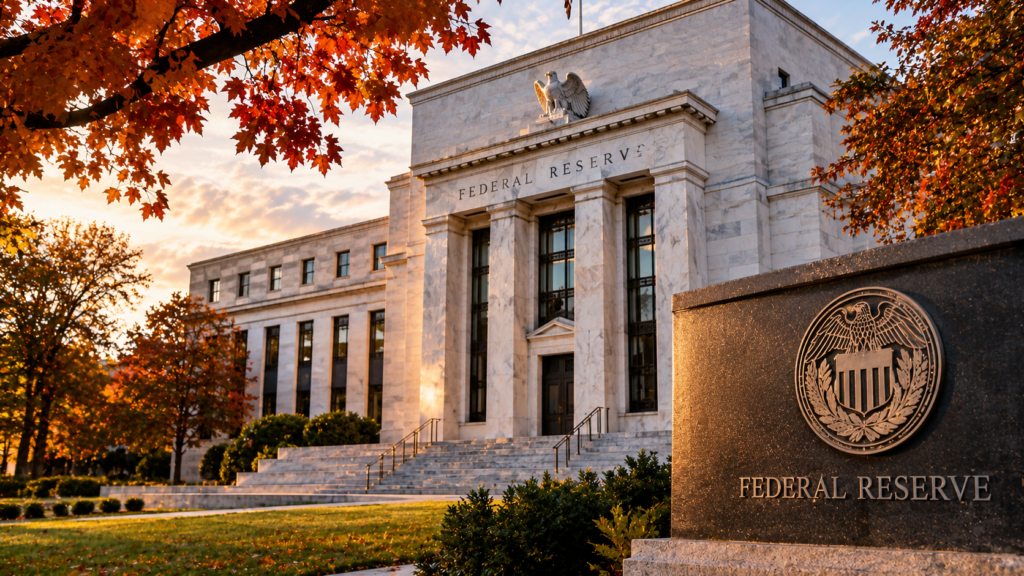
Summary: Federal Reserve minutes reveal broad support for additional interest-rate increases as policymakers remain concerned about persistent inflation. While most officials favour further tightening, divisions over the timing and scale of future moves are raising uncertainty ahead of the December meeting.
◉ Further interest-rate increases may be needed to bring inflation back towards the central bank’s 2% target, according to most Federal Reserve officials.
◉ Two policymakers indicated that a rate increase exceeding 25 basis points could be considered in December if incoming inflation data deteriorate.
◉ Financial markets are increasingly pricing in additional monetary tightening, creating fresh pressure on government bonds, equities, housing and borrowing costs.
A More Hawkish Federal Reserve
The Federal Reserve is signalling a more restrictive monetary policy outlook as persistent inflation continues to challenge its objective of restoring price stability.
Minutes from the October 27–28 Federal Open Market Committee meeting, released on November 18, reveal that almost all participants considered additional interest-rate increases appropriate in the months ahead.
The discussion highlights a significant shift in the policy environment. Although the central bank decided to leave interest rates unchanged in October, the decision did not represent a change in its commitment to fighting inflation.
Policymakers instead emphasised the importance of incoming economic data, particularly inflation developments and labour-market conditions, before determining the appropriate pace of further tightening.
The minutes also revealed that the decision to maintain rates was not unanimous in spirit. Several participants considered an immediate increase appropriate, while some members supporting the pause described the decision as a close call.
December Could Bring a Larger Increase
One of the most significant details in the minutes concerns the possibility of a larger-than-expected rate increase.
Two policymakers indicated that an increase exceeding 25 basis points could warrant consideration at the December meeting if incoming inflation data proved unfavourable.
This introduces an additional layer of uncertainty for financial markets.
A conventional quarter-point increase would represent a continuation of gradual monetary tightening. A 50-basis-point adjustment, however, would signal a more aggressive response to persistent price pressures.
Federal Reserve Governor Christopher Waller also expressed support for considering a half-percentage-point increase, arguing that a larger move could provide a stronger response to inflation.
Nevertheless, other policymakers have advocated a more measured approach, highlighting the importance of avoiding unnecessary pressure on interest-sensitive sectors of the economy.
The next FOMC meeting is scheduled for December 8–9, making upcoming inflation releases particularly important for market expectations.
Inflation Remains Above Target
The central bank’s concerns are supported by inflation developments.
Federal Reserve staff estimated that annual headline personal consumption expenditures inflation reached 3.6% in September, while core PCE inflation, excluding food and energy, stood at 3.1%.
Both measures remain considerably above the Federal Reserve’s 2% objective.
Policymakers identified several sources of inflationary pressure, including energy prices, tariffs and rising costs associated with technology-related investment.
The expansion of artificial intelligence infrastructure is also becoming an increasingly relevant factor. Strong demand for advanced semiconductors, data-centre equipment and other technology products could contribute to price pressures across certain segments of the economy.
The challenge for the Federal Reserve is determining whether these pressures are temporary or sufficiently persistent to require a more restrictive monetary policy.

Bond Markets Reassess Interest Rates
Expectations of additional rate increases are influencing financial markets well beyond the immediate outlook for US monetary policy.
Interest-rate futures indicate expectations of further quarter-point increases, with market pricing reflecting additional tightening into early 2027.
Government bond yields are particularly sensitive to changes in the expected path of monetary policy. Higher expected interest rates can push bond prices lower, increasing financing costs for governments, businesses and households.
The US dollar could also receive support from higher interest-rate expectations, particularly if monetary policy in the United States becomes more restrictive than in other major economies.
For equity markets, the implications are more complicated.
Higher discount rates generally place pressure on company valuations, especially among technology and growth businesses whose expected earnings are concentrated further into the future.
Financial institutions, meanwhile, face a different environment in which lending margins, funding costs and credit quality become increasingly important.
Housing and Credit Under Pressure
The housing market remains one of the sectors most exposed to prolonged monetary tightening.
Higher mortgage rates increase monthly financing costs, reduce affordability and can discourage potential buyers from entering the property market.
The October meeting minutes highlighted weaknesses in interest-sensitive areas of the economy, including housing and commercial real estate.
Small businesses and companies dependent on external financing could also face additional pressure as borrowing becomes more expensive and lending conditions tighten.
This creates a difficult balancing act for policymakers: controlling inflation without causing an excessive deterioration in economic activity.
The December Decision Becomes Critical
The latest minutes suggest that the Federal Reserve is not yet comfortable declaring victory over inflation.
Although policymakers remain divided over the appropriate pace of tightening, the broader direction is becoming clearer: additional rate increases remain firmly on the table.
For investors, the distinction between a standard 25-basis-point increase and a potentially larger adjustment will be particularly important.
The December meeting could therefore become a defining moment for US monetary policy and global financial markets as investors reassess bond yields, currency valuations, equity multiples and borrowing costs.
The central question is no longer simply whether the Federal Reserve will maintain restrictive monetary policy, but how aggressively it may need to act to restore inflation to its 2% objective.
Sources
- Bloomberg – Fed Minutes Show Almost All Officials Expect More Rate Hikes.
- Federal Reserve – October 27–28 FOMC Meeting Minutes (Official Document).
- Associated Press – Fed Minutes: Higher Interest Rates Needed in December as Inflation Worries Mount.
- The Washington Post – Nearly All Fed Officials Expect Further Rate Increases.
- Editorial Disclosure & Transparency.