
Understanding ownership, diversification, investment risk, costs and long-term wealth creation.
Executive Summary
Individual stocks and exchange-traded funds (ETFs) provide two different ways to participate in financial markets. Both can generate investment returns through rising prices and, where applicable, dividends or other distributions. However, they differ fundamentally in what an investor owns, how risk is distributed and how much research is required.
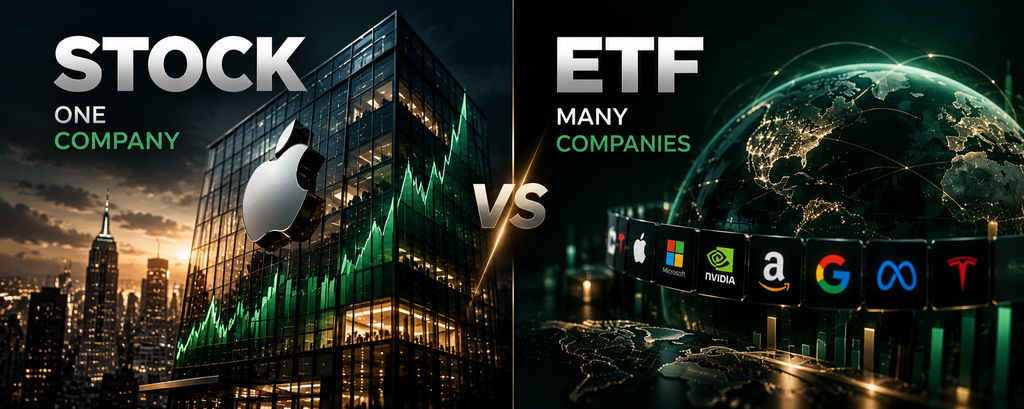
A stock represents an ownership interest in an individual company. An ETF is an investment fund whose shares represent an interest in a portfolio of assets. Depending on its investment strategy, an ETF may hold dozens, hundreds or thousands of securities.
The central distinction is concentrated exposure versus portfolio exposure. Buying an individual stock makes the investor’s outcome more dependent on one company’s performance. Buying a broadly diversified equity ETF spreads exposure across many businesses, although it does not eliminate market risk.
Neither structure guarantees a profit. An individual stock can outperform a diversified ETF by a substantial margin, but it can also lose most or all of its value. An ETF can reduce company-specific risk while remaining vulnerable to market downturns, sector concentration, currency movements and the risks of its underlying holdings.
For investors evaluating these instruments, the relevant questions extend beyond potential returns. Ownership rights, investment horizon, fees, taxation, liquidity and the ability to withstand losses all influence the final outcome.
1. What Is a Stock?
A stock, also called a share or equity security, represents an ownership interest in a company. When an investor purchases shares in a publicly traded business, the investor acquires a proportional interest in that company’s equity.
The financial outcome depends on the company’s operating performance, financial position, future growth prospects, valuation and the broader economic environment.
A company’s share price may rise when earnings exceed expectations, its competitive position strengthens or investors become more optimistic about its future. Conversely, disappointing results, excessive debt, regulatory problems, declining demand or poor management decisions can put substantial downward pressure on the price.
Shareholders may also receive dividends if the company’s board declares them. Dividends are not guaranteed, and companies can reduce, suspend or eliminate distributions.
Depending on the share class and applicable corporate rules, shareholders may have voting rights on matters such as director appointments and significant corporate decisions.
The defining feature of direct stock ownership is that the investment’s outcome is closely linked to the fortunes of a specific business.
2. What Is an ETF?
An exchange-traded fund pools investors’ capital and invests it according to a defined investment objective. Its portfolio may contain equities, bonds, commodities or other eligible assets, depending on the fund’s legal structure and mandate.
ETF shares trade on an exchange during market hours, generally through a brokerage account. Their market prices can fluctuate throughout the trading session.
Many ETFs follow an index. For example, an S&P 500 ETF seeks to track an index representing large US companies. A global equity ETF may provide exposure to companies across multiple countries and sectors.
Other ETFs focus on specific industries, dividend-paying companies, government bonds, corporate bonds or investment themes. Actively managed ETFs allow managers to select and adjust holdings rather than simply replicate an index.
This distinction matters: an ETF is a structure, not a guarantee of diversification or low risk. A fund holding thousands of companies across global markets has a very different risk profile from one concentrated in a single industry or a narrow investment theme.
Investors in an ETF own shares in the fund, rather than directly holding each underlying company in their own brokerage accounts. Their returns depend on the fund’s portfolio performance, expenses and the difference between its market price and underlying net asset value.
3. Stocks vs ETFs: Key Differences
| Feature | Individual stock | ETF |
|---|---|---|
| What you own | Shares in one company | Shares in an investment fund |
| Diversification | Depends on the rest of your portfolio | Depends on the fund’s holdings |
| Company-specific risk | Potentially high | Usually lower in a broadly diversified fund |
| Market risk | Yes | Yes |
| Potential outperformance | Can substantially outperform the market | Depends on the strategy and benchmark |
| Income | Dividends, if declared | Distributions from the fund, if applicable |
| Management fees | No fund expense ratio for directly held shares | Usually has ongoing fund expenses |
| Research requirements | Detailed company-level analysis | Fund, index, holdings and cost analysis |
| Trading | Generally during exchange hours | Generally during exchange hours |
| Ownership rights | Rights attached to the share class | Rights attached to the ETF share; no direct voting in each underlying company |
| Main analytical focus | Business performance and valuation | Portfolio construction, exposure, tracking and costs |
These are general characteristics rather than universal rules. Individual securities can be inexpensive to hold, while some ETFs have high expenses, limited liquidity or concentrated exposure.
4. Understanding Investment Risk
Risk is not simply the likelihood that an investment’s price will decline. It also includes the magnitude of possible losses, the uncertainty of future returns and the possibility that an investment will fail to meet a financial objective.
Individual stocks: company-specific exposure
Consider an investor who puts €5,000 into a single technology company.
If the share price falls by 40%, the investment falls to €3,000, excluding dividends and transaction costs. Recovering from that decline requires a subsequent gain of approximately 66.7%.
A severe deterioration in the company’s financial position could cause an even greater loss. In an insolvency, common shareholders rank behind creditors and other senior claims, and may recover nothing.
A company’s excellent reputation does not automatically make its stock attractively priced. Even a successful business can be a poor investment if the purchase price already assumes unrealistically high future growth.
ETFs: diversified exposure, not risk-free exposure
Now consider an investor who places €5,000 in a broadly diversified equity ETF.
If the underlying market falls by 20%, the investment would approximately decline to €4,000, before fees, tracking differences and other effects. Diversification does not prevent this loss, but the investor is not dependent on one company’s survival or earnings trajectory.
The outcome depends on the fund’s actual holdings and market exposure. A technology-sector ETF can fall sharply when technology shares decline. A global equity ETF can experience substantial losses during a worldwide financial crisis.
Diversification primarily reduces the impact of individual security-specific events. It cannot remove the risks associated with owning assets that decline together.
5. How Diversification Changes the Equation
Diversification distributes investments across different securities, industries, regions or asset classes. Its purpose is to reduce dependence on any single holding or source of risk.
An ETF tracking a broad market index may offer exposure to hundreds or thousands of companies through a single transaction. Replicating a similar portfolio with individual stocks would require more research, transactions and portfolio maintenance.
However, the number of holdings alone does not establish how diversified a fund really is.
A fund may own hundreds of companies while allocating a large proportion of its assets to a small group of major businesses. Two ETFs may also hold many of the same companies, creating substantial overlap between them.
A proper evaluation therefore examines:
- The number and weighting of holdings.
- Country and sector allocations.
- Concentration in the largest companies.
- Exposure to currencies and different economic cycles.
- Correlations between holdings during market stress.
- Whether the fund’s investment strategy matches its stated objective.
Broad diversification can make portfolio construction simpler, but it does not eliminate the need to understand what a fund owns.
6. Returns: Which Can Make More Money?
There is no universal answer. The comparison depends on the individual company, the ETF’s benchmark, the purchase price, the holding period, fees and taxes.
An individual stock can outperform an index substantially if the company expands its earnings, gains market share or develops a valuable new product. The reverse is also true: a business can underperform for years or lose most of its market value.
A diversified ETF generally aims to deliver the performance of its chosen market or strategy, minus expenses and tracking differences, if it is index-tracking. It does not need every company in its portfolio to succeed for the overall portfolio to perform well.
Investment Outcome After One Year
Initial Investment: €5,000
| Parameter | Individual Stock | ETF |
|---|---|---|
| Initial investment | €5,000 | €5,000 |
| Assumed annual return | +20% | +8% |
| Investment gain | +€1,000 | +€400 |
| Final value after one year | €6,000 | €5,400 |
Adjustable Investment Scenarios
| Initial Investment | Stock Return | Stock Outcome | ETF Return | ETF Outcome |
|---|---|---|---|---|
| €500 | +20% | €600 | +8% | €540 |
| €5,000 | +20% | €6,000 | +8% | €5,400 |
| €25,000 | +20% | €30,000 | +8% | €27,000 |
| €50,000 | +20% | €60,000 | +8% | €54,000 |
Understanding the Results
These figures are hypothetical calculations, not forecasts or historical performance. They exclude fees, taxes, dividends unless included in the assumed return, and currency effects.
Diversification does not necessarily produce the highest return in every period. Instead, it spreads exposure across multiple investments and reduces reliance on individual companies, although market risk remains.
A fair performance comparison should use the same dates, investment currency and return methodology. It should also distinguish between price returns and total returns, including reinvested distributions.
7. Costs That Investors Often Overlook
The purchase price is only one component of investment cost.
Costs associated with individual stocks
Investors may incur brokerage commissions, bid–ask spreads, currency-conversion fees, exchange fees and applicable taxes. Frequent trading can increase the cumulative effect of these costs.
Directly held stocks do not have a fund-level annual expense ratio, although this does not mean owning them is cost-free.
Costs associated with ETFs
ETF investors may face the same transaction costs, together with ongoing fund expenses. These expenses are usually expressed as an annual percentage, often called the total expense ratio (TER) or ongoing charges, depending on the product’s disclosure.
A fund’s total economic cost can also involve tracking differences, spreads, foreign-exchange expenses and other costs not fully captured by its headline annual fee.
For example, if an ETF has annual expenses of 0.20%, a €10,000 holding corresponds to approximately €20 in annual fund expenses at that value. Actual costs vary with the value of the investment, the fund’s charges and the time held.
A seemingly small fee can matter over decades because expenses reduce the capital available for compounding.
Equally, investors should avoid choosing a fund solely because it has the lowest TER. Index methodology, liquidity, tracking quality, domicile, tax treatment and the reliability of the fund structure also matter.
8. Dividends and Income
Individual stocks and ETFs can both generate investment income, but the mechanics differ.
An individual company may distribute part of its profits to shareholders through dividends. The amount and frequency depend on the company’s financial position and distribution policy. Some profitable companies do not pay dividends, while others may pay them consistently for extended periods.
An equity ETF receives dividends from its underlying holdings, subject to applicable withholding taxes and other expenses. The fund may then distribute income to investors or retain and reinvest it, depending on its share class and structure.
Distributing ETF
Pays out distributions to investors when declared under the fund’s policy. These payments can provide cash flow but are not guaranteed.
Accumulating ETF
Retains and reinvests eligible income within the fund, reflected in its net asset value and market performance rather than paid out as a regular cash distribution.
A high dividend yield should not automatically be interpreted as a sign of a superior investment. A falling share price can increase the displayed yield even when the underlying business is deteriorating. Total return, sustainability of distributions and valuation are more informative than yield alone.
9. Active vs Passive Investing
Stocks and ETFs are not mutually exclusive with active and passive investing.
Buying individual shares is commonly associated with active stock selection: an investor researches companies and decides which securities to buy, hold or sell.
A passive ETF generally tracks a defined index rather than trying to outperform it through discretionary security selection. Its objective is to replicate the benchmark’s performance as closely as practical, after costs.
An actively managed ETF, by contrast, gives a portfolio manager discretion over security selection and portfolio weights. It can have higher fees and may deviate significantly from broad market performance.
The distinction is important because the ETF label alone does not tell investors whether the strategy is passive, how diversified the portfolio is or what its expected costs may be.
Investors comparing strategies should assess whether the benchmark is appropriate, whether the manager has a credible process and whether any additional expenses are justified by the strategy’s objectives.
10. What Matters for Investors in Slovenia?
For Slovenian tax residents, the legal and tax structure of an investment can be as important as its headline return.
The tax treatment of dividends and capital gains is not necessarily identical. It may depend on the instrument, the nature of the income, holding period, applicable legislation and the investor’s individual circumstances.
For a direct stock investment, a sale can generate a taxable capital gain or a deductible loss under the applicable rules. Dividends may be subject to separate tax treatment.
ETF investments also require attention to the instrument’s legal form, the nature of distributions and the tax consequences of selling fund shares. An accumulating ETF should not automatically be assumed to be tax-free: reinvesting income inside a fund and selling an investment are distinct events, and the relevant treatment must be established under Slovenian rules.
The following documents are particularly important before investing:
- Key Information Document (KID): outlines the product, intended investor profile, risk indicator, potential outcomes, costs and other key disclosures for covered retail investment products in the EU.
- Prospectus and fund documentation: explain the fund’s investment objective, risks, structure, holdings policy and operating arrangements.
- Brokerage fee schedule: sets out trading commissions, currency-conversion costs, custody charges and other fees.
- Current Slovenian tax guidance: clarifies reporting requirements and the treatment of capital gains, dividends and investment funds.
Tax legislation and administrative guidance can change. Investors should verify the current rules with the Slovenian Financial Administration (FURS) or a qualified tax professional, especially before selling investments or selecting a fund primarily for tax reasons.
11. How to Evaluate an ETF Properly
An ETF should be evaluated as an investment product, not simply by its name or recent performance.
A practical research process includes the following steps.
- Identify the benchmark. Understand whether the ETF tracks a broad global index, a regional market, one sector or a narrow theme.
- Examine the holdings. Review the largest positions, country allocations, industry weights and overlap with other investments.
- Review the costs. Compare the ongoing expense ratio, bid–ask spread, transaction fees and tracking difference.
- Understand the structure. Check the fund’s domicile, legal structure, replication method, securities-lending policy and counterparty exposures where relevant.
- Assess liquidity. Consider trading volume, spreads, market-maker support and the liquidity of the underlying assets.
- Read the risk disclosures. Check for leverage, derivatives, concentration, currency exposure and other risks that could materially change the investment outcome.
- Check tax and account eligibility. Confirm the applicable Slovenian treatment and whether the instrument can be held in the intended account.
For an individual stock, the equivalent research process focuses more heavily on revenue growth, margins, cash flow, debt, competitive advantage, management, valuation and the company’s ability to sustain its earnings.
Both approaches require analysis. The difference lies in whether the investor must underwrite one business or evaluate a portfolio and its investment rules.
12. When Does Each Investment Approach Make Sense?
There is no single instrument that is best for every investor. The choice depends on the investor’s objective, knowledge, available time, risk tolerance and existing portfolio.
| Investor objective | Relevant consideration |
|---|---|
| Broad, long-term market exposure | A diversified equity ETF can provide access to many companies through one investment. |
| Researching a specific business | An individual stock allows targeted exposure to that company’s potential growth and risks. |
| Building an income-oriented portfolio | Compare dividend stocks with distributing ETFs, focusing on sustainability and total return. |
| Investing in a particular industry | A sector ETF spreads exposure across several companies, but can remain highly concentrated. |
| Minimising ongoing fund expenses | Direct stocks have no fund expense ratio, while low-cost ETFs can offer inexpensive diversification. |
| Spending less time managing investments | A broad index ETF can reduce the need to research and rebalance many individual positions. |
A portfolio can also combine the two approaches. An investor may use a diversified ETF as the main source of market exposure and hold individual stocks for more targeted positions. This structure still requires attention to concentration: the individual holdings may already represent large positions inside the ETF.
13. Common Misconceptions
“ETFs cannot lose as much as individual stocks.”
A diversified ETF can experience substantial losses during a broad market decline. Certain specialised, leveraged or concentrated ETFs can be particularly risky.
“Owning ten stocks automatically creates a diversified portfolio.”
Ten companies operating in the same industry or relying on the same economic factors may behave similarly. Diversification depends on the nature and weighting of the exposures, not just the number of holdings.
“A low-priced share is cheaper than an expensive share.”
The nominal price per share does not establish whether a company is undervalued. Market capitalisation, earnings, cash flow, debt and future expectations are more relevant.
“A high dividend yield means a better investment.”
A high yield may reflect a falling share price or an unsustainable distribution. Total return and financial strength must also be considered.
“An ETF is always passive.”
ETFs can follow indexes or use active management. Their investment objectives and risks vary widely.
“The best-performing investment last year will perform best next year.”
Past performance does not guarantee future results. Market leadership, valuations, economic conditions and investor expectations change over time.
14. Final Research Assessment
The distinction between individual stocks and ETFs is fundamentally a distinction between the ownership of a specific business and participation in an investment portfolio.
Individual stocks offer direct exposure to a company’s business performance and valuation. They can deliver exceptional returns, but also expose investors to substantial company-specific losses. Their analysis demands a detailed understanding of financial statements, competitive dynamics, corporate governance and market expectations.
ETFs provide a mechanism for accessing defined investment strategies through a single listed instrument. Broadly diversified funds can reduce dependence on individual companies and simplify portfolio construction. Nevertheless, their results remain dependent on their underlying assets, fees, investment methodology and market conditions.
The most important analytical question is therefore not simply which instrument can produce the highest return. It is whether the investment’s structure, risk and cost profile fit the investor’s objective.
For long-term wealth accumulation, a broad and appropriately diversified ETF can be a useful building block. Individual stocks may have a role where an investor understands the business, can evaluate its valuation and accepts the additional concentration risk. Neither approach substitutes for a clear investment plan, and neither guarantees positive returns.
This report is educational and does not constitute individual investment, legal or tax advice.

Sources and Further Reading
The following international and institutional sources were reviewed to develop the report. They provide additional explanations of stock ownership, ETF structures, diversification, costs, risk disclosures and Slovenian tax considerations.
Official investor education and regulation
1. U.S. Securities and Exchange Commission (SEC) — Investor.gov: Characteristics of Mutual Funds and Exchange-Traded Funds. ETF structure, trading mechanics and investor considerations.
2. SEC — Investor.gov: Exchange-Traded Funds (ETFs). How ETFs pool assets and provide exposure to underlying investments.
3. SEC — Investor.gov: Asset Allocation and Diversification. Diversification, investment horizons and risk tolerance.
4. SEC: Beginners’ Guide to Asset Allocation, Diversification, and Rebalancing. Risk, return and portfolio construction.
5. European Commission: Key Information Documents for PRIIPs. EU retail investment product disclosures, risk indicators and costs.
International investment education and fund research
6. Vanguard: ETFs vs. Individual Stocks: How to Choose. A practical comparison of stock ownership, ETFs, diversification and costs.
7. Vanguard: Investing in Individual Stocks and Bonds. Equity ownership and the role of individual securities in portfolios.
8. State Street Global Advisors: ETFs vs. Stocks: A Guide to Similarities and Differences. Fund holdings, portfolio exposure and expense ratios.
9. European Securities and Markets Authority (ESMA): Costs and Performance of EU Retail Investment Products. European fund costs and performance. The regulator’s March 2026 report discusses developments in costs through 2024.
10. European Securities and Markets Authority (ESMA): Costs and Performance of EU Retail Investment Products — 2021 Report. Historical research on active and passive management, costs and net performance.
Slovenia: taxation and investor considerations
11. Financial Administration of the Republic of Slovenia (FURS): Income Tax — Capital Income. Official guidance on the taxation of dividends, capital gains and other capital income.
12. FURS: Sale of Securities, Other Equity Interests and Investment Coupons. Reporting and tax treatment when disposing of securities and investment fund units.
Editorial note: The sources above are intended for further verification and education. Tax treatment depends on the instrument, the investor’s circumstances and the legislation applicable at the relevant time.