Summary: Anthropic’s record-breaking Nasdaq debut is already facing its first major competitive challenge. Shares retreated after Apple reportedly began developing an autonomous AI agent, raising questions about competition, market leadership and the long-term value of the rapidly expanding AI industry.
◉ Anthropic shares fell in after-hours trading as Apple’s reported AI agent ambitions introduced a new competitive threat.
◉ The $83 IPO price quickly turned into a $2 trillion valuation at the opening, before shares surrendered much of their initial gains.
◉ The emergence of Apple’s AI strategy highlights how competition among technology giants could reshape the economics of the AI industry.
Apple’s AI Ambitions Challenge Company Anthropic
Anthropic’s first day as a publicly traded company delivered an extraordinary market debut, but investor enthusiasm quickly encountered a new challenge.
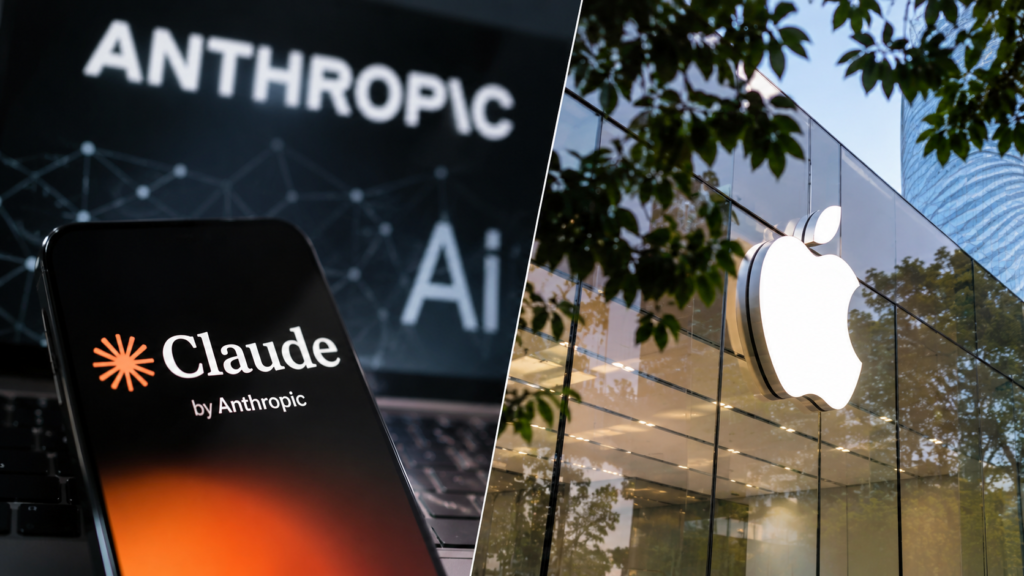
Apple is reportedly developing an autonomous AI agent designed to perform tasks on behalf of users, potentially moving beyond conventional voice assistants and chatbot interactions.
The planned system is expected to handle more complex activities, including browsing the internet, writing code and interacting with applications. The longer-term objective is to allow users to delegate multi-step tasks to an AI system rather than manually operating individual applications.
The reported development places Apple in a market already attracting substantial investment from Anthropic, OpenAI and Meta.
For Anthropic, the timing is significant. Its Claude models have gained traction among enterprise customers, while Claude Code has become an important product in the software development market.
Apple’s potential entry introduces a competitor with an enormous installed device base, established consumer relationships and control over a major software ecosystem.
The key question is whether Apple can turn that distribution advantage into a commercially competitive AI platform.
A Record IPO Meets Market Reality
Anthropic’s Nasdaq debut initially exceeded expectations.
The company priced its shares at $83, above its original target range of $70–$78. On Thursday, November 19, shares opened at $111.50, representing a gain of approximately 34% and briefly implying a fully diluted valuation above $2 trillion.
The IPO raised approximately $81.3 billion, making it the largest public offering in market history.
However, the initial enthusiasm faded during the session. Anthropic closed at $97.17, approximately 17% above its IPO price but nearly 13% below its opening level.
The shares subsequently weakened further in after-hours trading.
The movement reflects a market increasingly sensitive to AI valuations. Even an exceptional IPO performance was insufficient to eliminate concerns about competition, profitability and the enormous capital required to develop advanced AI models.

The Economics Behind the $2 Trillion Valuation
Anthropic’s financial performance explains why investors were willing to support such an extraordinary IPO valuation.
The company reported third-quarter 2026 revenue of approximately $16.96 billion, while its annualised revenue run rate reached approximately $81 billion by October 31.
Its enterprise business has expanded rapidly. The company reported nearly 11,900 customers generating at least $100,000 in annual revenue, compared with approximately 1,500 in 2025.
Claude Code has also become an important growth engine, particularly among software developers and enterprise customers.
However, growth comes with substantial infrastructure costs.
Anthropic reported a third-quarter operating loss of approximately $567 million, with computing expenses and other costs associated with developing advanced AI models weighing on profitability.
This creates a significant challenge for investors: determining how much of the company’s future growth can eventually translate into sustainable earnings and free cash flow.
Competition Is Moving Beyond Chatbots
The next phase of AI competition is increasingly focused on autonomous agents.
Traditional AI assistants primarily respond to questions and generate content. AI agents are designed to take action, interact with software, complete workflows and coordinate multiple tasks with limited human intervention.
This creates a potentially larger commercial opportunity, but also introduces new competitive pressures.
Apple has several advantages that could become important in this market:
- Distribution: A global ecosystem of iPhones, Macs and other connected devices.
- Integration: Control over its operating systems, applications and hardware.
- Customer relationships: Direct access to an enormous established consumer base.
- Privacy positioning: The ability to differentiate through its approach to personal data and on-device processing.
Anthropic, meanwhile, has built its position around advanced models, enterprise adoption and developer-focused products.
The competition may therefore develop along two different paths: companies building the underlying AI intelligence and companies controlling the platforms through which consumers access it.
Apple’s reported plans could make that distinction increasingly important.
A Reality Check for AI Valuations
Anthropic’s market debut arrives during a period of growing uncertainty across the technology sector.
Investors are increasingly questioning whether the enormous capital expenditure required for AI infrastructure can generate sufficient returns.
The company’s IPO initially demonstrated strong demand for exposure to frontier AI developers. Yet the subsequent share-price reversal suggests that investors are not willing to overlook valuation and profitability risks simply because a company operates in a rapidly expanding industry.
The comparison with established technology companies is also becoming more relevant.
Apple, Microsoft, Alphabet and Meta possess existing distribution networks, substantial cash generation and established customer relationships. Their ability to integrate AI into existing businesses could create significant competitive pressure on independent AI developers.
Anthropic’s long-term valuation will therefore depend on more than model performance. Its ability to retain customers, defend pricing, control infrastructure costs and maintain technological differentiation will be equally important.
What Comes Next
The coming months could provide an important indication of how public-market investors value the next generation of AI companies.
For Anthropic, the priorities include maintaining enterprise growth, expanding Claude’s commercial applications and improving the economics of its computing infrastructure.
For Apple, the reported agent initiative represents a potential expansion into a market where control of the user experience could become as important as ownership of the underlying AI model.
The broader implication is that the AI industry may be entering a new competitive phase. The initial investment cycle rewarded companies capable of developing powerful models and securing computing capacity. The next phase could increasingly reward those capable of turning AI into widely adopted, profitable products.
Anthropic’s first trading sessions offer an early indication that even the largest AI valuations will face close scrutiny as competition intensifies.
Sources
- Bloomberg – Anthropic Shares Drop Post-Market on Apple’s AI Agent Plans, November 20.
- Reuters – Anthropic’s Post-Debut Stumble Delivers Reality Check for AI Trade, November 20.
- Investing.com – Anthropic Opens 34% Above IPO Price, Reaches $2 Trillion Valuation, November 19.
- Investing.com – Anthropic Shares End Debut 17% Above IPO Price, November 20.
- Editorial Disclosure: Denarni Fokus – Editorial Disclosure & Transparency.