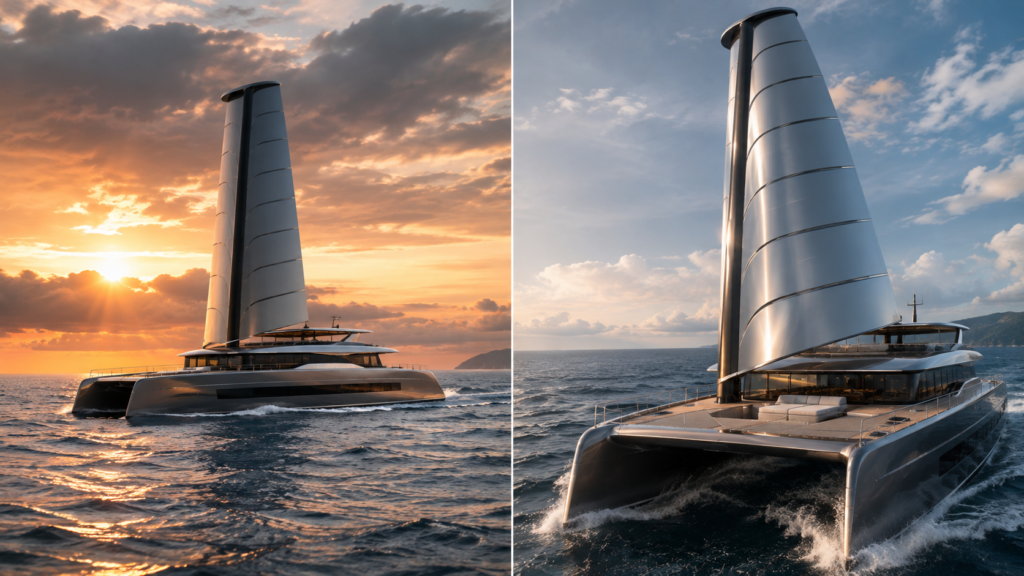
Summary: Sunreef Yachts has introduced the Sunreef Wing, an AI-assisted rotating wing-sail system designed for its next generation of sailing catamarans. Combining adaptive aerodynamics, automated sail handling and integrated energy management, the technology could reshape how large luxury sailing yachts use wind power and onboard automation.
◉ The Sunreef Wing can rotate through 360 degrees and automatically adjust its aerodynamic profile to changing wind conditions.
◉ Sunreef claims up to 50% more lift and 40% more propulsive force than a conventional sail of equivalent area under optimal apparent-wind conditions.
◉ AI-assisted controls coordinate the wing, rudders and propulsion, while voice commands and automated handling aim to reduce crew workload.
A New Direction for Sailing Yachts
The luxury sailing market is entering another phase of technological development as yacht builders explore ways to combine traditional wind propulsion with intelligent automation.
Polish shipyard Sunreef Yachts has introduced its new Sunreef Wing, an automated wing-sail concept intended for its next generation of sailing catamarans.
The announcement represents a significant departure from conventional sailing arrangements.
Traditional rigs rely on fabric sails, rigging and continuous adjustments by the crew. Sunreef’s proposed system instead uses a self-supported aerodynamic wing that can rotate through 360 degrees and automatically adapt to changing wind conditions.
The objective is to simplify sailing operations while improving aerodynamic efficiency and integrating wind propulsion into a wider onboard energy system.
The technology is particularly relevant to large luxury catamarans, where managing substantial sail areas can require considerable crew involvement.
360-Degree Rotation and Adaptive Aerodynamics
The central component is a rotating wing designed to position itself according to the apparent wind.
Unlike a conventional mainsail, which requires adjustments through established rigging systems, the Sunreef Wing uses adaptive camber control to change its aerodynamic profile in real time.
Camber describes the curvature of an aerodynamic surface. Adjusting it changes how the wing generates lift and manages aerodynamic forces.
This approach could allow the system to respond more efficiently to changing wind angles and sailing conditions.
Another notable feature is automated hoisting and lowering. Sunreef says the wing can even be raised while the yacht is at anchor with the wind coming from behind.
The simplified arrangement is also intended to reduce the number of moving components and maintenance requirements compared with a conventional rig.

The Performance Claims
One of the most interesting aspects of the announcement concerns the projected aerodynamic performance.
Sunreef claims that, under optimal apparent-wind conditions, its wing can generate:
- 50% more lift than a conventional sail of equivalent area.
- 40% more propulsive force than a conventional sail of equivalent area.
- Improved upwind performance compared with a traditional sail configuration.
These figures are manufacturer claims, not independently verified sea-trial results.
Importantly, greater propulsive force does not automatically translate into an equivalent increase in yacht speed. Actual performance depends on hull resistance, wind conditions, sea state, vessel displacement and the efficiency of the complete propulsion system.
Nevertheless, the proposed performance improvements make the technology an interesting development for large sailing multihulls.
Artificial Intelligence Takes Control
The Sunreef Wing is designed to operate as part of an intelligent control architecture.
Its AI-assisted system continuously analyses sailing conditions and coordinates the wing, rudders and propulsion to maintain efficient operation.
Voice commands are also incorporated into the proposed interface, allowing owners and crew to issue instructions without relying exclusively on conventional manual controls.
Integrated safety systems are intended to monitor operations and keep people onboard informed.
This could reduce the number of routine adjustments required during navigation, although professional crew and conventional navigational oversight remain essential.
The technology therefore represents a move towards assisted sailing rather than the removal of human responsibility.
Beyond Wind Propulsion: An Integrated Energy System
Perhaps the most strategically important aspect of the announcement is how the wing fits into Sunreef’s wider energy strategy.
The shipyard intends to combine three technologies across its next generation of sailing catamarans:
- Sunreef Wing: Automated wind propulsion and aerodynamic control.
- Hydrogeneration: Electricity production using water flow while the yacht is moving.
- Solar Skin: Solar panels integrated into the yacht’s composite structure.
An AI-based energy-management system is designed to coordinate these sources with the yacht’s engines and electrical systems.
Sunreef also says the wing can harness apparent wind to generate clean energy while the yacht is motoring.
This approach reflects a broader development in luxury yacht engineering: moving away from treating propulsion, electricity generation and energy storage as separate systems.
Instead, the objective is to create an interconnected energy ecosystem that can adapt to different operating conditions.
The actual efficiency gains will depend on the final installation, energy conversion losses and operating profile.
What It Means for the Superyacht Industry
The introduction of automated wing-sail technology could have implications beyond Sunreef’s own portfolio.
Large sailing catamarans offer substantial accommodation space and stability, but their size also creates challenges when managing wind propulsion.
Reducing the complexity of sail handling could make these vessels more attractive to owners who want sailing capabilities without requiring extensive manual operations.
It could also influence future yacht design, particularly in the integration of aerodynamic structures, automated navigation assistance and onboard energy management.
However, several technical questions remain unanswered.
The manufacturer has not yet disclosed model-specific installation schedules, detailed operating limits or independently verified performance results. Further information will be needed regarding storm handling, emergency depowering, structural loads and long-term maintenance.
These factors will be essential in determining whether the technology can deliver its intended advantages in real-world cruising conditions.
The Next Generation of Sailing Catamarans
Sunreef intends to introduce the Wing across its sailing yacht portfolio, although the first production models and delivery timetable have not yet been confirmed.
The concept represents an interesting intersection between traditional seamanship and advanced engineering.
Rather than abandoning wind propulsion, Sunreef is attempting to make it more automated, integrated and accessible.
If the technology performs as intended, it could become an important development in the evolution of luxury sailing catamarans.
The next major milestone will be a fully equipped yacht demonstrating the system at sea, providing measurable evidence of its efficiency, reliability and operational advantages.
For now, Sunreef has presented an ambitious vision of sailing in which aerodynamic engineering, artificial intelligence and renewable energy operate as parts of a single system.
Sources
- SuperYacht Times – Sunreef Unveils AI-Assisted Wing-Sail Technology.
- Marine Business – Sunreef Unveils Automated Wing Sail.
- Sail-World – Sunreef Wing: Sailing, Reinvented.
- YACHT – Inside Sunreef’s AI-Powered Wing Sail.
- Superyacht Guide – Sunreef Wing Automated Sailing Technology.
- Denarni Fokus – Editorial Disclosure & Transparency.