Summary: European leaders have selected Spain’s former central-bank governor Pablo Hernández de Cos as their preferred candidate to succeed Christine Lagarde as President of the European Central Bank. The nomination comes as the eurozone faces persistent inflation, rising government borrowing costs and renewed financial-market uncertainty. His appointment could influence the ECB’s policy discussions from February 2027, although monetary decisions will continue to be made collectively.
◉ Pablo Hernández de Cos was selected to succeed Christine Lagarde, whose departure is scheduled for February 7, 2027, following the decision by European leaders on November 26.
◉ The 55-year-old former Bank of Spain governor previously served on the ECB Governing Council from 2018 to 2024 and currently leads the Bank for International Settlements.
◉ The nomination reflects expectations of a pragmatic and relatively moderate monetary-policy approach, while ECB inflation remains around 4%, twice the central bank’s 2% target.
A New Chapter for the ECB
The European Central Bank is preparing for a leadership transition at a particularly challenging moment for the eurozone economy.
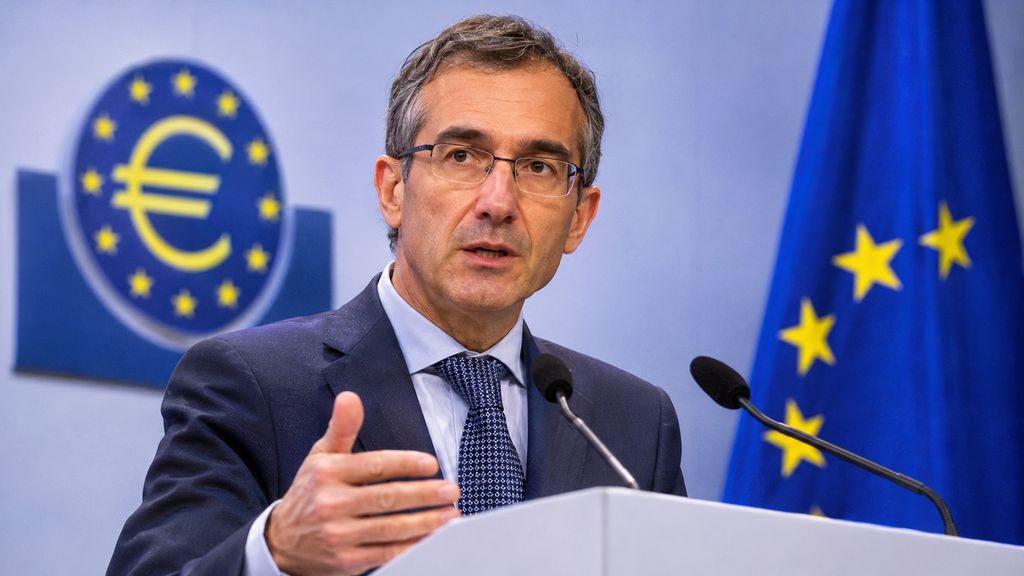
On November 26, European leaders selected Pablo Hernández de Cos as their preferred candidate to become the institution’s next president, replacing Christine Lagarde.
The decision followed negotiations between euro-area governments, with the Netherlands eventually supporting a consensus candidate and withdrawing its own contender, former Dutch central-bank governor Klaas Knot.
The selection concludes several months of discussions over the future leadership of Europe’s most influential monetary institution.
De Cos, 55, is a familiar figure within the European central-banking system.
He served as Governor of the Bank of Spain between 2018 and 2024, during which he was also a member of the ECB’s Governing Council.
He currently serves as General Manager of the Bank for International Settlements (BIS), a position he assumed in July 2025.
His experience includes the Spanish banking crisis, the COVID-19 pandemic and the inflation surge that forced the ECB to implement its most aggressive interest-rate tightening cycle in its history.
What His Appointment Could Mean for Interest Rates
The choice of the next ECB president comes as monetary policy remains a central concern for European financial markets.
Euro-area inflation reached approximately 4% in October, significantly above the ECB’s medium-term target of 2%.
Persistent price pressures have increased expectations of further monetary tightening, while higher borrowing costs are creating additional pressure for governments with substantial debt burdens.
De Cos is generally viewed as a pragmatic central banker with a moderate approach to monetary policy.
Some market participants consider him relatively dovish compared with more inflation-focused policymakers. However, his previous statements and policy record suggest that he cannot easily be placed into a simple hawk-versus-dove classification.
The distinction is important.
A central-bank president may have influence over policy discussions and communication, but interest-rate decisions are not made independently by the president.
The ECB’s Governing Council consists of six Executive Board members and the governors of the euro-area national central banks.
Consequently, the new president will need to build consensus among policymakers representing economies with different inflation conditions, fiscal positions and economic priorities.
France and Government Debt Add Pressure
One of the most significant challenges facing the incoming ECB leadership concerns the relationship between monetary policy and government finances.
France has become an important source of concern for European bond markets amid political uncertainty, budget pressures and questions surrounding the sustainability of public finances.
Higher government borrowing costs could create additional difficulties for heavily indebted euro-area economies.
The ECB must maintain price stability while also protecting the effective transmission of monetary policy across member states.
This creates a complicated environment for its next president.
If borrowing costs rise sharply in one country, financial-market stress can spread across the wider eurozone, potentially creating pressure for central-bank intervention.
However, the ECB’s mandate remains centred on price stability rather than financing individual governments.
De Cos will therefore inherit a difficult balance between controlling inflation and maintaining financial stability.
A Broader Leadership Reshuffle
The presidential nomination is part of a wider restructuring of the ECB’s Executive Board.
European leaders also put forward two candidates for other important positions:
- Laurence Boone (France): Nominated for an Executive Board position, potentially overseeing market operations.
- Markus Brunnermeier (Germany): Nominated to replace chief economist Philip Lane when his term expires.
These appointments reflect the broader political negotiations surrounding the distribution of influence within the ECB.
The composition of the Executive Board matters because its members participate in monetary-policy discussions, institutional management and the implementation of decisions made by the Governing Council.
The changes will also affect how the ECB communicates its assessment of economic conditions and financial-market developments.
What Happens Before February 2027?
Although European leaders have selected De Cos, the appointment process is not yet complete.
The European Council must consult the European Parliament and the ECB’s Governing Council before making the formal appointment.
The final decision is expected at the December 2026 European Council meeting.
If confirmed, De Cos will take office on February 7, 2027, following Lagarde’s departure.
He is expected to chair his first monetary-policy meeting on March 18, 2027.
His eight-year mandate would be non-renewable, giving him responsibility for guiding the institution through a substantial period of economic and financial uncertainty.
What Financial Markets Will Watch
The leadership transition creates several important questions for investors.
- Interest-rate policy: Whether De Cos maintains the current restrictive monetary-policy approach or places greater emphasis on economic growth once inflation moderates.
- Government bond markets: How the ECB responds if financial stress increases in heavily indebted euro-area countries, particularly France.
- Inflation expectations: Whether price growth returns towards the 2% target or requires additional monetary tightening.
- Institutional direction: Whether the new Executive Board maintains policy continuity or introduces changes in communication and strategic priorities.
The selection of De Cos does not immediately change the ECB’s monetary-policy direction.
However, the appointment is significant because the president plays an important role in shaping discussions, building consensus and communicating the institution’s position to financial markets.
For investors, the coming months will provide a clearer indication of how the new leadership intends to approach inflation, borrowing costs and financial stability.
Europe is entering this transition with several economic challenges unresolved. The incoming president will inherit an institution whose decisions remain central to the cost of borrowing, government financing and the broader investment environment across the eurozone.
Sources
- European Council – Official Nomination of Pablo Hernández de Cos, November 26, 2026
- Reuters – Spain’s De Cos to Take Over as ECB President
- Associated Press – European Leaders Choose Spain’s Former Central Bank Head
- Euronews – Hernández de Cos Selected to Succeed Lagarde
- Reuters – ECB Leadership Reshuffle and Monetary Policy Outlook
- Denarni Fokus – Editorial Disclosure & Transparency