Summary: Chinese equities staged their strongest rally in more than two years on November 27 after Beijing signalled stronger government support for the country’s capital markets. The Shanghai Composite gained 3.7%, while the CSI 300 advanced 4.2%. Technology and semiconductor shares led the recovery, as investors welcomed the prospect of increased state-backed buying and measures designed to restore confidence.
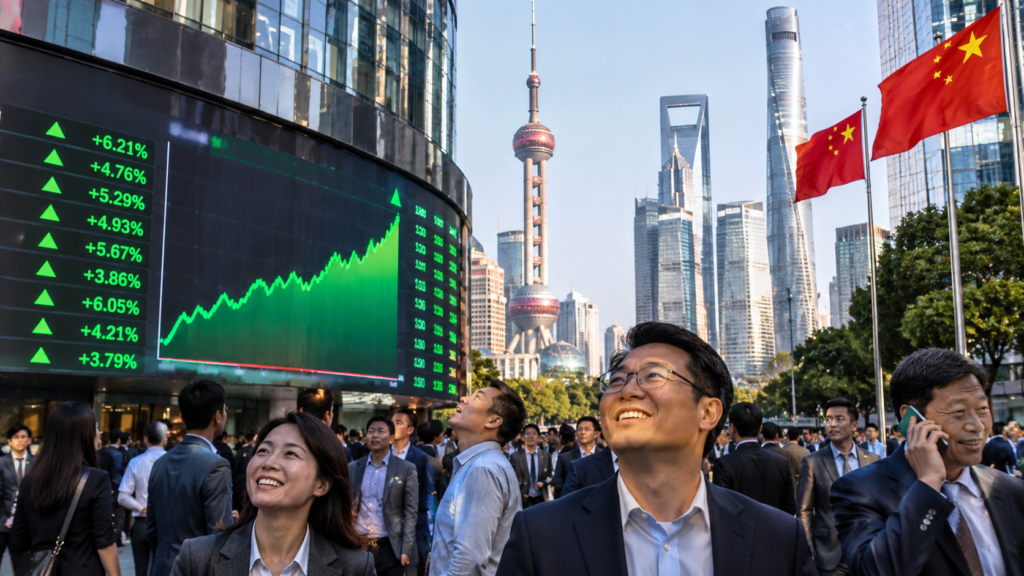
◉ The Shanghai Composite climbed 3.7%, while the CSI 300 gained 4.2%, recording their strongest daily advances since October 2024.
◉ Their technology-focused STAR 50 index surged approximately 15%, while the semiconductor sector recorded gains approaching 19%.
◉ Beijing signalled a greater stabilisation role for state-backed investor Central Huijin, alongside measures designed to encourage long-term institutional investment.
Beijing Sends a Strong Market Signal
Chinese equity markets experienced a substantial recovery on Friday as investors reacted to a stronger commitment from government authorities to stabilise the domestic stock market.
The rally followed a State Council meeting chaired by Premier Li Qiang, during which officials emphasised the importance of capital markets to China’s broader economic development.
According to the official communication reported by state media, authorities intend to strengthen the role of state-backed investors and improve the availability of long-term capital.
The announcement represents an important shift in market sentiment after months of declining valuations and persistent uncertainty surrounding China’s economic outlook.
Investors have been particularly concerned about weak domestic consumption, the prolonged property-sector downturn and international trade tensions.
Against this background, the government’s latest communication was interpreted as a signal that authorities are becoming increasingly uncomfortable with the scale of the equity-market decline.
The response was immediate.
The Shanghai Composite finished approximately 3.7% higher, while the CSI 300 advanced around 4.2%. Both benchmarks recorded their largest daily gains since October 2024, when Beijing introduced substantial measures to support financial markets.
State-Backed Investors Return to Focus
One of the most important elements of the announcement concerns Central Huijin Investment.
Central Huijin is a domestic investment arm of China Investment Corporation, the country’s sovereign wealth fund.
It is a leading participant in what financial markets commonly describe as China’s national team — a group of state-backed investors that can purchase shares during periods of significant market stress.
The State Council indicated that Central Huijin would enhance its role as a quasi-stabilisation fund, helping maintain sufficient liquidity in the domestic equity market.
For investors, this represents an important signal.
The presence of state-backed institutional capital can influence market expectations, particularly when private investors are reducing exposure and liquidity conditions are deteriorating.
However, the actual scale, timing and composition of future purchases remain important unknowns.
Government support can improve confidence and reduce short-term selling pressure, but it cannot independently guarantee sustainable earnings growth or higher corporate valuations.
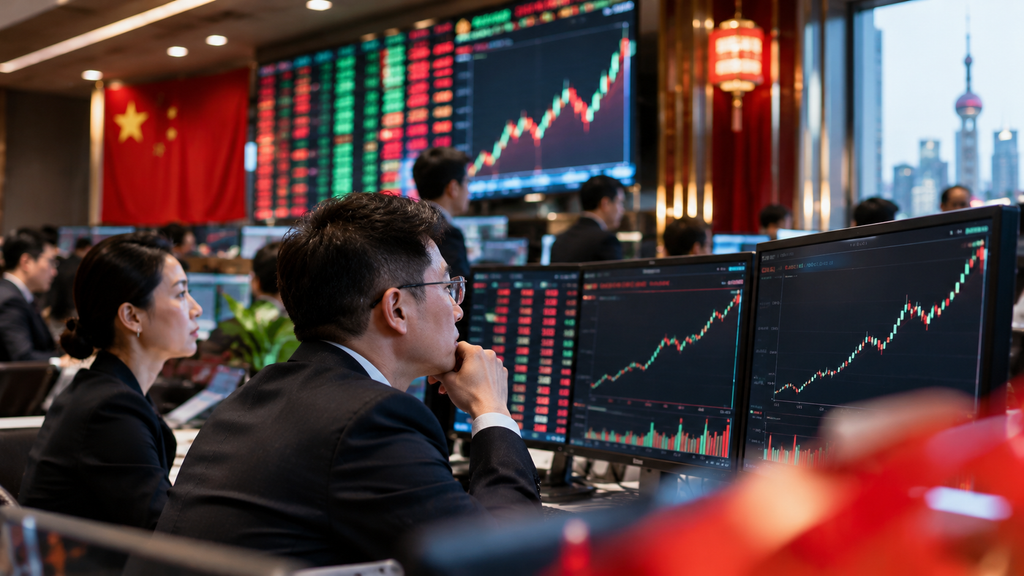
Technology and Semiconductor Stocks Lead
The strongest gains emerged in China’s technology sector.
The STAR 50 index, which tracks major technology companies listed on the Shanghai Stock Exchange’s STAR Market, surged approximately 15%.
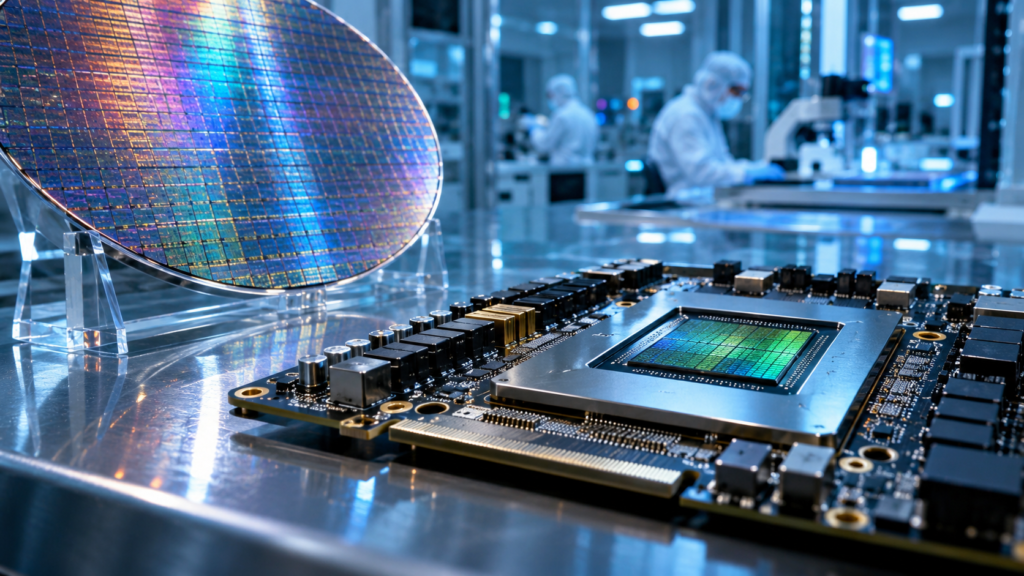
The semiconductor industry performed even more strongly, with the relevant sector index advancing close to 19%.
Companies connected to artificial intelligence, cloud computing and consumer electronics also experienced substantial buying interest.
The recovery is particularly important because China’s technology sector has faced considerable pressure in recent months.
Investors have been reassessing valuations, earnings expectations and the financial sustainability of large-scale AI infrastructure investments.
The government’s commitment to stabilising capital markets also appears to reflect the strategic importance of technology development.
China is attempting to strengthen its domestic semiconductor capabilities and reduce dependence on foreign technology suppliers.
A more stable equity market could help support financing conditions for companies operating in these strategically important industries.
Hong Kong Joins the Recovery
The rally extended beyond mainland China into Hong Kong, where technology-related shares also attracted significant buying interest.
The Hang Seng Index gained approximately 2.1%, while the Hang Seng Tech Index advanced more than 6%.
The improvement reflected renewed interest in Chinese technology companies following the latest government announcements.
The recovery also coincided with stronger regional sentiment.
South Korea’s Kospi advanced 4.3%, supported by semiconductor companies Samsung Electronics and SK Hynix. Japan’s Nikkei gained approximately 2.1%.
The regional performance suggests that Friday’s recovery was supported by both China-specific policy developments and a broader improvement in demand for technology-related equities.
For international investors, the simultaneous strength across Asian semiconductor markets is particularly relevant given the industry’s importance to global AI infrastructure investment.
Additional Measures Target Market Confidence
The latest announcement follows other measures introduced by Chinese authorities over the preceding days.
These include adjustments to margin-lending requirements and reductions in certain trading-related costs.
Regulators have also indicated plans to strengthen restrictions on share sales by controlling shareholders of listed companies.
Another priority involves preventing companies with inflated earnings or questionable technology credentials from entering public markets.
These measures address several concerns that have affected investor confidence.
Greater restrictions on insider selling could reduce additional supply during periods of market weakness, while stronger listing requirements could improve corporate reporting standards.
The broader objective is to create more favourable conditions for long-term investment rather than relying exclusively on short-term liquidity injections.
Nevertheless, the effectiveness of these measures will depend on implementation and whether they produce measurable improvements in market quality.
The Yuan Strengthens Alongside Equities
Currency markets also responded positively.
The offshore Chinese yuan strengthened approximately 0.1% against the US dollar, recovering from earlier weakness and reaching its strongest level in around three weeks.
The movement suggests that the latest policy announcements also improved sentiment towards Chinese financial assets more broadly.
A stronger currency can support international investor confidence, although its long-term direction will continue to depend on monetary policy, capital flows and the relative performance of the Chinese economy.
The relationship between equity-market stabilisation and currency performance will remain an important indicator of whether the latest improvement extends beyond domestic stock trading.
Can Government Support Deliver a Sustainable Recovery?
Despite Friday’s strong performance, the longer-term outlook remains uncertain.
China continues to face several structural economic challenges.
Weak consumer demand remains an obstacle to domestic growth, while the property-sector downturn continues to affect household confidence and investment activity.
International trade tensions and restrictions affecting advanced semiconductor technology also create additional uncertainty.
Government-backed investment can help stabilise equity prices, but a sustained market recovery generally requires improving corporate earnings, stronger consumption and greater confidence in future economic growth.
This distinction is particularly important for Chinese technology companies.
Their valuations increasingly reflect expectations surrounding artificial intelligence, semiconductor development and domestic technological independence.
If these businesses deliver sustainable revenue growth, the latest recovery could become part of a broader valuation adjustment.
If economic fundamentals remain weak, government support alone may prove insufficient.
What Comes Next for Chinese Equities?
Three developments will be particularly important in determining whether Friday’s rally can continue:
- Government intervention: Whether Central Huijin increases its market activity and whether additional support measures follow.
- Corporate fundamentals: Whether domestic consumption, earnings growth and private-sector investment begin improving.
- Technology development: Whether Chinese semiconductor and AI companies can translate strategic government support into commercial growth.
Friday’s performance demonstrates how strongly Chinese equity markets can respond to changes in government policy expectations.
The rally has restored some confidence after months of pressure, particularly across technology and semiconductor shares.
However, investors will need evidence that the government’s commitment translates into stronger economic fundamentals.
The distinction between a policy-driven rebound and a sustainable market recovery will remain central to China’s investment outlook heading into December.
Sources
- Reuters – China Stocks Surge Most in Two Years as Beijing Vows Stronger Market Support
- Associated Press – Global Shares Rise as Asian Markets Rally
- Reuters – Chinese Stocks Rally as Beijing Strengthens National Team Support
- RTHK – Hong Kong and Mainland Stocks Rally After Beijing’s Announcement
- Investing.com – China Stocks and Yuan Rally After Beijing Vows Market Support
- Denarni Fokus – Editorial Disclosure & Transparency