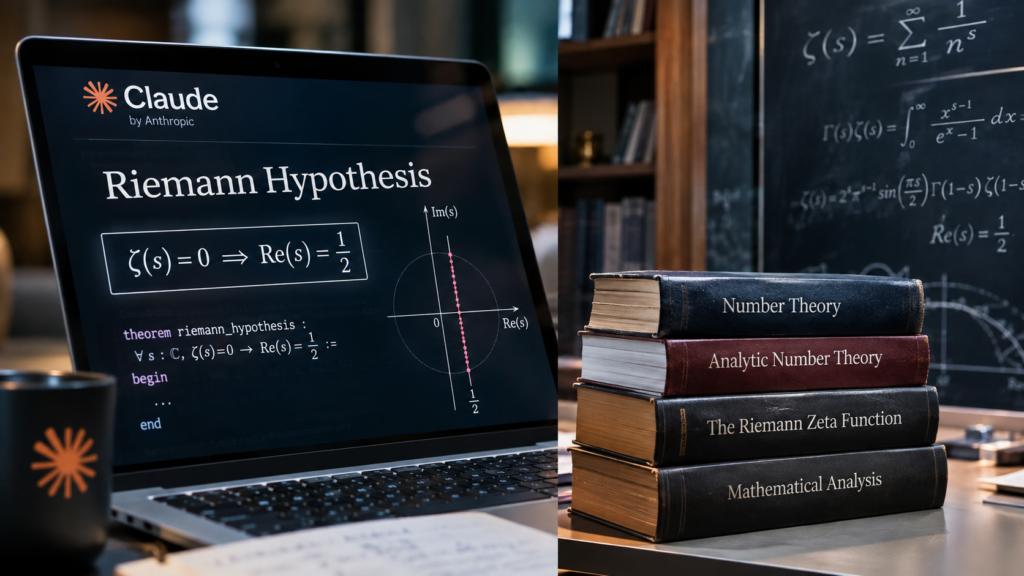
Summary: An extraordinary AI-assisted mathematical claim involving Anthropic researcher Levent Alpöge and Claude has triggered renewed debate about the future of scientific research. The reported Riemann Hypothesis proof has passed important formal verification checks, but independent mathematical scrutiny remains essential. The episode highlights the growing potential of AI in advanced research — and the importance of distinguishing computational verification from scientific acceptance.
◉ Anthropic mathematician Levent Alpöge announced on November 20 that he and Claude had developed a proof of the Riemann Hypothesis, one of mathematics’ most famous unsolved problems.
◉ The formal proof contains approximately 17 million lines of Lean code. The widely circulated claim of a 250,000-page written proof was subsequently clarified by Alpöge as a joke.
◉ The Lean and Mathlib communities have reported successful formal verification, but independent mathematical understanding, peer review and formal recognition remain important milestones.
A Historic Mathematical Claim
Artificial intelligence has reached another remarkable point in its development, with a claim involving one of the most difficult problems in modern mathematics.
On November 20, Levent Alpöge, a mathematician working at Anthropic, announced that he had developed a proof of the Riemann Hypothesis with assistance from the company’s Claude AI model.
First proposed by Bernhard Riemann in 1859, the hypothesis concerns the distribution of prime numbers and the mathematical properties of the Riemann zeta function.
It is one of seven Millennium Prize Problems selected by the Clay Mathematics Institute, each carrying a $1 million prize for an accepted solution.
For more than 165 years, mathematicians have attempted to establish whether all non-trivial zeros of the zeta function lie on a particular vertical line in the complex plane.
A valid proof would represent a major development in number theory, with implications extending across several areas of mathematics.
The significance of Alpöge’s announcement is therefore not simply that an AI system assisted with a difficult calculation. It is that a human researcher claims to have used an AI model to develop an argument addressing a problem that has resisted generations of mathematical research.
What Has Actually Been Verified?
The most important distinction in this story concerns the verification process.
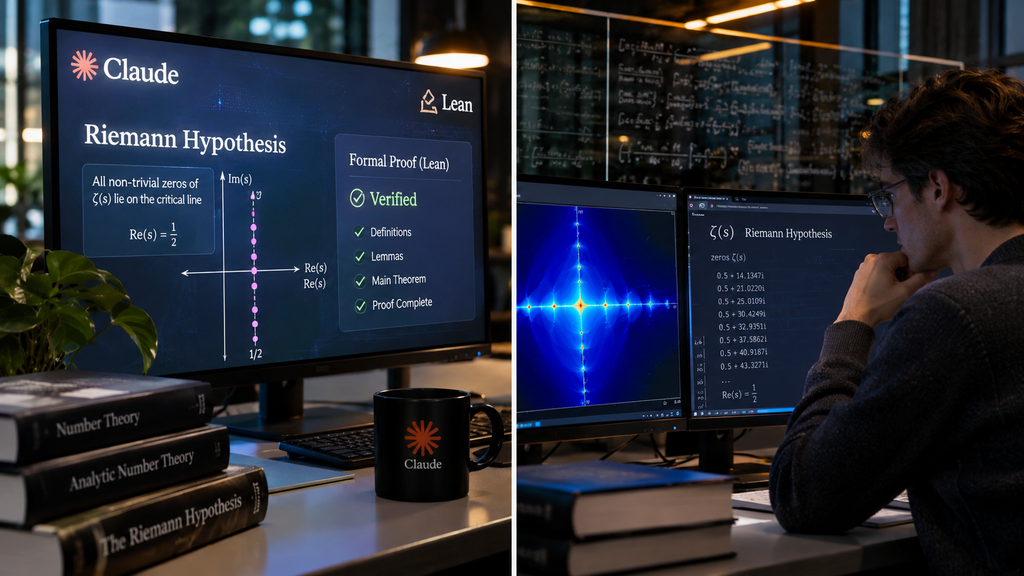
Alpöge released the mathematical work in Lean, a formal proof assistant designed to check mathematical arguments through machine-readable logical statements.
The published archive reportedly contains approximately 175,000 files and 17 million lines of code.
Lean and Mathlib community representatives subsequently reported that the formalised theorem and proof passed their verification checks.
This is significant because formal verification is fundamentally different from asking an AI model whether its own answer is correct.
A proof assistant checks whether each logical step follows from the definitions, assumptions and previously established mathematical results within its formal system.
However, this does not automatically mean that the broader mathematical community has fully understood the argument or accepted its mathematical significance.
The distinction between a formally verified proof and a comprehensible, independently reviewed mathematical result remains important.
The Riemann Hypothesis Enters the AI Era
One of mathematics’ most famous unsolved problems has become the centre of an extraordinary development in artificial intelligence.
On November 20, Levent Alpöge, a mathematician working at Anthropic, announced that he had developed a proof of the Riemann Hypothesis with assistance from Claude.
Originally proposed by Bernhard Riemann in 1859, the hypothesis concerns the distribution of prime numbers and the mathematical properties of the Riemann zeta function.
It is one of seven Millennium Prize Problems established by the Clay Mathematics Institute, with a $1 million prize attached to an accepted solution.
For generations, mathematicians have attempted to establish whether all non-trivial zeros of the zeta function lie on a specific vertical line in the complex plane.
A successful proof would represent a major development in number theory and potentially influence several connected areas of mathematics.
The significance of Alpöge’s announcement is that an AI model reportedly contributed to developing an argument addressing a problem that has resisted more than a century and a half of mathematical research.
What Has Actually Been Verified?
The most important aspect of the announcement is its formal verification.
Alpöge published the work using Lean, a mathematical proof assistant that checks logical arguments through machine-readable code.
The released archive contains approximately 175,000 files and 17 million lines of formalised mathematics.
The Lean and Mathlib communities subsequently reported successful verification of the formal proof and its mathematical statement.
This is an important distinction from conventional AI-generated answers.
A language model can produce convincing mathematical explanations that contain logical errors. A formal proof assistant checks whether the submitted argument follows from its definitions, assumptions and established mathematical results.
However, formal verification and scientific acceptance are not identical.
Mathematicians still need to understand the underlying reasoning, examine its implications and establish how the result connects with existing mathematical knowledge.
The Clay Mathematics Institute’s recognition process also remains separate from computer verification.
As of November 26, the Riemann Hypothesis should not be described as an officially awarded or universally accepted Millennium Prize solution.
The 250,000-Page Clarification
One detail attracted considerable attention following the initial announcement.
Reports circulated that the complete mathematical work exceeded 250,000 pages.
Alpöge subsequently clarified that this figure was a joke.
The actual published material is primarily a formal Lean development containing approximately 17 million lines of code, accompanied by a much shorter explanatory document.
The clarification is important because it illustrates how quickly extraordinary technical claims can become distorted when circulated through headlines and social media.
Nevertheless, the scale of the formal development remains remarkable.
It also raises an important question for the scientific community: how can researchers independently understand and evaluate mathematical results that are formally checked but extremely difficult to interpret?
OpenAI Expands AI Mathematical Research
Anthropic is not alone in pursuing advanced mathematical research through artificial intelligence.
OpenAI has also reported substantial progress.
In October, the company published more than 700 mathematical papers covering 372 open mathematical problems.
The results were produced using an internal frontier model and included full or partial solutions across multiple mathematical disciplines.
Earlier, OpenAI announced that its internal AI system had made progress on more than 100 additional longstanding mathematical problems.
The company also established an independent mathematical advisory group hosted at the Institute for Advanced Study in Princeton.
These developments demonstrate that advanced AI research is increasingly moving beyond traditional language generation and towards structured scientific problem-solving.
However, the scale of the results has also generated debate.
Some mathematicians have welcomed the opportunity to explore previously inaccessible research directions, while others have questioned the quality, transparency and presentation of large volumes of machine-generated mathematical work.
The central challenge is no longer simply generating possible solutions. It is establishing which results are correct, significant and understandable.
Why This Matters for the AI Industry
The developments could have important commercial implications beyond mathematics.
Scientific research is an expensive and time-consuming activity involving specialised expertise, extensive computing resources and years of investigation.
AI systems capable of accelerating discovery could potentially change the economics of research across several industries.
Important application areas include:
- Pharmaceutical research: Accelerating mathematical modelling and computational drug discovery.
- Financial engineering: Developing more sophisticated mathematical models for risk, derivatives and portfolio analysis.
- Cybersecurity: Advancing cryptography, formal verification and mathematical security research.
- Engineering: Improving simulations, optimisation and complex system modelling.
- Scientific computing: Reducing the time required to investigate difficult theoretical problems.
For technology companies, these applications create opportunities to commercialise specialised AI systems beyond conventional productivity software.
The potential market includes universities, pharmaceutical companies, financial institutions, research laboratories and engineering organisations.
However, the economic value will depend on whether AI-generated results can be independently reproduced and integrated into practical research workflows.
The New Competition in Scientific AI
The developments also reveal an increasingly important competitive dimension between major AI laboratories.
Anthropic and OpenAI are demonstrating different approaches to advanced mathematical reasoning, with both companies reporting progress on problems previously considered exceptionally difficult.
The competition is not limited to model performance.
It also involves access to computing infrastructure, specialised research teams, mathematical verification tools and relationships with academic institutions.
A major advantage could emerge for companies capable of combining advanced reasoning models with reliable verification systems.
This could create a new category of enterprise AI products focused specifically on scientific discovery and technical research.
Nevertheless, there is a considerable difference between demonstrating impressive mathematical capabilities and building commercially reliable research systems.
What Comes Next?
The coming months will be important for determining whether AI-assisted mathematical research can become a reproducible scientific process.
Three developments deserve particular attention:
- Independent scrutiny: Whether mathematicians can fully understand and validate the Claude-assisted Riemann Hypothesis argument.
- Research productivity: Whether OpenAI and Anthropic can consistently produce significant results across additional mathematical disciplines.
- Commercial applications: Whether advanced mathematical reasoning translates into practical improvements in finance, pharmaceuticals, engineering and scientific computing.
The current developments represent an important moment for artificial intelligence.
However, the greatest achievement may not simply be solving a famous mathematical problem.
It could be the emergence of AI systems capable of participating in the discovery process itself, helping researchers explore questions that previously required years of specialised work.
For the technology industry, this creates an opportunity extending far beyond chatbots and conventional business automation.
Scientific research could become one of the most important long-term markets for advanced artificial intelligence.
Sources
- Business Standard – Alpöge Clarifies the 250,000-Page Claim, November 26
- Associated Press – Anthropic Researcher Claims Claude-Assisted Riemann Hypothesis Proof
- The Guardian – Two Groups Verify Claude-Assisted Mathematical Proof
- OpenAI – Sharing AI Progress in Mathematics
- Nature – AI and the Future of Mathematics
- University of Waterloo – Independent Analysis of the Alpöge/Claude Proof
- Denarni Fokus – Editorial Disclosure & Transparency