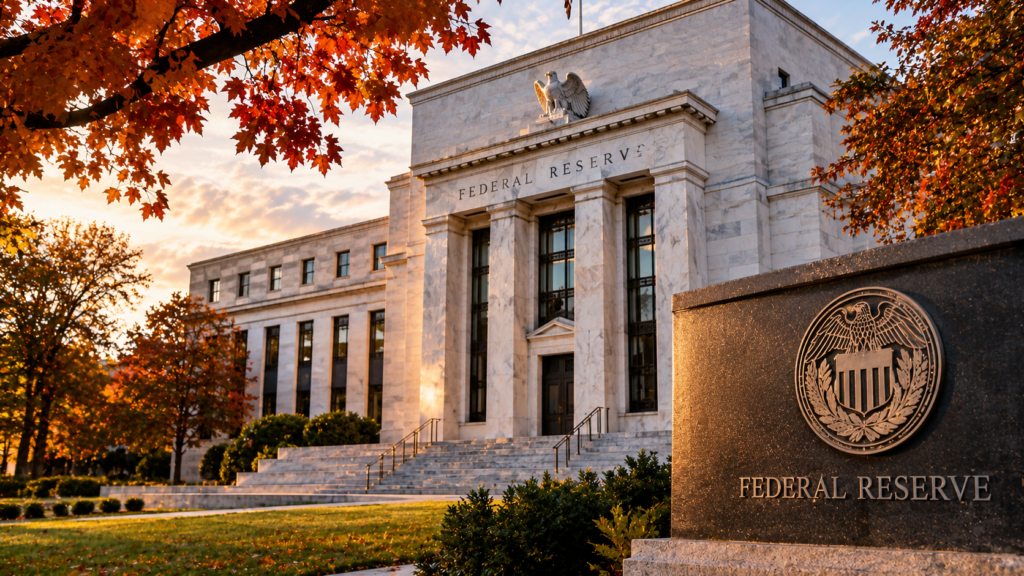
Summary: Global government bonds are losing some of their recent momentum as stronger-than-expected US inflation reinforces expectations of another Federal Reserve rate increase in December. Despite persistent demand for safe-haven assets, rising price pressures and resilient economic growth are creating a challenging environment for fixed-income markets.
◉ US core PCE inflation accelerated to 3.3% annually in October, exceeding expectations and reinforcing the case for another December Fed rate increase.
◉ The US 10-year Treasury yield fell to approximately 4.86%, while German 10-year Bund yields reached their lowest levels since August.
◉ Markets are increasingly pricing in a 25-basis-point Fed increase in December, although expectations of more aggressive tightening have eased.
Global Bonds Take a Breather
Global government bond markets entered Thursday’s trading session with investors reassessing the relationship between inflation, economic growth and monetary policy.
The latest rally in sovereign debt had pushed borrowing costs lower across the United States, Europe and Asia-Pacific, as investors sought protection following substantial volatility in global equity markets.
However, the latest US economic figures have reinforced the possibility that central banks will maintain restrictive monetary conditions for longer.
The October Personal Consumption Expenditures (PCE) report showed that core inflation increased to 3.3% annually, above economists’ expectations of 3.2%.
At the same time, US third-quarter economic growth was revised upwards to an annualised 4.3%, significantly exceeding the previous estimate of 3.4%.
The combination of persistent inflation and stronger economic activity creates a difficult environment for monetary policymakers.
Although bond investors have continued buying government debt, the latest data suggest that the Federal Reserve may have limited flexibility to change its monetary policy direction.
Treasury Yields Signal Conflicting Expectations
US government bonds have experienced a substantial rally in recent sessions.
The benchmark 10-year Treasury yield declined to approximately 4.86%, reaching its lowest level since September. This represented its eighth consecutive daily decline, the longest winning streak since 2019.
The two-year Treasury yield, which is particularly sensitive to expectations surrounding Federal Reserve policy, also moved lower, touching approximately 4.58%.
Normally, stronger inflation and economic growth would create upward pressure on government bond yields.
However, the recent movement suggests that investors are responding to another important factor: declining confidence in the sustainability of the technology-led equity rally.
Concerns surrounding artificial intelligence valuations and technology-sector profitability have encouraged investors to reduce exposure to riskier assets and increase allocations to government bonds.
This creates an unusual market dynamic in which bond prices rise even as inflation data strengthens the case for additional monetary tightening.
The rally therefore appears to reflect defensive positioning rather than a fundamental improvement in the inflation outlook.

Europe Faces Its Own Monetary Challenge
European government bonds have also benefited from the global move towards safer assets.
German 10-year Bund yields declined to approximately 3.21%, their lowest level since August.
The movement comes as European investors assess the possibility of additional monetary tightening by the European Central Bank.
Recent ECB meeting minutes revealed that a significant number of policymakers could have supported an interest rate increase during October.
Financial markets have consequently increased their expectations of a December rate increase, with derivatives pricing suggesting approximately a 90% probability of a 25-basis-point move.
This creates a complicated situation for European fixed-income markets.
While demand for government bonds is supporting prices, expectations of higher ECB interest rates could limit the sustainability of the rally.
Germany remains a particularly important reference point because Bund yields influence borrowing costs and valuation benchmarks across the wider eurozone.
Japan and Australia Follow the Global Trend
The bond rally has also extended across Asia-Pacific markets.
Japanese government bonds experienced substantial buying interest, with the 10-year yield falling to approximately 2.58% during Wednesday’s trading session before recovering towards 2.65%.
The decline represented one of the strongest single-session movements in recent weeks.
Australian government bonds followed a similar pattern. The 10-year yield declined towards 4.75%, its lowest level since July, before recovering slightly.
These movements illustrate how international investors are increasingly responding to developments in US monetary policy and global risk sentiment.
However, domestic inflation conditions and central-bank policies remain important differences between individual markets.
Japan, in particular, continues to face a different monetary policy environment from the United States and Europe.
The Dollar Loses Some Momentum
The recent bond rally has also influenced currency markets.
The US dollar’s interest-rate advantage has become less pronounced as Treasury yields have declined.
The dollar index traded around 103.70 on Thursday, remaining close to its highest level since March 2025 but losing some momentum as global equity markets stabilised.
The euro traded around $1.098, recovering from recent weakness, while the Japanese yen remained near 159.20 per dollar.
Nevertheless, the broader monetary policy outlook continues to favour the dollar.
Persistent US inflation, stronger economic growth and expectations of additional Federal Reserve tightening remain supportive factors.
The relationship between bond yields and the dollar will therefore remain an important indicator of how investors interpret incoming economic information.
December Becomes a Critical Turning Point
The Federal Reserve’s December 8–9 meeting is becoming the next major event for global financial markets.
Current expectations increasingly favour another 25-basis-point increase, which would take the federal funds target range to 4.00%–4.25%.
However, the market outlook has become more nuanced.
Although investors are increasingly confident about another increase, expectations of a larger 50-basis-point move have largely disappeared.
The distinction matters because financial markets are already adjusting to the possibility of tighter monetary conditions.
A gradual increase may have a different impact on bond valuations, currency markets and equity valuations than a more aggressive tightening cycle.
The Federal Reserve will also have to consider the potential consequences of higher borrowing costs for economic activity, employment and corporate investment.
What Comes Next for Bond Markets?
The current bond rally highlights the growing tension between two competing forces.
On one side, persistent inflation and strong economic activity support expectations of higher interest rates.
On the other, equity-market uncertainty and concerns surrounding future economic growth are increasing demand for government debt.
The direction of sovereign bond yields will depend on which of these forces becomes dominant.
If inflation remains elevated while economic growth continues to outperform expectations, central banks could maintain restrictive policies for longer.
Conversely, a significant deterioration in equity markets or economic activity could strengthen demand for safe-haven assets, potentially pushing bond yields lower despite persistent inflation.
For now, global fixed-income markets are navigating an unusual environment in which defensive demand is supporting bond prices while monetary policy expectations remain firmly hawkish.
Sources
- Investing.com – Global Bond Rally Eases as Sticky PCE Locks in December Fed Hike
- The Wall Street Journal – Treasury Yields Extend Fall After US Data Flurry
- Reuters – Global Markets View: European Markets and Bond Yields
- Reuters – Dollar Rally Pauses for Thanksgiving
- Denarni Fokus – Editorial Disclosure & Transparency