Short Description: A reported €2.4 million weekly charter price for the 102-metre superyacht Nixie highlights the financial machinery behind extreme luxury at sea—from specialist crews and technical operations to seasonal demand, maintenance and the economics of chartering versus ownership.
Hot Points
◉ €2.4 million per week: The reported charter price for Nixie illustrates the extraordinary cost of accessing one of the world’s most exclusive yacht experiences. It is an advertised or reported rate, not evidence that the yacht regularly books at that price.
◉ A floating operation: A 102-metre yacht with a helipad, glass-bottomed infinity pool, spa facilities and a crew of 34 requires far more than a luxury interior. It operates as a complex maritime business, with substantial staffing, engineering, maintenance and logistical demands.
◉ Demand meets seasonality: Superyacht charter activity strengthened in 2026, but bookings vary by destination and time of year. Premium pricing depends on the vessel, itinerary, availability and service—not simply its size or headline amenities. The Guardian
The Price of Access
The economics of extreme luxury are increasingly defined by access rather than ownership alone. A charter gives guests temporary use of a highly specialized vessel, with its accommodation, onboard facilities and crew, without requiring them to purchase and maintain the yacht themselves.
Nixie, built by German shipyard Lürssen and reported to be owned by Revolut co-founder and chief executive Nik Storonsky, measures 102 metres. Its reported features include a helipad, a glass-bottomed infinity pool, a dedicated spa and wellness area, and a crew of 34.
At a reported €2.4 million per week, the headline price places the yacht in a rarefied segment of the global charter market. Yet that figure should be interpreted carefully. It is a reported rate, not a confirmed record of completed bookings, realized revenue or annual utilization.
The distinction matters because a yacht’s advertised price is only one part of its commercial picture. Actual income depends on how many weeks are chartered, the rates achieved for individual periods, contractual terms and the expenses associated with each voyage.
A Floating Business
A 102-metre superyacht is not simply a private residence that happens to travel. It is a complex maritime operation combining hospitality, engineering, logistics, safety management and personalized service.
A crew of 34 reflects the demands of operating a vessel of this scale while maintaining guest-facing services. Crew responsibilities can span navigation, engineering, deck operations, housekeeping, food preparation, guest services and safety procedures. Specialists may also be required to maintain sophisticated onboard systems and manage tenders or other equipment.
The vessel must remain operational whether it is carrying guests, repositioning between destinations or undergoing maintenance. Technical readiness is therefore a continuing requirement, not an expense that begins only when a charter starts.
Fuel is another major variable. Consumption depends on engine configuration, speed, distance travelled, sea conditions and time spent operating onboard systems. An itinerary involving long passages at higher speeds can have a very different cost profile from a shorter journey with extended periods at anchor.
Maintenance, insurance, berthing, provisions, regulatory compliance and periodic refits add further layers of expenditure. For a yacht of Nixie’s size and specification, a generic cost estimate cannot substitute for a vessel-specific operating budget.
What the Charter Rate Covers
The headline weekly rate does not necessarily represent the complete cost of a guest’s trip. Depending on the charter agreement, additional expenses may be charged separately, including fuel, food and beverages, port fees and other voyage-specific costs.
These arrangements can make comparisons between yachts less straightforward. Two vessels with similar weekly prices may deliver different levels of service, include different provisions or require substantially different itineraries and operating expenditure.
For the charterer, the total cost is shaped by more than the number printed in a brochure. Destination, duration, guest requirements, itinerary complexity and the timing of the booking can all affect the final bill.
For the owner, the central question is different: how much revenue remains after the cost of making the yacht available, operating it and maintaining it to the expected standard?
That calculation cannot be answered from the charter rate alone. It requires information about actual bookings, contractual terms, operating costs and periods when the vessel is unavailable.
The Cost of Ownership
The financial commitment behind a superyacht extends well beyond its acquisition price. Industry estimates sometimes use an annual operating-cost rule of thumb equivalent to roughly 10–15% of a yacht’s value. This is a broad benchmark, not a universal formula, and should not be treated as a verified estimate for Nixie.
Actual expenditure varies with the vessel’s age, technical complexity, usage, crew arrangements, home port, insurance conditions and refit schedule. A yacht with extensive specialist equipment or an intensive cruising programme may face a different cost structure from a vessel used less frequently.
Refits introduce an additional challenge. Large yachts periodically require substantial work to refresh interiors, replace equipment, service propulsion systems and maintain compliance with relevant maritime requirements. Such projects can also remove a yacht from the charter market for an extended period, creating an opportunity cost beyond the refit bill itself.
Ownership therefore combines recurring expenditure with occasional, potentially substantial capital requirements. The vessel may be a highly visible symbol of wealth, but maintaining its condition and operational readiness requires a sustained financial commitment.
Charter Demand Is Seasonal
The wider charter market provides context for understanding how these vessels are marketed. Northrop & Johnson’s third-quarter 2026 market report recorded an 18.5% year-on-year increase in global charter bookings during the first nine months of the year. The number of individual yachts receiving bookings rose by a more modest 1.8%, while booked days increased by 17.4%.
The figures suggest that stronger activity was driven largely by more bookings and days across a broadly similar pool of yachts, rather than by a comparable expansion in the number of vessels being booked.
The Mediterranean remained the dominant charter region, with Greece, the Adriatic and other established cruising grounds attracting substantial demand. But charter activity was not uniform throughout the year. June and July accounted for much of the reported booking growth, highlighting the importance of timing in a business where weather, school holidays, destination preferences and vessel availability intersect.
At the very top of the market, a yacht’s price and specification may distinguish it from competing vessels, but they do not remove the influence of seasonality. High-profile vessels still need to match their availability, itineraries and service offering to client demand.
Privacy as Part of the Product
The appeal of superyacht chartering extends beyond accommodation and amenities. For high-net-worth guests, privacy, control over the itinerary and the ability to host family, friends or business associates in a secluded environment can be central to the experience.
A private vessel can combine travel, dining, wellness and entertainment in one setting. The crew provides a service structure designed around the guests, while the itinerary can be tailored within operational, safety and regulatory constraints.
This personalization is expensive to deliver. It requires trained staff, advance planning, provisioning and the ability to coordinate services across changing locations. In this segment, service quality is not an incidental extra; it is part of the product being sold.
The model also explains why the comparison between a yacht charter and a conventional luxury hotel is incomplete. The charter provides mobility, privacy and control over a private environment, but it carries the operating requirements of a large vessel as well as the costs of high-end hospitality.
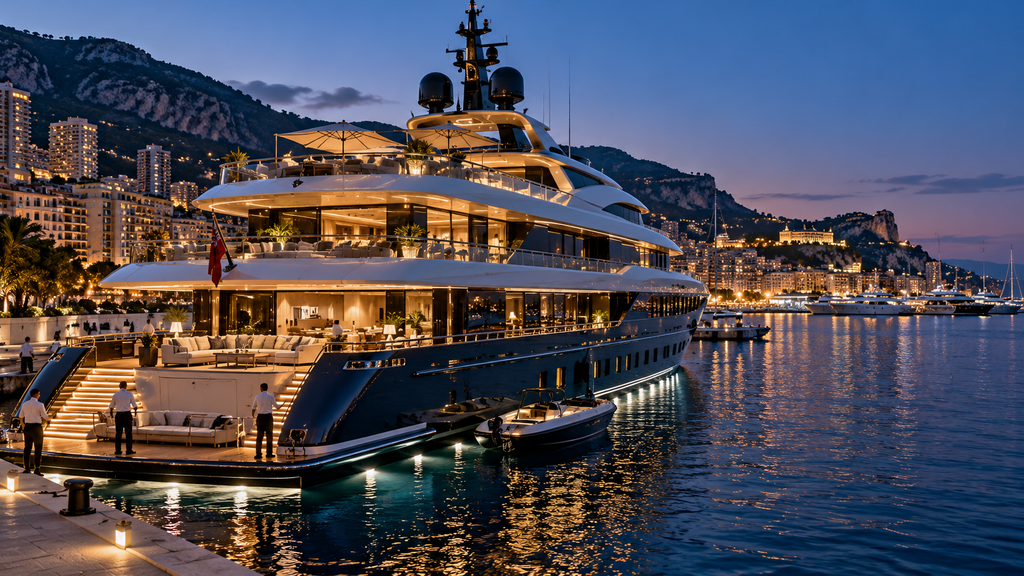
Illustrative AI-generated image: A luxury yacht at dusk and an elegant onboard dinner setting, evoking the privacy and personalized service associated with premium charter travel. This is not a verified photograph of Nixie.
Ownership Versus Chartering
For a potential guest, chartering can provide access to a yacht without taking on the long-term responsibilities of ownership. The commitment is concentrated around the chosen trip, subject to the charter agreement and any additional expenses.
Ownership offers a different proposition: control over the vessel and its availability, balanced against continuing costs, maintenance obligations and the risk that the yacht may spend significant periods unused or out of service.
Charter revenue can offset some ownership expenses where a yacht is made available commercially. But gross charter income is not the same as profit, and a high weekly rate does not guarantee that annual revenue will cover the vessel’s full cost of ownership. Booking levels, achievable rates, commissions, operating expenses and maintenance downtime all influence the outcome.
There is also no basis for assuming that every private yacht is operated primarily as an income-generating asset. Owners may place greater weight on personal use, privacy or other non-financial considerations. Without access to a yacht’s private financial records, its actual commercial performance cannot be established from a public charter rate.
The Environmental Equation
The financial model also intersects with environmental scrutiny. Large superyachts require energy for propulsion, onboard systems and guest services, while their impact varies according to size, engine technology, speed, itinerary and time spent operating.
The Guardian’s report from the 2026 Monaco Yacht Show placed these vessels within a broader debate about concentrated wealth, emissions and the environmental consequences of luxury consumption. The article also highlighted emerging technologies and sustainability claims across the industry.
For yacht operators, improvements in propulsion, energy management and onboard efficiency can influence environmental performance. However, the presence of new technology alone does not establish a vessel’s overall footprint. A meaningful assessment requires evidence about how the yacht is operated and the emissions associated with its activities.
The same scrutiny applies to claims about sustainability. The environmental implications of a vessel should be evaluated against its actual operations, rather than inferred from its design features or marketing language.
The Economics Behind the Spectacle
Nixie’s reported weekly charter price offers a striking entry point into the economics of extreme luxury, but the figure alone tells only part of the story.
The business behind a superyacht combines expensive assets, specialist labour, substantial maintenance requirements and a charter market shaped by seasonality and individual client preferences. A high weekly rate may reflect the rarity of the vessel and the service it offers, but it does not establish profitability or guarantee consistent demand.
The distinction between price and performance is fundamental. An advertised charter rate describes the cost of access under particular terms; it does not reveal the yacht’s actual booking record, annual revenue or operating margin.
For owners, the decision to charter or retain a yacht privately depends on a combination of financial considerations and personal priorities. For guests, chartering offers temporary access to a highly personalized environment without requiring long-term ownership.
In the end, the economics of a yacht like Nixie are not defined by size or price alone. They emerge from the interaction of capital, operating discipline, service quality, availability and the willingness of a very small market to pay for an exceptional experience.
Sources
- The Guardian — Excessive wealth, extreme emissions – and ecocide: what I learned at Europe’s big superyacht show, 20 October 2026. Coverage of Nixie, its reported charter rate, specifications and the wider luxury-yachting industry. The Guardian report
- Northrop & Johnson — Q3 2026 Superyacht Market Report, 15 October 2026. Charter bookings, booked days, seasonal patterns and brokerage-market context. Q3 2026 Superyacht Market Report
- Northrop & Johnson — The Charter Market After a Strong Summer, September 2026. Booking windows and seasonal charter trends. Charter Market Report
- IYC — IYC Insights: Reviewing the Yacht Charter Market and IYC Performance During the First Half of 2026. Demand, destinations, booking behaviour and operating-cost pressures. IYC market analysis
- Superyacht Guide — How Much Does It Really Cost to Own a 40m, 60m, 80m or 100m Superyacht?, July 2026. General ownership-cost benchmarks and the factors affecting annual expenditure. Superyacht ownership costs