Summary: Global demand for electricity to cool buildings has overtaken demand for heating for the first time, marking a historic shift in energy consumption. Rising temperatures, expanding air-conditioning ownership and economic growth are reshaping electricity markets, infrastructure investment and long-term energy demand.
◉ Cooling has overtaken heating as the world’s leading building-related electricity demand, according to the IEA’s 2026 World Energy Outlook.
◉ Cooling is expected to account for more than 40% of global energy-demand growth through 2035, driven by rising temperatures and increasing air-conditioning adoption.
◉ Emerging economies, particularly India and Southeast Asia, are becoming major drivers of electricity demand, increasing pressure on power generation, grids and energy security.
A Historic Shift in Energy Consumption
The global energy system is entering a new phase as demand for cooling overtakes demand for heating in buildings for the first time in history.
The development reflects two structural changes taking place simultaneously: rising global temperatures and increasing household purchasing power. As incomes improve, millions of households in emerging economies are gaining access to air conditioning, while traditionally cooler regions are experiencing more frequent periods of extreme heat.
The International Energy Agency’s World Energy Outlook 2026 identifies this transition as one of the defining developments in the future energy landscape.
Across the three scenarios examined in the report, cooling accounts for more than 40% of the growth in energy demand through 2035.
The implications extend beyond household electricity bills. Increasing cooling requirements are changing seasonal consumption patterns, creating additional pressure on electricity infrastructure and influencing decisions about future power-generation capacity.
Air Conditioning Becomes a Global Growth Market
The expansion potential remains substantial, particularly in developing economies.
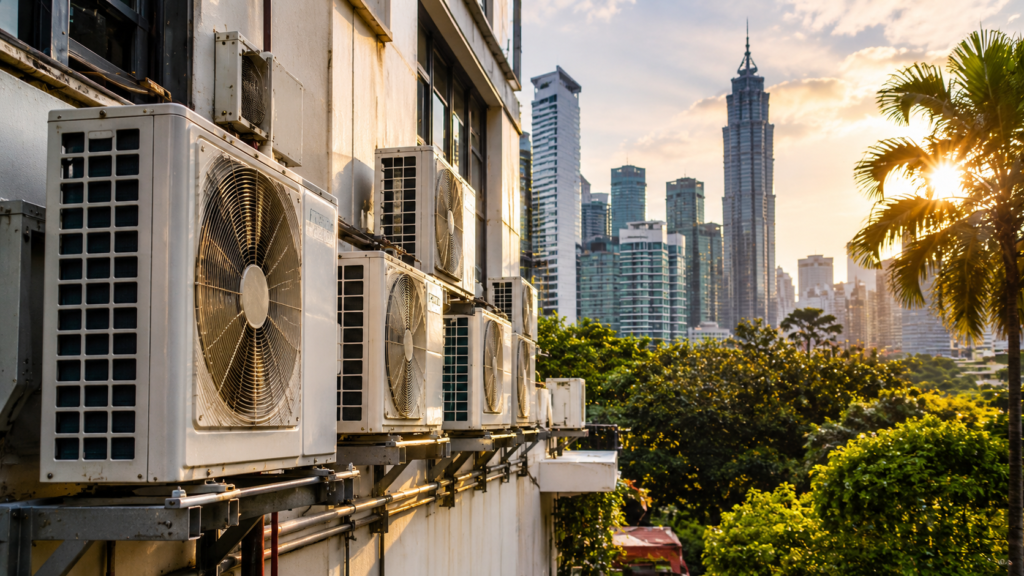
Approximately 85% of households in emerging and developing economies outside China experience high temperatures, yet fewer than 20% currently have air conditioning.
This gap represents significant potential demand for air-conditioning manufacturers, compressor producers, electrical equipment suppliers and companies involved in building infrastructure.
As household incomes rise, cooling is increasingly becoming an essential service rather than a luxury product.
The trend is also expanding geographically. Europe, traditionally associated with higher heating requirements, has experienced increasingly severe summer temperatures, accelerating the adoption of cooling systems in residential and commercial buildings.
This creates a structural change in electricity consumption that could persist even if individual years experience different weather conditions.

Electricity Infrastructure Faces New Pressure
The growing importance of cooling introduces a major challenge for electricity systems: demand is becoming increasingly concentrated during hot periods.
Air conditioning places additional pressure on power networks precisely when temperatures are highest and electricity consumption can rise sharply.
This creates several investment requirements, including additional generation capacity, stronger transmission networks, modernised distribution systems and improved energy storage.
The IEA estimates that global electricity demand for cooling will increase by approximately 1,700 TWh by 2035 under its Stated Policies Scenario. In a more extreme heatwave sensitivity case, the increase could be around 700 TWh higher.
These figures demonstrate how weather patterns and infrastructure planning are becoming increasingly interconnected.
For energy companies, the expansion of cooling demand creates opportunities across electricity generation, grid equipment, transformers, cables, batteries and energy-management technologies.
However, the speed of infrastructure investment will determine how effectively electricity systems can accommodate this additional consumption.
Southeast Asia Faces Growing Energy Needs
Geographically, emerging Asia is expected to play a particularly important role in the next stage of global energy consumption.
India and Southeast Asia are among the regions facing the largest increases in overall energy needs, supported by population growth, industrial development, urbanisation and rising household incomes.
Southeast Asia faces a particularly complex energy challenge. Rapidly increasing electricity consumption could extend the region’s reliance on coal-fired generation, especially where investment in alternative generation and electricity infrastructure fails to keep pace with demand.
This creates a tension between energy affordability, security of supply and emissions reduction.
Countries must expand electricity availability while simultaneously managing the environmental consequences of additional power generation.
The Investment Implications
The shift from heating towards cooling has implications for several industries.
Air-conditioning manufacturers could benefit from expanding household ownership, particularly in emerging markets. Electricity utilities may face increasing requirements for generation capacity and network investment, while manufacturers of transformers, power cables and grid-management equipment could see stronger long-term demand.
The development also strengthens the importance of energy efficiency.
More efficient cooling systems can reduce electricity consumption without sacrificing comfort, potentially limiting the need for additional power generation. Technologies such as advanced compressors, heat pumps, building insulation and smart energy-management systems are therefore becoming increasingly relevant.
At the same time, the expanding electricity requirements of data centres and artificial intelligence infrastructure are adding another layer of demand.
The energy sector is consequently facing several simultaneous structural pressures rather than a single isolated consumption trend.
A New Energy Landscape
The transition towards a cooling-driven energy system represents more than a change in household consumption. It signals a broader transformation in how electricity is generated, distributed and used around the world.
The IEA also warns that its three principal scenarios all point towards global warming exceeding the 1.5°C threshold above pre-industrial levels, highlighting the scale of the climate challenge.
For energy markets, the central question is increasingly how quickly infrastructure and generation capacity can adapt to rising electricity requirements.
As air conditioning becomes more accessible and extreme temperatures become a more significant economic factor, cooling is emerging as one of the major structural drivers of global energy demand through the next decade.
Sources
- Bloomberg – Global Cooling Demand Overtakes Need for Heating, IEA Says.
- International Energy Agency – World Energy Outlook 2026, Executive Summary.
- Reuters – Energy Security Response to Iran War Could Cut Oil Demand by 4% by 2035.
- Associated Press – IEA Warns of Historic Energy-System Transformation.
- Editorial Disclosure & Transparency