Short description: Adobe is embedding AI agents across Photoshop, Premiere and Firefly, introducing automated creative workflows, new editing capabilities and integrations that could reshape the economics of professional content production.
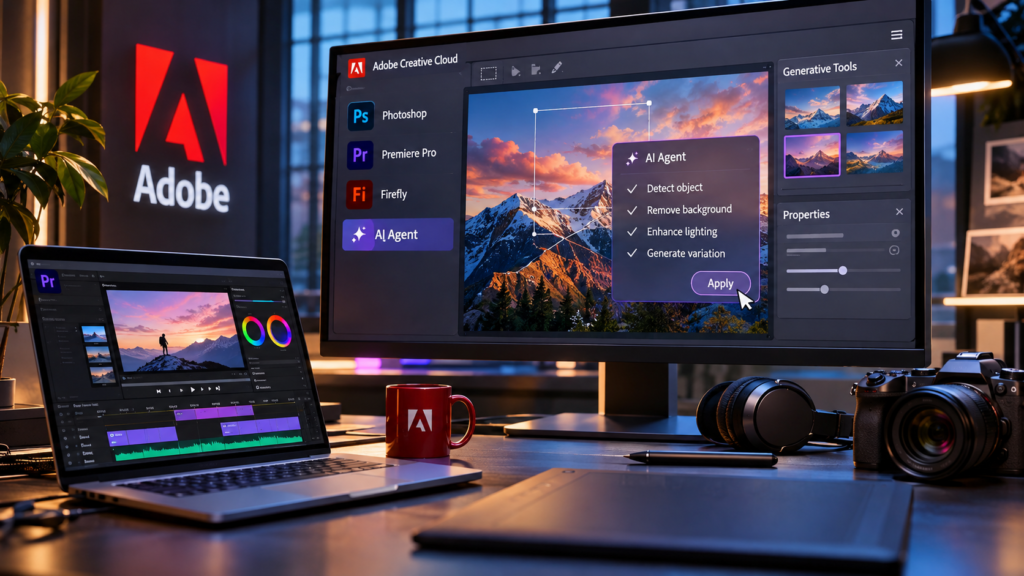
◉ Adobe is expanding its Creative Agent across Creative Cloud, allowing users to delegate complex, multi-step creative tasks through natural-language instructions.
◉ Firefly is evolving into a broader AI creative studio, combining image, video, audio and design tools with models from multiple technology providers.
◉ New integrations based on the Model Context Protocol could allow third-party AI agents to interact directly with editable Photoshop, Illustrator, Premiere and After Effects projects.
The Shift Towards Agentic Creativity
Adobe is accelerating its transformation from a traditional creative software provider into an AI-powered creative platform. Announced on November 10 at Adobe MAX in Miami, its latest product developments introduce a more advanced approach to integrating artificial intelligence into professional creative workflows.
The central development is the expansion of Adobe Creative Agent across Creative Cloud and Firefly. Instead of relying exclusively on individual commands and manual editing, users can delegate more complicated tasks to AI assistants that coordinate multiple operations.
The distinction is important. Generative AI traditionally focuses on producing individual outputs, such as an image, background or video clip. Agentic AI aims to manage sequences of connected tasks, potentially reducing the time required to complete entire projects.
Adobe is positioning this technology as an additional layer of assistance rather than a replacement for professional creative judgment.
Photoshop Gets More Intelligent
How long does it take to learn Photoshop | PSDDude
Photoshop is receiving new capabilities designed to provide more control over image editing.
Among the announced innovations are:
- Generative Restyle: New prompt-based creative styling capabilities.
- Relight: Improved control over image lighting.
- Advanced AI editing: More targeted modifications while preserving other elements of an image.
The direction reflects an important change in image-generation technology. Rather than simply creating an entirely new picture, AI tools are increasingly being developed to modify specific elements while preserving the original composition.
For professional photographers, designers and marketing teams, precision and consistency remain essential. This is where integration directly into established editing software could become commercially significant.

Premiere Expands AI Video Production
Adobe is also expanding artificial intelligence capabilities in Premiere.
One of the most notable additions is Color Mode, a new color-grading system designed to provide greater control over video appearance.
The Creative Agent introduces additional workflow automation, including the ability to:
- Apply effects across multiple clips in a sequence.
- Track masked subjects through video frames.
- Adjust color and exposure across an entire sequence.
These capabilities target repetitive production tasks that can consume considerable time in professional video editing.
The broader implication is that AI is moving beyond isolated editing features towards assisting with entire production processes.
Firefly Becomes an AI Creative Studio
Perhaps the most strategically important development is the expansion of Adobe Firefly.
Adobe is bringing image, video, audio and design capabilities into a more integrated creative environment. The platform also offers access to models from multiple providers, including Google, OpenAI, ByteDance, Kling and ElevenLabs.
Several additional products and features were announced:
- Firefly Design: A new design workspace in beta combining raster, vector, motion, 3D and print workflows.
- Firefly Video: Expanded tools for assembling videos from clips, images and audio.
- Firefly Graph: A beta environment for creating repeatable creative workflows.
- Firefly Builder: A private-beta tool for developing interactive prototypes using natural-language instructions.
- Always-on Agents: Preview capabilities for recurring background tasks, including asset organization and quality checks.
This represents a broader strategic move. Adobe is attempting to reduce the fragmentation between individual creative applications, AI models and production environments.
Rather than forcing users to move between numerous separate services, the company wants Firefly to become a central environment for managing creative production.
The MCP Integration Changes the Competitive Landscape
One of the most significant announcements concerns the Model Context Protocol (MCP).
Adobe is previewing local MCP integrations for Photoshop, Illustrator, Premiere and After Effects.
This would allow compatible third-party AI agents to interact with creative applications and make changes directly to native project files.
Importantly, layers, sequences and other project elements remain editable, allowing professionals to review and refine the results.
The strategic importance extends beyond Adobe’s own AI assistant.
It opens the possibility of connecting creative software with broader AI ecosystems, including assistants and agents developed by other technology companies.
Adobe has already expanded collaborations with OpenAI and Anthropic, while announcing further partnerships involving Google and Microsoft.
The emerging competitive environment is therefore no longer defined exclusively by which company has the strongest image-generation model. Integration, workflow compatibility, professional control and access to established creative tools are becoming equally important.
What It Means for the Creative Software Industry
Adobe’s announcements highlight a structural shift in the creative software market.
For years, the competitive advantage of professional applications was built around advanced editing capabilities, specialised tools and established user workflows.
AI is changing that equation.
Software companies increasingly compete on how effectively they combine traditional professional functionality with automated production, intelligent assistants and access to multiple AI models.
Adobe has several advantages in this transition: an established Creative Cloud ecosystem, a large professional user base and applications deeply integrated into existing production environments.
However, competition is intensifying. Canva, Figma and emerging AI-native creative platforms are also developing products that aim to simplify design and content creation.
The challenge for Adobe will be to maintain professional precision while making AI-driven workflows accessible and economically attractive.
For the wider industry, the transition could influence productivity, creative service pricing, software subscriptions and the structure of digital marketing and content-production businesses.
The Bigger Picture
Adobe’s latest announcements are more than another collection of AI features.
They signal a move towards software that can understand instructions, coordinate tasks and operate across multiple creative applications.
The next stage of competition in creative technology may therefore depend less on individual editing tools and more on which platform can manage the complete journey from an initial idea to a finished professional product.
Adobe is positioning itself to compete in that environment.