Summary: US stock markets suffered a broad selloff on November 19 as renewed concerns over artificial intelligence valuations, weakening technology shares and rising uncertainty about monetary policy overwhelmed enthusiasm surrounding Anthropic’s record-breaking stock market debut. The S&P 500 recorded its sixth consecutive daily decline, while the Dow Jones lost more than 1,100 points.
◉ US stocks recorded sharp losses, with the Dow Jones Industrial Average dropping 2.19% to 49,097.06, shedding more than 1,100 points, while the S&P 500 fell 2.02% to 7,175.83.
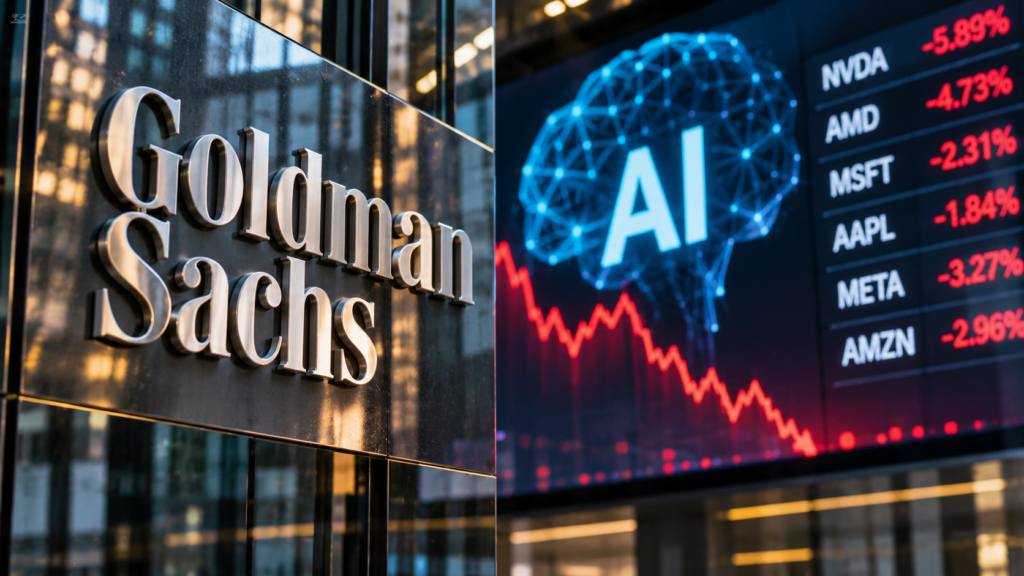
◉ The Nasdaq Composite dropped 2.25% to 23,879.20, extending pressure on technology and artificial intelligence stocks despite Anthropic’s high-profile IPO.
◉ More than 90% of S&P 500 constituents finished lower, highlighting how the selloff extended beyond a handful of major technology companies.
Wall Street Faces Broad Selling Pressure
US equities experienced another significant decline on Thursday, November 19, as investors continued reducing exposure to risk-sensitive assets.
The Dow Jones Industrial Average dropped 1,101.11 points, equivalent to 2.19%, closing at 49,097.06. The S&P 500 lost 2.02% to finish at 7,175.83, recording its sixth consecutive session of losses. The technology-heavy Nasdaq Composite declined 2.25% to 23,879.20.
The scale of the decline was particularly notable because selling extended across almost the entire market. More than 90% of companies in the S&P 500 ended the session lower.
The broad weakness suggests that investors are reassessing risk exposure across multiple sectors rather than simply rotating away from individual technology companies.
The S&P 500’s losing streak also reflects a deterioration in market confidence following weeks of uncertainty surrounding technology valuations, corporate investment and the future profitability of artificial intelligence.
Anthropic IPO Fails to Restore AI Confidence
One of the most closely watched developments was the stock market debut of Anthropic, which attracted substantial attention from investors.
The artificial intelligence company priced its offering at $83 per share. Its stock opened at $111.50 and briefly climbed as high as $115 before losing some of its initial momentum.
Shares eventually closed at $97.17, approximately 17.1% above the offering price.
Despite the strong debut, the listing failed to restore broader enthusiasm for AI-related equities.
The market reaction illustrates an increasingly important distinction between demand for individual AI companies and confidence in the wider technology sector.
Investors continue to recognise the long-term commercial potential of artificial intelligence. However, concerns about valuations, capital expenditure and the time required to generate sustainable returns are becoming more influential.
The scale of investment required to develop AI infrastructure is also raising questions about whether future revenues will justify current market expectations.

Technology Stocks Remain Under Pressure
Technology shares continued to weigh heavily on market performance.
Investors have become increasingly sensitive to the relationship between AI-related capital expenditure and expected corporate returns. Major technology companies are committing substantial resources to data centres, advanced processors and cloud infrastructure.
Although these investments are intended to strengthen long-term competitiveness, they also increase financial commitments and raise expectations for future earnings growth.
When valuations already incorporate ambitious growth assumptions, even relatively modest changes in investor confidence can trigger substantial share-price adjustments.
The latest selloff therefore reflects more than short-term profit-taking. It highlights a growing debate over how much investors should pay for the expected future expansion of the AI economy.
Interest Rates Add Another Layer of Uncertainty
Monetary policy expectations are providing another source of pressure.
Recent Federal Reserve communications have reinforced concerns that interest rates could remain elevated for longer than previously anticipated.
Higher borrowing costs generally affect the valuation of growth companies because a larger proportion of their expected earnings lies further in the future.
The impact can be particularly significant for technology businesses whose market valuations depend heavily on anticipated long-term expansion.
US Treasury yields have also remained elevated, increasing competition between equities and fixed-income investments.
As bond yields become more attractive, investors may demand stronger expected returns before committing additional capital to higher-risk equities.
Market Weakness Extends Beyond Technology
The latest trading session also demonstrated that market weakness is no longer limited to the largest technology companies.
The decline across more than 90% of S&P 500 constituents indicates broad selling pressure.
Consumer, industrial and other market segments also experienced weakness, while company-specific developments contributed to individual share-price movements.
Walmart shares came under pressure following a weaker-than-expected annual sales outlook, while Palo Alto Networks advanced after raising its financial forecast.
These contrasting performances demonstrate how company earnings and forward guidance continue to influence individual stocks even during periods of broader market volatility.
What Comes Next for US Equities?
The November 19 selloff represents another important deterioration in Wall Street’s short-term market structure.
The combination of declining technology shares, uncertainty surrounding AI investment returns, elevated borrowing costs and widespread selling has created a more challenging environment for equities.
Investors will be closely monitoring upcoming corporate earnings, Federal Reserve signals, Treasury yields and developments across the artificial intelligence industry.
Anthropic’s successful market debut demonstrates that demand for individual AI businesses remains substantial. However, the broader market reaction suggests that enthusiasm for the sector is becoming more selective.
The central question for Wall Street is whether the current correction represents a temporary adjustment in valuations or the beginning of a more prolonged reassessment of technology-led market growth.
For now, the broad decline in US equities indicates that investors are becoming increasingly cautious about the relationship between market valuations, financing conditions and future corporate earnings.
Sources
- Bloomberg – Stock Market Today: Dow and S&P 500 Live Updates, November 19
- Reuters – Wall Street Ends Sharply Lower as Anthropic’s Debut Fails to Revive AI Fervor Reuters
- Associated Press – How Major US Stock Indexes Fared Thursday, November 19 AP News
- The Motley Fool – Dow Plunges 1,100 Points as S&P 500 Suffers Sixth Straight Loss The Motley Fool
- Denarni Fokus – Editorial Disclosure & Transparency