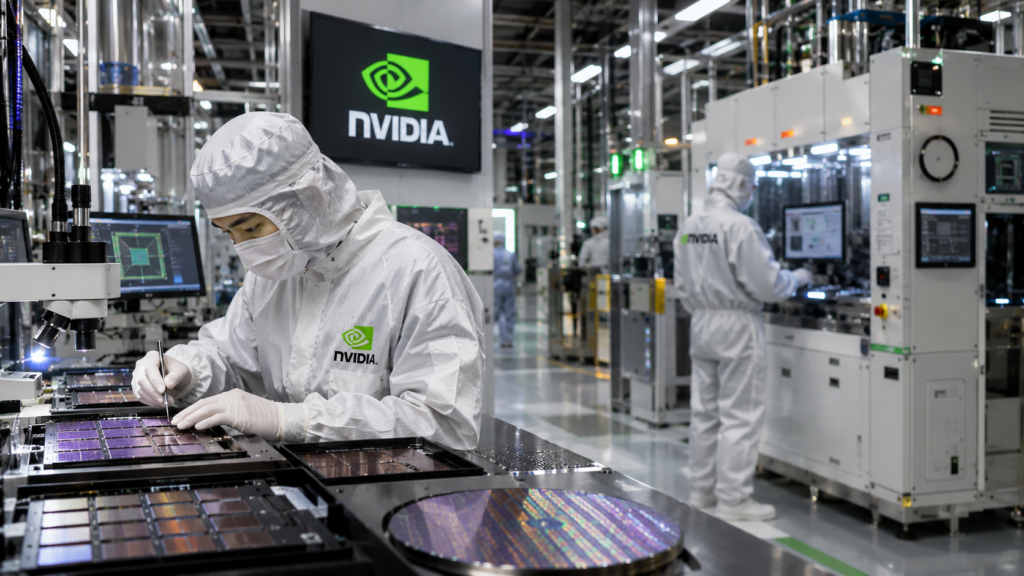
Summary: NVIDIA’s third-quarter fiscal 2027 results arrive as global investors reassess the sustainability of the artificial intelligence investment boom. With revenue expectations above $109 billion, attention is shifting towards Blackwell demand, Vera Rubin production, profit margins, hyperscaler spending and an unprecedented leadership transition.
◉ Quarterly revenue of approximately $109.0–109.3 billion and adjusted earnings of $2.47–$2.49 per share are expected from NVIDIA, according to analysts.
◉ Data Center revenue is expected to reach approximately $101.8 billion, with Blackwell GPU systems remaining the central growth driver.
◉ The earnings call will be the first major financial presentation under interim CEO Colette Kress following Jensen Huang’s departure on November 12.
NVIDIA Earnings: Schedule And Market Context
NVIDIA’s third-quarter fiscal 2027 earnings announcement is scheduled for Tuesday, November 17, making it one of the most closely watched corporate events of the current earnings season.
The reporting period ended October 25, 2026. The results will provide an updated picture of demand for advanced semiconductors, AI computing infrastructure and cloud-based services.
Earnings release
Today
22:20 CET
November 17 · Slovenia time
Conference call
23:00 CET
Reporting period
Q3 FY2027
Period ended
October 25, 2026
Stock ticker
NASDAQ: NVDA
Times confirmed against NVIDIA’s official October 28 announcement. Results are scheduled, not yet reported.
The timing is particularly important for European investors because the announcement will arrive after the regular European trading session and during US after-hours trading.
NVIDIA’s results frequently influence semiconductor shares, AI infrastructure companies, technology ETFs and broader US equity indices.
Wall Street Expectations
Analyst forecasts have moved higher as demand for AI computing infrastructure continues to expand.
The current consensus estimates provide a demanding benchmark for the company.
| Financial metric | Analyst expectations |
|---|---|
| Revenue | $109.0–109.3bn |
| Adjusted EPS | $2.47–2.49 |
| Data Center revenue | $101.8bn |
| Gross margin | ~74.0% |
| Operating expenses, non-GAAP | ~$9.0bn |
Analyst estimates, not actual results. Data Center and revenue estimates based on Visible Alpha consensus and market reporting.
NVIDIA’s previous company guidance was $108 billion in revenue, plus or minus 2%.
That would represent approximately 89% year-over-year growth at the guidance midpoint, demonstrating the scale of the company’s current expansion.
For comparison, the previous quarter generated $96.2 billion in revenue, with a reported gross margin of 75%.
The difference between company guidance and analyst consensus is important. Investors will be examining whether NVIDIA can exceed expectations while maintaining sufficient profitability to support its valuation.

The Five Things Investors Must Watch
1. Blackwell And Vera Rubin Demand
Blackwell remains central to NVIDIA’s current revenue growth, while Vera Rubin represents the next stage of its AI computing roadmap.
Visible Alpha consensus estimates approximately $48.5 billion in Blackwell revenue for the quarter.
Investors will want confirmation that production capacity, deliveries and customer demand remain strong.
Vera Rubin is also important because its contribution could become increasingly significant as hyperscalers transition towards next-generation computing systems.
The key question is whether NVIDIA can maintain its technological advantage while increasing production at a scale sufficient to satisfy demand.
2. Microsoft, Amazon, Google And Meta Spending
The largest cloud infrastructure companies remain among NVIDIA’s most important customers.
Microsoft, Amazon, Alphabet and Meta are committing substantial capital to AI infrastructure, including data centres, networking equipment, electricity supply and advanced processors.
Their spending plans are therefore closely connected to NVIDIA’s revenue outlook.
Investors will be looking for evidence that capital expenditure will remain strong into 2027.
The main risk is that infrastructure investment could grow faster than the revenue generated by AI services, eventually forcing cloud providers to reconsider spending priorities.
This is becoming an increasingly important issue for the wider technology sector.
3. Gross Margins And Production Costs
Profitability will be another major focus.
NVIDIA previously guided towards a 74% gross margin, compared with 75% in the preceding quarter.
The difference may appear relatively small, but at NVIDIA’s revenue scale, even modest margin changes can translate into substantial differences in operating profit.
Higher memory prices, advanced packaging requirements and the complexity of producing complete AI computing systems are potential sources of cost pressure.
The market will also be watching whether NVIDIA can maintain pricing power while expanding production.
4. Leadership Transition
NVIDIA enters this earnings announcement under an unusual corporate structure.
The company confirmed on November 12 that Jensen Huang had resigned as president and CEO, effective immediately.
Chief Financial Officer Colette Kress was appointed interim CEO while the board searches for a permanent successor.
This makes the November 17 earnings presentation particularly important.
Investors will be examining whether the leadership transition affects customer relationships, product development, capital allocation and execution of the company’s technology roadmap.
Kress has extensive experience managing NVIDIA’s financial operations, having served as CFO since 2013.
However, maintaining confidence during a leadership transition at a company as influential as NVIDIA presents a significant challenge.
5. China And Semiconductor Export Restrictions
Geopolitical restrictions remain an important structural risk.
NVIDIA’s previous quarterly revenue guidance explicitly excluded Data Center compute revenue from China.
This reflects the impact of US export controls on advanced semiconductor technology.
Investors will be looking for updates on potential regulatory changes, international demand and the company’s ability to redirect production towards other markets.
China remains an important consideration because restrictions can affect both potential sales and long-term competitive positioning.
The broader issue is whether geopolitical fragmentation will create lasting limitations on NVIDIA’s addressable market.
Why This Earnings Report Matters Beyond NVIDIA
NVIDIA’s financial performance has become an important indicator of the health of the wider AI investment cycle.
The company’s customers include major cloud providers, technology platforms, AI developers and enterprise infrastructure operators.
A strong earnings report would provide further evidence that investment in AI computing continues to translate into semiconductor demand.
However, the market is also increasingly focused on the financial returns generated by the companies purchasing these systems.
The scale of AI infrastructure investment is creating questions around capital efficiency, depreciation, electricity requirements and future monetisation.
If hyperscalers continue increasing spending without demonstrating sufficient returns, investors could become more selective towards companies exposed to the AI ecosystem.
This means NVIDIA’s guidance could influence not only semiconductor valuations but also the broader technology sector.
Market Reaction: What Could Move NVDA?
Three potential earnings scenarios are particularly relevant:
| Scenario | Potential market interpretation |
|---|---|
| Revenue and guidance beat expectations | Stronger confidence in AI infrastructure demand |
| Revenue beats, but guidance disappoints | Valuation pressure despite strong reported results |
| Margins weaken and demand outlook softens | Increased concerns about AI investment sustainability |
The most important distinction is between backward-looking results and forward-looking guidance.
NVIDIA could report another record quarter, but if management signals slower growth, production constraints or weaker margins, the market reaction could remain negative.
Conversely, strong forward guidance could reinforce confidence in the AI infrastructure investment cycle.
What Comes Next?
The November 17 earnings announcement represents an important checkpoint for the global technology market.
Investors will be examining four central questions:
- Can NVIDIA sustain revenue growth above $100 billion per quarter?
- Will Blackwell and Vera Rubin maintain their expected contribution to future sales?
- Can gross margins remain close to the company’s 74% guidance?
- Can the new leadership structure maintain confidence among customers, suppliers and shareholders?
The results will also provide an important indication of whether the AI infrastructure expansion is entering a more mature phase or whether demand continues to accelerate.
The biggest test for NVIDIA tonight is not simply delivering another record quarter. It is demonstrating that the next stage of AI infrastructure investment can support the growth expectations already embedded in global technology valuations.
Sources
- NVIDIA – Official Q3 FY2027 Earnings Schedule
- NVIDIA – Q2 FY2027 Financial Results and Q3 Guidance investor.nvidia.com+1
- S&P Global – NVIDIA Q3 2027 Earnings Preview, November 12 S&P Global
- Reuters – NVIDIA Set to Deliver First Life-After-Huang Briefing, November 16 Reuters
- NVIDIA – Official CEO Transition Announcement, November 12 NVIDIA Newsroom
- Editorial Disclosure & Transparency