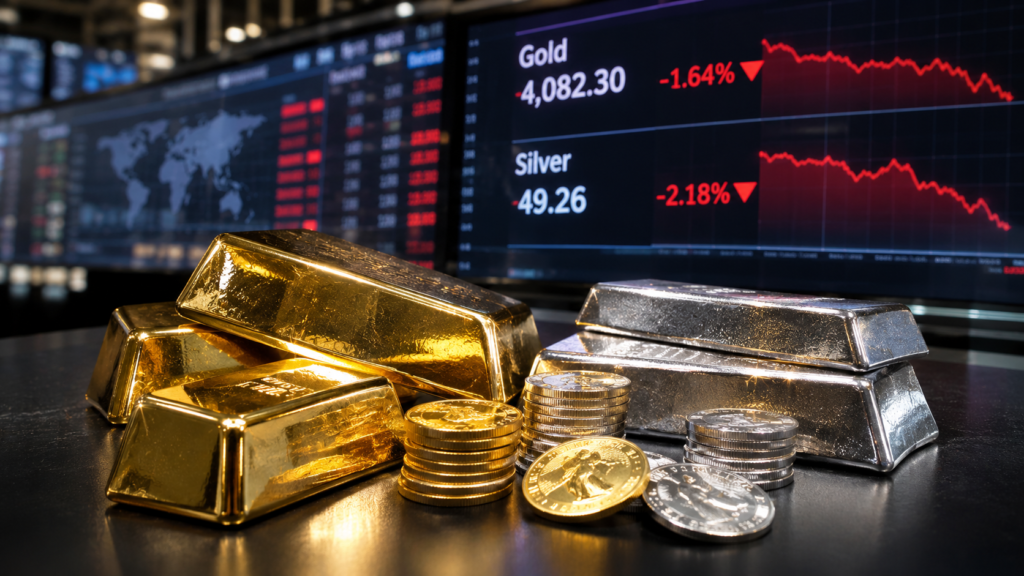
Gold, silver and industrial metals extended their decline on Monday as a stronger US dollar and expectations of further Federal Reserve rate increases weighed on commodity markets. Silver recorded the sharpest losses, while gold touched its lowest level in more than a year.
◉ Gold fell to approximately $3,856 per ounce, reaching its lowest level since October 2025 as expectations of tighter US monetary policy strengthened.
◉ Silver dropped below $48 per ounce, underperforming gold amid weaker industrial-demand expectations and broader selling pressure.
◉ Copper extended its decline towards four-month lows as concerns over Chinese demand and global technology investment added pressure to industrial metals.
Precious Metals Face Renewed Selling
The precious-metals market came under renewed pressure on Monday, 16 November, as investors reassessed the outlook for US monetary policy and the strength of the dollar.
Gold declined to approximately $3,856 per troy ounce during European morning trading, after briefly touching $3,830, its lowest level since October 2025. The move extended the metal’s recent decline and highlighted the sensitivity of bullion to changing interest-rate expectations.
Silver experienced a more pronounced correction, falling approximately 2.7% to $47.40 per ounce. Platinum and palladium also moved lower, reflecting broad weakness across the precious-metals complex.
The latest session illustrates how quickly sentiment can change when expectations surrounding inflation, central-bank policy and currency markets shift simultaneously.
The Federal Reserve and Dollar Effect
The stronger US dollar has become one of the main pressures on precious metals.
Recent comments from Federal Reserve officials, including Kansas City Fed President Jeff Schmid and San Francisco Fed President Mary Daly, reinforced concerns that inflation remains persistent and that further monetary tightening may be necessary.
Markets have consequently increased their expectations of another US interest-rate increase in December.
Higher interest rates generally reduce the relative attractiveness of gold and silver because these assets do not generate interest income. At the same time, a stronger dollar makes dollar-denominated commodities more expensive for international buyers.
This combination has created an unfavourable environment for bullion, particularly after the substantial price movements recorded earlier in the year.
Silver Underperforms Gold
Silver’s sharper decline reflects its dual role as both a precious metal and an industrial commodity.
Unlike gold, silver has substantial exposure to manufacturing, electronics, solar technology and electric vehicles. Its price is therefore influenced not only by monetary policy and investment flows but also by expectations for industrial consumption.
Research published by Metals Focus points to a projected 5% decline in global silver demand in 2026, with weaker jewellery demand and reduced consumption in solar cells among the contributing factors.
The combination of weaker demand expectations and a stronger dollar has increased selling pressure. Silver’s greater market volatility has also amplified its decline relative to gold.
Copper Adds to Industrial Pressure
Weakness has extended beyond precious metals.
Copper prices moved towards four-month lows on Monday, with benchmark London Metal Exchange copper falling to approximately $13,265 per tonne during Asian trading.
The decline reflects several overlapping concerns:
- Uncertainty surrounding global industrial demand.
- Weaker Chinese economic activity and consumption.
- Reduced optimism around AI-related investment and data-centre expansion.
- Expectations of further US monetary tightening.
Copper is particularly sensitive to changes in industrial activity because it is widely used in construction, electrical infrastructure, manufacturing and energy transition technologies.
For European mining and basic-resource companies, lower copper prices can translate into pressure on revenue expectations and operating margins, particularly when accompanied by weaker demand forecasts.
Market Snapshot
Indicative morning market-feed readings supplied for 16 November 2026. Not guaranteed live quotes.
| Commodity | Price | Change |
|---|---|---|
| Gold | $3,867/oz | -0.49% |
| Silver | $47.41/oz | -3.49% |
| Copper | $6.04/lb | -0.80% |
| Platinum | $1,469/oz | -1.42% |
| Palladium | $989/oz | -1.90% |
Later Reuters reporting placed gold at $3,855.87 and silver at $47.40 per ounce, illustrating how prices continued to fluctuate during the session. Reuters+1
What Comes Next?
The direction of precious metals will remain closely linked to US monetary policy, currency movements and inflation expectations.
Several developments are particularly relevant:
- Federal Reserve signals: Comments from Chair Kevin Warsh and the publication of the October FOMC meeting minutes on Wednesday could influence expectations for December interest rates.
- US dollar strength: Continued appreciation of the dollar could maintain pressure on dollar-denominated commodities.
- Industrial demand: Chinese economic activity and global manufacturing indicators will remain important for copper and silver.
- Investment positioning: Changes in demand for precious metals and exchange-traded products could influence the pace of further selling or potential stabilisation.
Monday’s decline demonstrates that precious metals are not immune to changing monetary expectations. Gold is facing pressure from higher expected interest rates, while silver and industrial metals are additionally exposed to concerns about economic growth and physical demand.
The broader commodities market is therefore entering a period in which monetary policy, industrial consumption and investor positioning are increasingly interconnected.