Summary: European equities opened higher on Thursday, 19 November, as improving technology sentiment and renewed demand for semiconductor shares supported a recovery after Wednesday’s broad market decline. ASML, Infineon and STMicroelectronics led the technology rebound, while weakness in London’s utilities and a sharp fall in Investec limited gains in the UK market.
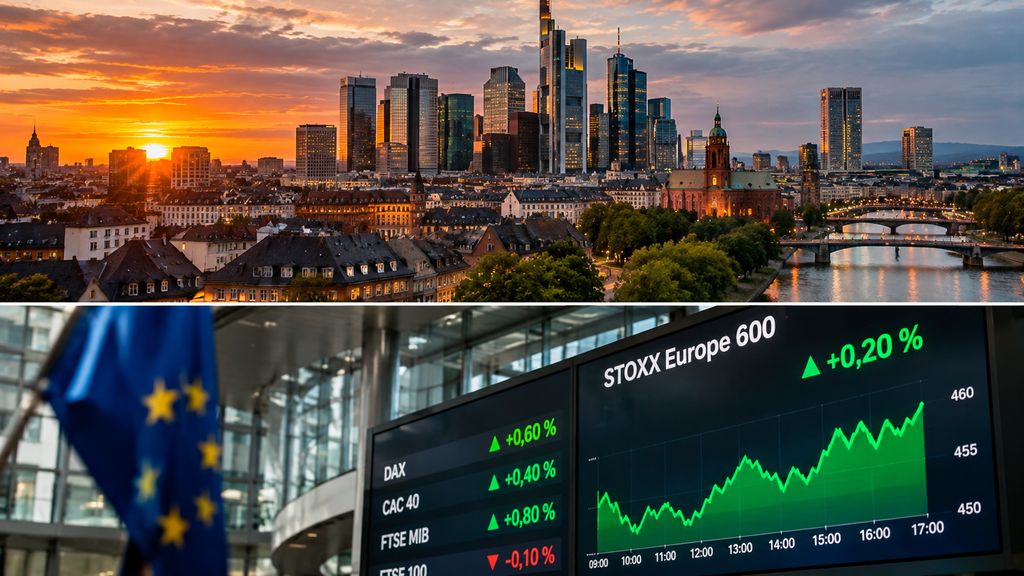
◉ The STOXX Europe 600 rose 0.2% at the open, while Germany’s DAX gained 0.6%, France’s CAC 40 advanced 0.4% and Italy’s FTSE MIB climbed 0.8%.
◉ Semiconductor shares led the recovery: Infineon advanced 3.1%, STMicroelectronics gained 4% and ASML rose approximately 3% in early trading.
◉ The benchmark index in London declined 0.1%, weighed down by utilities, while Investec fell 7.3% following its earnings update.
1. European markets attempt to recover
European equities began Thursday’s session on a firmer footing, following a difficult trading day in which concerns about technology valuations, commodity prices and global economic conditions pushed major indices lower.
The early rebound was relatively broad across continental Europe, with Germany, France and Italy recording positive opening movements.
At approximately 08:22 GMT (09:22 CET), the STOXX Europe 600 was up 0.2%. Germany’s DAX advanced 0.6%, while France’s CAC 40 gained 0.4%. Italy’s FTSE MIB was the strongest among the major regional benchmarks, rising 0.8%.
The FTSE 100 moved in the opposite direction, edging 0.1% lower as weakness in utility shares offset gains elsewhere.
European indices – opening observations, 19 November 2026
| Index | Opening move |
|---|---|
| STOXX Europe 600 | +0.2% |
| DAX 40 | +0.6% |
| CAC 40 | +0.4% |
| FTSE MIB | +0.8% |
| FTSE 100 | -0.1% |
Source: The Wall Street Journal, approximately 09:22 CET. These are opening observations, not closing returns or current live quotes.
2. Semiconductor stocks lead the rebound
Technology shares were the main source of support for European markets.
The improved sentiment followed Nvidia’s latest quarterly results, which exceeded analyst expectations and included a stronger-than-anticipated revenue outlook.
The results helped revive demand for companies supplying the semiconductor and artificial-intelligence infrastructure industries.
Among the strongest early performers were:
| Company | Reported opening move |
|---|---|
| STMicroelectronics | +4.0% |
| Infineon | +3.1% |
| ASML | +3.0% |
| Siemens Energy | +2.9% |
| Schneider Electric | +1.4% |
STMicroelectronics led the listed semiconductor performers, supported by renewed interest in the European chip sector.
Infineon also advanced, reflecting improved sentiment towards companies supplying semiconductor components and power-management technologies.
ASML, one of Europe’s most important semiconductor equipment manufacturers, gained approximately 3% in Amsterdam trading.
The strength of these companies is particularly relevant because their performance is closely connected to expectations for global semiconductor investment, data-centre expansion and AI-related capital expenditure.
3. Nvidia results improve technology sentiment
Nvidia remains a central reference point for the global technology sector.
Its latest quarterly report delivered stronger-than-expected results and an optimistic revenue outlook, reinforcing expectations that demand for AI computing infrastructure remains substantial.
For European markets, the implications extend beyond Nvidia itself.
Companies such as ASML, Infineon and STMicroelectronics participate in different parts of the semiconductor supply chain. Their performance is influenced by global investment in chip manufacturing, equipment, advanced computing and industrial electronics.
However, the market reaction should not be interpreted as confirmation that concerns about AI valuations have disappeared.
Investors continue to assess whether the enormous capital expenditure commitments made by major technology companies can generate sufficient revenue and long-term returns.
This explains why semiconductor shares can recover even while other parts of the technology market remain under pressure.
The latest session therefore represents an improvement in sentiment, rather than a definitive resolution of the broader AI investment debate.
4. Siemens Energy benefits from renewed industrial demand
Siemens Energy was another notable performer, gaining approximately 2.9% at the open.
The company is positioned within several important infrastructure themes, including power generation, grid technology and electricity systems.
The expansion of artificial-intelligence data centres is increasing attention on electricity demand and the infrastructure required to support it.
Data centres require reliable power supplies, grid connections and substantial energy-management capacity. This creates potential business opportunities for companies involved in the development and modernisation of electricity infrastructure.
The early share-price increase reflects renewed interest in this investment theme, although the company’s longer-term performance will also depend on order execution, profitability and the wider energy market.
5. London remains weaker as Investec falls
The UK’s FTSE 100 was the main exception to the positive European opening.
The index slipped approximately 0.1%, partly due to weakness in utility stocks.
Investec was among the most significant individual decliners, falling 7.3% following its earnings update.
The move highlights the importance of company-specific developments even during a broader market recovery.
While semiconductor and AI-related shares benefited from improving sentiment, financial companies and utilities faced separate earnings and sector-specific pressures.
The difference between the FTSE 100 and continental European benchmarks also reflects their different sector compositions.
London’s index has considerable exposure to financial institutions, energy companies, mining businesses and utilities, while Germany’s and France’s leading indices have different industrial and technology exposures.
6. Wednesday’s sell-off remains important
Thursday’s recovery follows a difficult session for European equities.
On Wednesday, 18 November, the STOXX Europe 600 ended approximately 1.03% lower at 644.05 points, recording its third consecutive daily decline and its lowest close since 6 November.
Mining shares were among the weakest performers, falling 4.7% as copper prices declined to a seven-month low.
Glencore and Aurubis both lost more than 5%, while oil-related shares also weakened.
The previous session demonstrated that strong technology earnings alone were not sufficient to support the entire European market.
The contrast between Wednesday’s commodity-led selling and Thursday’s semiconductor-led recovery illustrates how sector rotation can influence regional index performance.
Investors are responding to several different forces simultaneously: AI investment expectations, commodity prices, interest-rate uncertainty and company-specific earnings.
7. What investors will watch next
The sustainability of Thursday’s recovery will depend on whether early technology gains spread into other market sectors.
Three developments deserve particular attention.
Semiconductor momentum: Continued strength in ASML, Infineon and STMicroelectronics could support the wider European technology sector. A reversal would suggest that investors remain cautious despite Nvidia’s results.
Commodity prices: Mining shares remain sensitive to movements in copper and other industrial metals. A stabilisation in commodity markets could help reduce pressure on the STOXX Europe 600 and FTSE 100.
Interest-rate expectations: Inflation developments and central-bank policy remain important for European equities. Changes in bond yields can affect company valuations, financing costs and investor demand for risk assets.
A selective recovery, not yet a market-wide reversal
European markets have started Thursday with improved sentiment, led by semiconductor manufacturers and companies connected to AI infrastructure.
The early gains in Germany, France and Italy contrast with London’s weaker opening, demonstrating that the recovery is not uniform across the region.
Nvidia’s results have provided an important catalyst for technology shares, but investors continue to assess the sustainability of AI investment and the broader economic environment.
The next sessions will show whether the semiconductor rebound can develop into a more durable recovery across European equities or remains a short-term response to improved technology sentiment.
Sources
- The Wall Street Journal – European Stock Indexes Rise as Tech Sentiment Improves, 19 November 2026
- Reuters – European Stocks Hit Two-Week Low on Weak Miners, Caution Ahead of Anthropic IPO, 18 November 2026
- Reuters – European Shares Muted as Tech Offsets Mining Weakness, 18 November 2026
- Nvidia – Investor Relations
- Editorial Disclosure & Transparency