Summary: SpaceX is entering a new phase of competition for NASA’s lunar infrastructure programme, which carries a maximum contract value of $10 billion over ten years. Beyond transporting equipment to the Moon, Elon Musk’s ambitions include lunar manufacturing, AI computing satellites and a potential commercial economy beyond Earth.
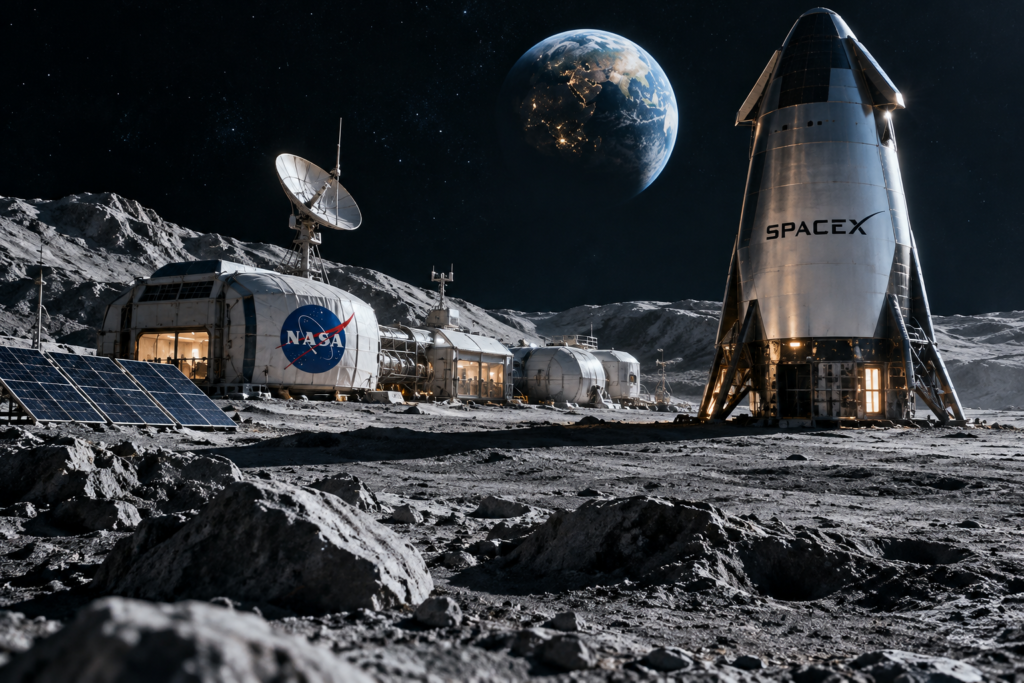
◉ Organisation NASA has selected SpaceX among eight companies eligible to compete for lunar delivery contracts under a 10-year framework worth up to $10 billion.
◉ The $10 billion represents a maximum contract ceiling, not money already awarded to SpaceX or a guaranteed programme expenditure.
◉ This week SpaceX has separately been selected to launch lunar communications satellites aboard Starship in 2028.
◉ The company’s longer-term vision includes lunar factories producing AI computing satellites using locally sourced materials.
◉ The emerging lunar economy could connect government procurement, commercial space transportation, energy infrastructure, advanced computing and resource extraction.
A $10 Billion Opportunity Beyond Earth
The global space industry is entering a new investment phase as NASA accelerates its plans to establish a sustained human presence on the Moon.
The latest development is a new 10-year Commercial Lunar Payload Services framework, known as CLPS 2, with a maximum combined value of $10 billion.
Announced on November 7, the programme allows eight commercial companies to compete for future contracts to transport scientific equipment, technology and infrastructure to the lunar surface.
SpaceX is among the selected companies, alongside Blue Origin, Firefly Aerospace, Intuitive Machines, ispace-U.S., Lockheed Martin, Northrop Grumman and Voyager Technologies.
The distinction is important: NASA has not awarded SpaceX $10 billion. The amount represents the maximum value of the overall contract framework, with individual missions and payments to be determined through future competitions.
Nevertheless, the programme creates a substantial commercial opportunity for companies capable of developing reliable lunar transportation systems.
For the private space industry, the strategic importance extends well beyond individual launch contracts.
NASA is effectively helping establish the first commercial supply chain for a future lunar economy.
SpaceX Wants More Than Lunar Transportation
For Elon Musk’s SpaceX, the Moon represents a potential industrial destination rather than simply another exploration milestone.
The company’s published investment documentation outlines ambitions to develop a commercial lunar economy built around transportation, resource utilisation and manufacturing.
One of the most ambitious elements involves establishing factories on the lunar surface to manufacture large-scale artificial intelligence computing satellites.
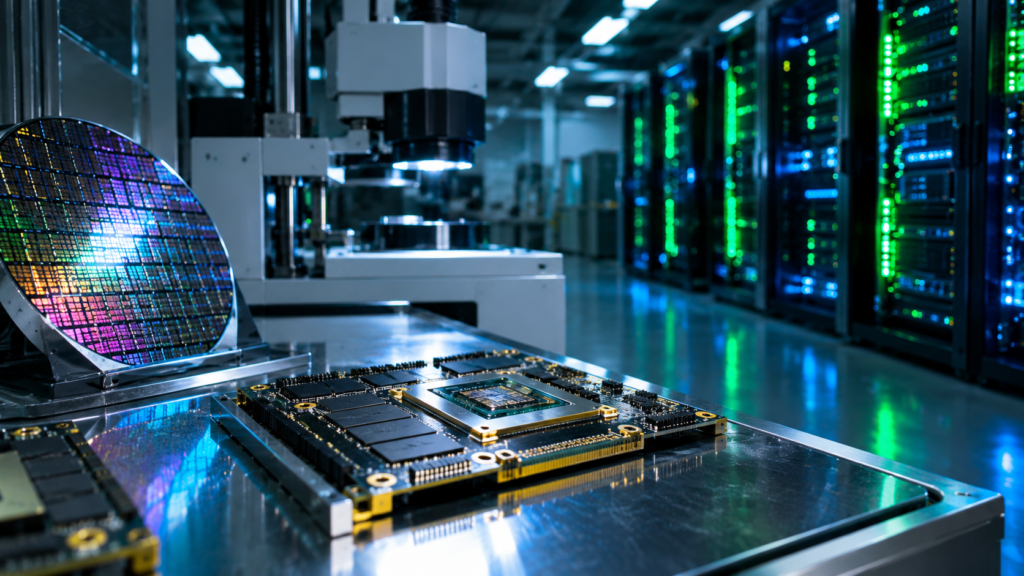
The proposed model would use materials extracted from the Moon to manufacture much of the physical structure of satellites, while advanced semiconductor chips and other components would still be transported from Earth.
The company argues that the Moon’s lower gravity could make it possible to launch manufactured satellites into space with significantly lower energy requirements than conventional Earth-based launches.
SpaceX has also described a potential lunar mass driver: an electromagnetic launch system designed to accelerate cargo and satellites into space without relying entirely on conventional rockets.
These remain long-term ambitions rather than operational technologies. Their commercial viability depends on major advances in lunar mining, energy generation, manufacturing and transportation.
However, their inclusion in the company’s published strategy signals how SpaceX views the next stage of its business.
The objective is potentially to transform lunar exploration into an industrial ecosystem.
Starship Becomes a Critical Asset
The development of this strategy depends heavily on Starship.
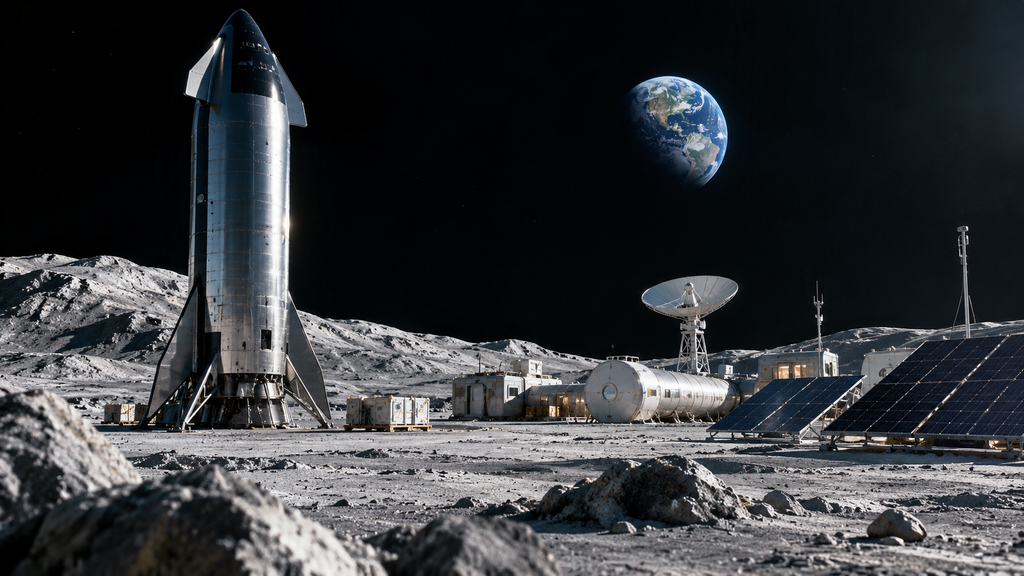
SpaceX is developing the fully reusable launch and transportation system to carry substantial quantities of cargo and eventually crew between Earth and the Moon.
Its economics are central to the wider commercial opportunity.
Traditional space missions have been constrained by high launch costs, limited payload capacity and the complexity of delivering equipment beyond Earth orbit.
A reusable transportation system capable of moving significantly larger payloads could change the economics of lunar construction.
NASA has already selected SpaceX for a separate lunar communications demonstration. Under the programme, Starship is scheduled to launch communications satellites into cislunar space in 2028.
The demonstration is intended to help develop the communications infrastructure needed to connect astronauts, mission controllers and future lunar facilities.
This is a separate commitment from the competitive CLPS 2 framework.
It demonstrates that SpaceX is already involved in specific elements of NASA’s lunar infrastructure programme, rather than relying exclusively on potential future cargo contracts.
AI Infrastructure Moves Into Space
The connection between lunar manufacturing and artificial intelligence is particularly significant.
The rapid expansion of AI computing has created enormous demand for electricity, advanced semiconductors, cooling systems and data-centre infrastructure.
Technology companies are investing billions in computing capacity, while electricity availability and the physical limitations of terrestrial infrastructure are becoming increasingly important considerations.
SpaceX’s longer-term concept attempts to address part of this challenge by moving some computing infrastructure beyond Earth.
Its vision involves manufacturing large satellite structures on the Moon, using lunar resources and deploying AI computing satellites into orbit.
Such systems could potentially use solar energy and operate as part of a distributed computing network.
However, major technical obstacles remain.
Space-based computing must overcome radiation exposure, thermal management, maintenance limitations, communications latency and the difficulty of replacing damaged equipment.
Solar power availability, transmission capacity and the economics of moving advanced processors into space also remain unresolved challenges.
The concept is therefore better understood as a long-term industrial ambition than an immediate alternative to conventional data centres.
Nevertheless, it illustrates how the AI infrastructure race is beginning to influence investment decisions in the space industry.
NASA Builds the Infrastructure First
NASA’s lunar strategy is not limited to transportation.
The agency is working towards a permanent outpost near the Moon’s South Pole, where access to sunlight and potentially valuable water ice could support longer-term operations.
Its programme includes several infrastructure priorities:
- Power generation: Solar systems, batteries and wireless energy-transfer technology.
- Communications: Satellite networks connecting lunar operations with Earth.
- Transportation: Commercial landers and orbital transfer vehicles.
- Robotics: Autonomous exploration systems and resource-mapping equipment.
- Resource utilisation: Research into water ice and other materials that could support future operations.
One notable development is NASA’s PROMISE nuclear-powered rover, which is scheduled for a targeted launch in late 2028.
Blue Origin received a $94 million base contract, with an additional $140 million option, to deliver the rover to the lunar South Pole.
The mission is intended to investigate the lunar surface and subsurface, including the potential availability of water ice.
These projects demonstrate that establishing a sustainable lunar presence requires an interconnected industrial system rather than a single successful landing.
SpaceX Versus Blue Origin
The expanding lunar programme is also intensifying competition between two of the most influential privately owned American space companies.
SpaceX has established a strong position in commercial orbital transportation through its Falcon launch systems and is developing Starship for larger-scale lunar and interplanetary operations.
Blue Origin is developing its New Glenn rocket and Blue Moon lunar lander, positioning itself as another major supplier of lunar infrastructure.
Both companies are involved in NASA’s broader ambitions, although their roles differ across individual programmes.
The competition is important because NASA increasingly relies on commercial partners rather than developing every component of its exploration infrastructure internally.
This creates opportunities for private companies to develop technologies that may eventually serve commercial customers beyond government-funded missions.
For investors, the emerging market extends to launch services, robotics, energy systems, communications, advanced materials and semiconductor manufacturing.
The Financial Opportunity Beyond Government Contracts
The $10 billion CLPS 2 framework is only one component of a much larger potential market.
The development of a lunar economy could require decades of investment in transportation, power generation, communications, robotics and industrial manufacturing.
Government contracts can provide initial demand and reduce commercial development risks.
Private-sector investment could then expand the infrastructure beyond NASA’s immediate requirements.
This is where the financial implications become particularly interesting.
Companies developing lunar transportation systems could eventually serve commercial satellite manufacturers, research organisations and resource-extraction businesses.
Energy providers could develop specialised power systems for extreme environments.
Technology companies could supply radiation-resistant computing equipment, autonomous robotics and advanced communication networks.
The opportunity is therefore not limited to the companies building rockets.
It potentially creates a new industrial supply chain involving multiple sectors of the global economy.
However, the commercial market remains largely unproven. Revenue opportunities, construction costs, resource availability and the timeline for private investment returns remain uncertain.
What Investors Can Watch
Several developments will determine whether the lunar economy becomes a commercially sustainable industry.
Starship development: Reusability, launch reliability and the ability to refuel in orbit will determine the economics of transporting equipment to the Moon.
NASA procurement: Future CLPS 2 mission awards will reveal which companies can translate eligibility into actual contracts and revenue.
Lunar infrastructure: Power generation, communications and autonomous systems must become operational before large-scale industrial activity becomes possible.
AI satellite economics: The cost of manufacturing, deploying and operating computing systems in space must be competitive with terrestrial alternatives.
Private-sector investment: The willingness of investors to finance infrastructure before the market generates substantial commercial revenue will be a major factor.
The Next Billion-Dollar Race Is Beyond Earth
The latest NASA programme signals a significant shift in the economics of space exploration.
The Moon is increasingly being viewed as a potential location for long-term infrastructure, manufacturing and commercial activity rather than simply a destination for scientific missions.
SpaceX’s participation in NASA’s lunar programme provides access to a developing market, while its broader ambitions connect space transportation with artificial intelligence, satellite manufacturing and resource utilisation.
The $10 billion contract framework is not a guaranteed investment in SpaceX, nor does it mean that a commercial lunar economy is already operational.
But it demonstrates that governments are beginning to establish the procurement structures needed to support a new generation of private space businesses.
For the investment industry, the next major technology race may not be fought exclusively on Earth.
It could increasingly take place beyond it.
Sources
- NASA – Moon Base transportation, technology and science contracts, November 7
- Fortune – SpaceX competes for NASA’s $10 billion lunar contracts, November 10
- Ars Technica – NASA accelerates its return to the Moon, November 11
- Space.com – NASA unveils $10 billion in Moon Base contracts
- SpaceX – Official investment prospectus, June 2026
- NASA – Commercial Lunar Payload Services
- Denarni Fokus – Editorial Disclosure & Transparency