Summary
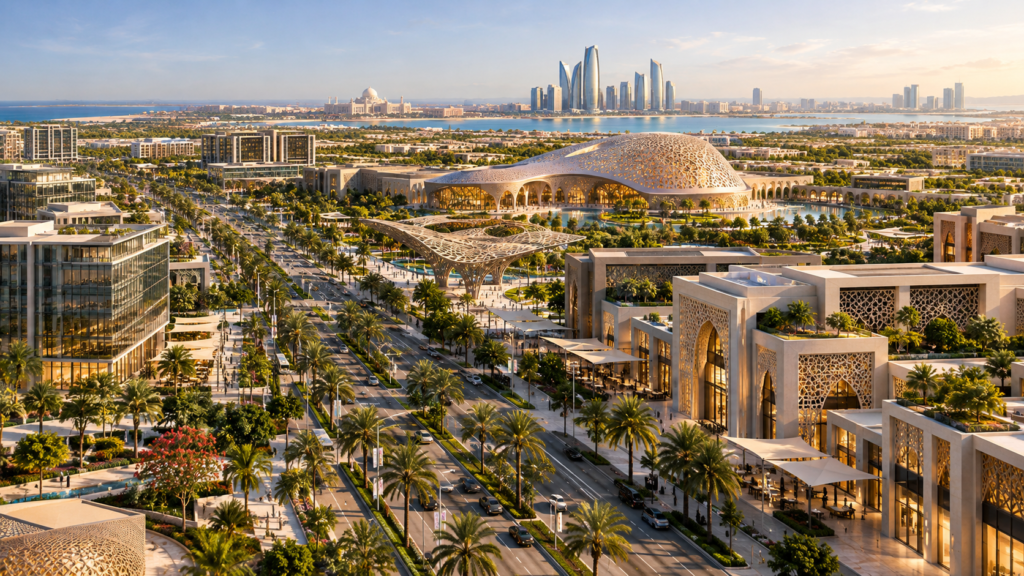
The UAE has unveiled an ambitious masterplan for a proposed futuristic city that combines Emirati cultural heritage with modern infrastructure, distinctive architecture and integrated urban services. The 20-by-18-kilometre concept reflects the Gulf’s growing ambition to position urban development as a long-term economic and real estate investment opportunity.
◉ De Sousa Holdings presented a 25-year masterplan for a proposed city of the future at the International Real Estate & Investment Show 2026 in Abu Dhabi.
◉ The proposed development would extend approximately 20 kilometres east to west and 18 kilometres north to south.
◉ Its architectural centrepiece would include an observation tower inspired by the number one and a five-star hotel designed in the shape of a traditional Arabic coffee pot.
◉ The masterplan incorporates residential and commercial infrastructure, shopping facilities, conference centres, transport networks and essential urban services.
◉ The concept highlights how cultural identity, sustainability and quality of life are becoming increasingly important elements of Gulf real estate development.
A New Vision for Urban Development
The United Arab Emirates is continuing to explore ambitious approaches to urban development, with a newly presented masterplan combining traditional Emirati architecture, modern infrastructure and long-term economic objectives.
De Sousa Holdings LLC unveiled its proposed City of the Future concept at the International Real Estate & Investment Show (IREIS 2026), held at the ADNEC Centre in Abu Dhabi.
The proposal represents the result of approximately 25 years of planning and design development. Its central idea is to create an integrated urban environment in which architecture, infrastructure, cultural identity and quality of life are treated as interconnected elements.
The concept was presented by Edgar Gerson, architect, founder and president of De Sousa Holdings.
Rather than following a conventional masterplan built around residential districts and commercial towers, the proposed development draws inspiration from Emirati heritage and traditional symbols.
Its architectural language incorporates references to the UAE’s national currency, Arabic hospitality, Bedouin culture and the country’s seven emirates.
The project reflects a broader change in the Gulf property market, where developers and planners are increasingly using distinctive architectural identities to differentiate large-scale destinations.
Architecture Inspired by Emirati Heritage
One of the most distinctive elements of the proposed city is its central architectural complex.
The observation tower would be inspired by the number one, representing the UAE dirham, and positioned on an island overlooking the Abu Dhabi Corniche.
The location would provide panoramic views across the surrounding urban landscape.
Another major architectural feature would be a five-star hotel designed in the shape of a traditional Arabic coffee pot, known as a dallah.
The structure would incorporate seven coffee cups, representing the seven emirates and symbolising national unity.
Traditional Arabic coffee hospitality has a particularly important cultural role in the UAE and wider Gulf region. Its inclusion in the architectural design demonstrates an attempt to translate cultural heritage into a modern commercial and tourism destination.
The proposal also incorporates a central complex inspired by traditional serving dishes, with two sugar bowls and a date bowl intended to accommodate conference facilities and wedding halls. A surrounding structure inspired by a serving tray would house a shopping centre.
The concept therefore extends beyond visual architecture, seeking to integrate hospitality, retail, business events and social activities into a single urban environment.
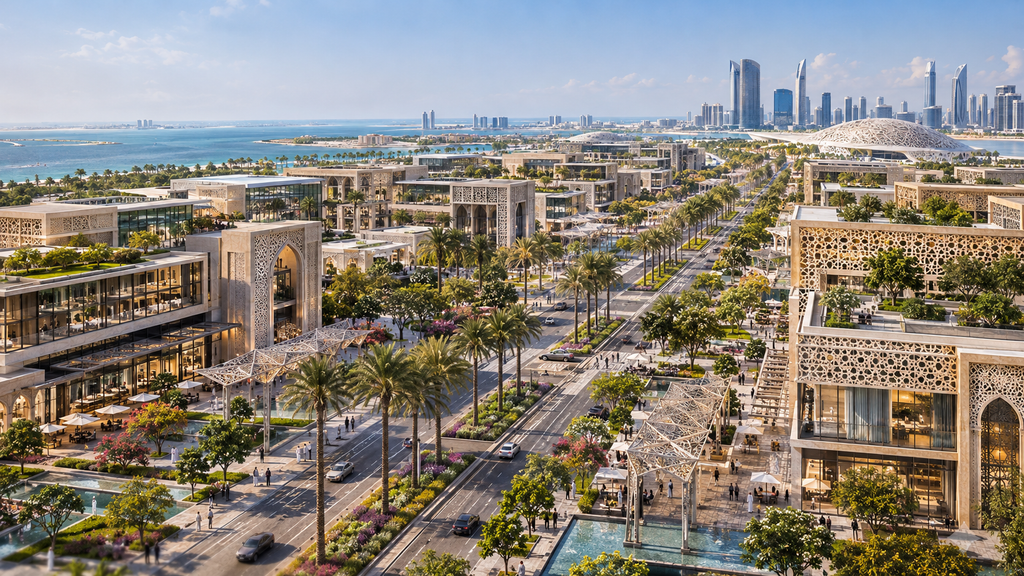
A City Designed Around Its Own Geography
The proposed development would cover approximately 20 kilometres from east to west and 18 kilometres from north to south.
One of its most unusual features is a clock-shaped masterplan.
The road network and distribution of buildings would allow residents and visitors to navigate using clock positions and building numbers rather than relying exclusively on GPS navigation.
According to the developer, the arrangement is intended to simplify movement throughout the city, improve accessibility and connect different districts with the central area.
The wider infrastructure concept includes:
- Electricity and water distribution.
- Internet and digital connectivity.
- Wastewater and sewerage systems.
- Waste management and recycling facilities.
- Integrated road networks.
- Commercial, retail and hospitality infrastructure.
The developer says that the distribution of facilities and transport connections is intended to reduce congestion, shorten journey times and limit unnecessary energy consumption.
This approach reflects a growing focus on integrated urban planning across the Gulf, where rapid population growth and increasing economic activity are creating demand for more efficient infrastructure.
The Gulf’s Expanding Urban Investment Pipeline
The announcement comes during a period of significant real estate and infrastructure activity across the UAE.
Other developments announced around the same time demonstrate that the country’s urban expansion is taking place across several emirates and different property segments.
Dubai, for example, has continued advancing major transport and community infrastructure projects, including a proposed AED 3.2 billion community development and Metro extension programme.
In Ajman, DAMAC has also announced a waterfront development valued at approximately $817 million.
These projects have different developers, locations and objectives, but collectively illustrate the scale of investment activity across the UAE property market.
The proposed City of the Future adds another dimension to this development pipeline: the creation of an integrated destination built around a distinctive cultural and architectural identity.
For the real estate sector, the commercial significance of such projects extends beyond the construction of individual buildings. Large-scale urban developments can create demand for residential property, hospitality, retail, commercial space, infrastructure services and supporting businesses.
However, the financial attractiveness of these developments ultimately depends on execution, demand, financing structures and the ability to deliver infrastructure in line with projected growth.
Sustainability and Quality of Life
An important element of the proposal is its emphasis on what the developer describes as the concept of profit from happiness.
The idea combines financial returns with residents’ quality of life, environmental considerations and the needs of future generations.
This represents an increasingly relevant theme in international real estate development.
In the Gulf, where major cities have expanded rapidly over recent decades, the next generation of urban projects faces a more complex set of requirements.
Developers must consider not only construction costs and property values, but also energy efficiency, water management, transport infrastructure, public spaces and long-term operating expenses.
The proposed city’s integrated approach seeks to address these considerations through the distribution of services and infrastructure across the wider development.
Nevertheless, the actual environmental performance of the project will depend on detailed engineering, energy sources, water consumption, construction materials and the eventual operating model.
At this stage, the announced masterplan does not provide enough technical information to establish its projected environmental footprint.
What It Could Mean for UAE Real Estate
The proposal highlights an important direction in the UAE’s property market: the increasing importance of large-scale, differentiated urban destinations.
The country’s real estate strategy has increasingly moved beyond traditional residential and commercial construction towards developments that combine multiple economic activities.
For international investors, these projects can create opportunities across several segments:
- Premium residential and branded property.
- Luxury hospitality and tourism.
- Retail and entertainment facilities.
- Commercial and conference infrastructure.
- Engineering, construction and urban technology.
- Long-term property and infrastructure management.
The proposed City of the Future could eventually become part of this broader investment landscape.
However, an important distinction must be made between an announced masterplan and an approved, financed and operational development.
The announcement does not yet establish a confirmed construction schedule, total project budget, residential capacity, property prices or expected completion date.
These details will be essential in assessing the project’s commercial viability and its potential impact on the UAE real estate market.
The Next Generation of Gulf Cities
The UAE’s proposed City of the Future illustrates how urban development is increasingly being positioned as a combination of economic infrastructure, cultural identity and international investment attraction.
Its design is particularly distinctive because traditional Emirati symbols are being translated into large-scale architectural and commercial structures.
The wider significance, however, lies in the underlying concept: creating a destination where residential, commercial, cultural and hospitality activities operate within one integrated urban framework.
For the UAE, this approach supports a broader ambition to remain an attractive destination for international businesses, investors, residents and visitors.
Whether the proposed city ultimately advances into construction will depend on the next stages of planning, approvals, financing and project execution.
For now, it represents an ambitious addition to the country’s evolving urban development vision and another indication of how the Gulf is redefining the relationship between real estate, architecture and long-term economic growth.
Sources
- Emirates News Agency (WAM) – De Sousa Holdings unveils City of the Future
- ZAWYA – UAE’s proposed city of the future blends heritage with urban design
- TradeArabia – Dirham-inspired tower anchors proposed UAE future city
- ZAWYA – UAE real estate and infrastructure developments
- UAE Ministry of Culture – Modern Architectural Heritage Initiative
- Editorial Disclosure & Transparency