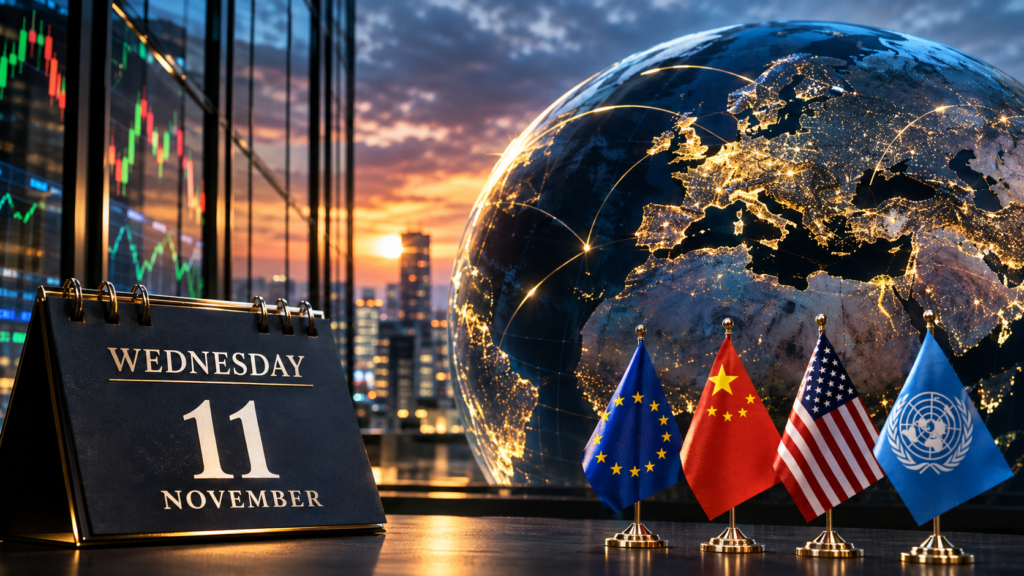
Six major international developments put energy security, geopolitical risk, European policy, Chinese consumer spending and artificial intelligence in focus on Wednesday. Meanwhile, stronger US inflation and rising bond yields continue to influence global investment sentiment.
◉ COP31 brings energy transition, electricity infrastructure and fossil-fuel security into the global investment debate.
◉ China’s Singles’ Day tests consumer demand while AI-powered shopping creates new opportunities for e-commerce companies.
◉ US inflation and Federal Reserve expectations remain the most immediate macroeconomic drivers for bonds, currencies, equities and gold.
Last 24 hours Coverage
Global Markets Face a Political and Economic Test
Wednesday’s international calendar brings together several developments with implications for global financial markets. Climate negotiations, security discussions, European legislative priorities and major technology events are taking place against a backdrop of renewed concerns about inflation and monetary policy.
The events are different in nature, but their economic connections are becoming increasingly clear.
Energy security is influencing government investment decisions. Geopolitical tensions are supporting discussions around defence spending. Artificial intelligence is changing the competitive landscape of technology companies, while China’s shopping festival provides another indication of the strength of domestic consumption.
At the same time, the latest US inflation figures have introduced fresh uncertainty into interest-rate expectations.
For investors, the important question is whether Wednesday’s developments generate new information that could influence capital allocation, economic growth expectations or corporate valuations.
1. COP31 – Energy Security in Focus
Priority 1 ANTALYA, TÜRKİYE | 9–20 NOVEMBER
The COP31 climate conference enters an important phase on Wednesday as world leaders address the challenges surrounding global climate policy, energy security and the transition towards lower-emission economies.
UN Secretary-General António Guterres has warned that climate change is progressing faster than the international response. Nearly 200 countries are involved in negotiations aimed at expanding electricity use and advancing the transition away from fossil fuels.
Türkiye is promoting a target to increase electricity’s share of global energy consumption to 35% by 2035. However, the proposal does not establish a specific clean-energy requirement or a comprehensive fossil-fuel phaseout.
This distinction is important for financial markets.
Electricity demand is becoming a central consideration in the development of artificial intelligence, data centres, industrial production and transportation. At the same time, governments remain concerned about energy affordability, supply reliability and dependence on imported fuels.
The economic implications extend across several industries:
- Oil and gas: Energy security, supply diversification and long-term demand expectations.
- Industrial metals: Copper and aluminium demand linked to electricity networks and infrastructure.
- Renewable energy: Solar, wind and energy-storage investment.
- Utilities: Grid expansion, electricity generation and distribution.
- Infrastructure: Long-term capital expenditure on energy systems.
The central investment question is whether international climate commitments translate into actual financing, infrastructure projects and measurable changes in energy policy.
The distinction between political declarations and commercially funded projects will remain important.
2. CSTO – Russia and Regional Security
Priority 2 MOSCOW, RUSSIA
The Collective Security Treaty Organization (CSTO) is another important geopolitical development in this week’s calendar.
The organisation’s annual ministerial and security discussions in Moscow took place on 10 November, making this a development to assess through its political consequences rather than treating it as a new Wednesday summit.
Russia’s role in the organisation and its relationships with other member states remain relevant to the wider security environment across Eurasia.
For financial markets, the main connections involve geopolitical risk, regional stability, military expenditure and energy security.
The sectors potentially affected include:
- Gold and precious metals.
- Oil and natural gas.
- European defence and aerospace.
- Military technology and cybersecurity.
- Emerging-market currencies.
The market impact will depend on whether the discussions produce concrete changes in regional security arrangements, military cooperation or geopolitical expectations.
For European investors, developments involving Russia and its regional partners remain relevant to the broader assessment of defence requirements and strategic energy exposure.
3. European Parliament – Regulation and Competitiveness
BRUSSELS, BELGIUM | 11–12 NOVEMBER
The European Parliament’s November plenary session begins on Wednesday, bringing several regulatory and economic issues back into focus.
The European Union continues to face the challenge of strengthening competitiveness while addressing security, industrial development and the changing requirements of its financial system.
One important area for the financial sector is the development of the EU’s retail investment framework and rules governing investment products.
Changes to investor information requirements, product distribution and consumer protection can influence how financial institutions structure and market their products across European markets.
The broader European policy environment is also relevant to industrial competitiveness, defence investment, digital infrastructure and economic security.
The main sectors to monitor include:
- European banks and financial institutions.
- Asset management and investment platforms.
- Insurance companies.
- Defence and aerospace.
- Technology and cybersecurity.
For the euro and European equities, the immediate effect of parliamentary discussions may be limited. However, regulatory decisions can influence operating costs, investment activity and business models over longer periods.
Investors should distinguish between parliamentary debate, adopted legislation and measures that have actually entered into force.
4. Paris Peace Forum – Geopolitical Cooperation
PARIS, FRANCE | 11–12 NOVEMBER
The Paris Peace Forum brings together international political representatives, institutions, businesses and civil-society organisations to discuss global cooperation.
This year’s discussions take place in an environment shaped by geopolitical fragmentation, international security concerns and competition over strategic technologies.
For financial markets, diplomatic events rarely produce an immediate repricing unless they result in concrete agreements or changes in government policy.
Nevertheless, international cooperation remains relevant to several investment areas.
Defence expenditure, cybersecurity, critical infrastructure and international supply chains are increasingly connected to national security priorities.
The discussions are therefore worth following for signals about future cooperation and the direction of international policy.
The sectors most relevant to investors include defence, aerospace, cybersecurity, digital infrastructure and strategic technology.
5. Singles’ Day – China’s Consumer Economy Faces a Test
Priority 5 CHINA | 11.11 SHOPPING FESTIVAL
China’s Singles’ Day provides one of the most closely watched commercial indicators of the country’s consumer economy.
What originally started as a one-day shopping event has evolved into an extended promotional period involving major e-commerce platforms, retailers, logistics companies and technology providers.
However, the latest available figures suggest that the growth story is more complicated than the headline scale of the event might indicate.
According to third-party data provider Syntun, sales during the October 7–31 promotional period increased by 2.4% year-on-year. The full campaign figures are expected on Thursday.
This comes against a backdrop of relatively subdued domestic consumption.
China’s retail sales increased by 1.1% during the first nine months of 2026, highlighting the challenge facing policymakers as they attempt to strengthen household spending.
Artificial intelligence is becoming a second major theme of Singles’ Day.
Chinese e-commerce platforms are increasingly integrating AI into product discovery, shopping recommendations, virtual try-ons and purchasing processes.
JD.com’s AI shopping assistant reportedly attracted nearly 80 million users during this year’s campaign, more than three times the previous year’s figure.
Alibaba has also reported significant growth in AI-related product activity, including AI tokens and AI-enabled devices.
This development creates two important commercial questions.
First, can AI improve the shopping experience sufficiently to increase conversion rates and customer engagement?
Second, can these tools improve profitability for e-commerce platforms operating in a highly competitive market?
Companies worth monitoring include Alibaba, JD.com and PDD Holdings, alongside China’s logistics, payment and consumer technology sectors.
The final sales figures will be important because they can help investors distinguish between promotional activity and genuine improvements in consumer demand.
6. Web Summit – AI and Technology Investment
LISBON, PORTUGAL | 9–12 NOVEMBER
Web Summit continues in Lisbon, bringing together technology companies, investors, startups and industry leaders.
Wednesday’s programme includes discussions on artificial intelligence, the future of work, European economic development and the relationship between technology and society.
One particularly relevant session is Maintaining the Human in an AI World, scheduled for 12:10 local time, featuring representatives from Reddit and Fast Company.
The broader importance of the event is the transition of artificial intelligence from technological experimentation towards commercial implementation.
Over recent months, the investment narrative has increasingly focused on the infrastructure required to support AI adoption.
Semiconductor manufacturing, data centres, cloud computing and high-performance networking remain essential parts of this ecosystem.
However, attention is gradually expanding towards the companies that can turn these investments into recurring revenue and measurable productivity improvements.
The main sectors to monitor include:
- Semiconductor manufacturers.
- Cloud and data-centre operators.
- Enterprise software.
- AI infrastructure.
- Robotics and automation.
- Cybersecurity.
For Nasdaq-listed companies, the broader question remains whether the substantial capital expenditure associated with AI can generate sufficient long-term returns.
Technology conferences can provide insight into emerging applications and commercial partnerships, but announcements alone do not establish future profitability.
The Macro Factor – US Inflation Changes the Market Equation
Beyond the six scheduled developments, the strongest immediate financial-market signal comes from the United States.
October’s US core consumer inflation increased by 0.3% month-on-month, above the 0.2% market expectation.
The data, combined with more hawkish comments from Federal Reserve officials, has increased expectations of further monetary tightening.
Federal Reserve Governor Christopher Waller has indicated support for at least a 25-basis-point increase in December, while the possibility of a larger move has also entered market discussions.
The reaction has been visible across global financial markets.
US Treasury yields have moved higher, the dollar has strengthened and gold has experienced selling pressure as investors reassess the interest-rate outlook.
This is particularly important for technology and growth stocks, where higher discount rates can put pressure on valuations.
For precious metals, higher yields and a stronger dollar can increase the opportunity cost of holding non-yielding assets.
The key markets to monitor are:
- US dollar: Further changes in interest-rate expectations.
- Gold: Real yields, dollar strength and geopolitical risk.
- US Treasuries: The market’s assessment of future Federal Reserve policy.
- Nasdaq: Sensitivity of technology valuations to financing conditions.
- Oil: Geopolitical developments and global demand expectations.
The next important US economic releases will provide additional information about inflation, employment and the direction of monetary policy.
Wednesday’s market environment also requires attention to trading liquidity because US cash Treasury markets are closed for Veterans Day, even though US equity markets remain open.
What Matters Most for Markets Today?
Wednesday’s calendar reflects several of the most important forces currently shaping the global investment environment.
COP31 highlights the relationship between energy transition and energy security. The CSTO discussions keep regional geopolitical risks in focus, while the European Parliament and Paris Peace Forum provide insight into the direction of regulation and international cooperation.
In China, Singles’ Day offers a practical assessment of consumer activity and the commercial adoption of AI. In Lisbon, Web Summit brings together companies and investors exploring the next stage of technological development.
However, the most immediate financial-market driver remains the US inflation outlook.
Higher interest rates can influence equity valuations, currency movements, commodity prices and the cost of capital across the global economy.
The connection between these developments is increasingly important: AI requires energy, energy requires infrastructure, geopolitical uncertainty influences government spending, and monetary policy determines the financial conditions under which these investments are made.
Wednesday’s key market question is whether political decisions, consumer activity and technological developments can provide a new direction for global capital allocation while inflation continues to challenge expectations for monetary easing.
Sources
GLOBAL NEWS & OFFICIAL SOURCES | 11 NOVEMBER 2026
- Reuters – COP31 and global climate negotiations · Reuters+1
- Reuters – CSTO meeting in Moscow · reutersconnect.com
- European Union – Official events calendar · European Union
- International – Paris Peace Forum agenda · NN24
- Reuters – China’s Singles’ Day and AI shopping · Reuters+1
- Web Summit – Official 2026 programme · November 9-12, 2026
- Reuters – Inflation, bonds and global markets · Investing.com Australia+1
- Denarni Fokus – Editorial Disclosure & Transparency