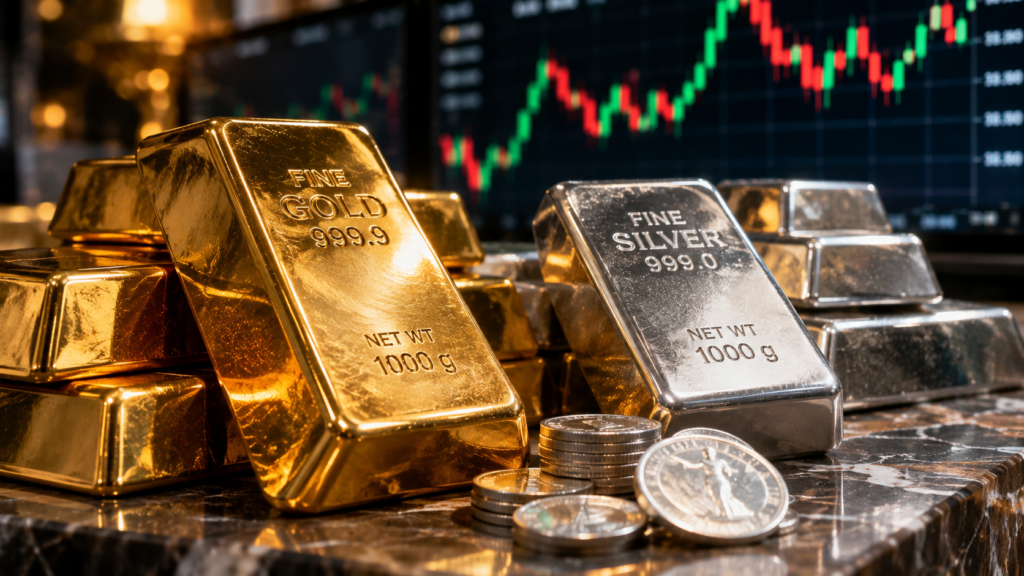
Summary: Gold and silver attempted a modest rebound on Thursday after a sharp sell-off pushed both metals lower. Gold recovered to $3,733.76 per ounce after touching a 14-month low, while silver remained under heavier selling pressure. Hawkish Federal Reserve signals, a stronger US dollar and rising interest-rate expectations continue to challenge precious metals.
◉ Gold recovered 0.3% to $3,733.76 per ounce by 06:30 GMT, after falling to $3,693.13, its lowest level since September 2025.
◉ Silver remained more vulnerable, with the supplied market reference at $45.29 per ounce following a decline of approximately 4.8% in Wednesday’s session.
◉ Markets were pricing in approximately a 90% probability of a 25-basis-point Federal Reserve rate increase in December, increasing the opportunity cost of holding non-yielding precious metals.
Gold rebounds from a 14-month low
Gold attempted to stabilise on Thursday after one of its sharpest declines in recent months.
Spot gold recovered approximately 0.3% to $3,733.76 per ounce by 06:30 GMT, following an earlier decline to $3,693.13. The low marked the weakest level since September 2025.
December US gold futures were trading at approximately $3,737.20 per ounce, down 0.1% at the reported observation.
The rebound followed substantial selling pressure during Wednesday’s session, when gold lost ground as investors reassessed the Federal Reserve’s interest-rate outlook.
The recovery was relatively modest. Market analysts attributed the move primarily to profit-taking by investors who had benefited from the preceding decline, rather than a meaningful improvement in the underlying market fundamentals.
This distinction matters because a short-term price recovery does not necessarily indicate that selling pressure has ended.

Why gold remains under pressure
Three factors are influencing the current gold market.
1. A stronger US dollar
Gold is priced internationally in US dollars. When the dollar strengthens, bullion becomes more expensive for buyers using other currencies, potentially reducing international demand.
The dollar’s recent strength has therefore added another headwind for gold.
2. Higher Treasury yields
Gold does not generate interest income. When government bond yields rise, investors may find interest-bearing assets relatively more attractive.
Higher yields can therefore increase the opportunity cost of holding bullion, particularly when investors expect monetary policy to become more restrictive.
3. Expectations of further Federal Reserve tightening
Minutes from the Federal Reserve’s 27–28 October meeting indicated that officials were increasingly concerned about persistent inflation.
Several policymakers considered further monetary tightening necessary, while some discussed the possibility of a larger increase if inflation remained elevated.
Following the release, markets priced in approximately a 90% probability of a 25-basis-point rate increase in December, according to the Reuters market observation supplied for this report.
The prospect of higher interest rates has become a significant source of uncertainty for precious metals.
The $3,800 level becomes an important reference
Gold’s inability to hold above $3,800 has added to the negative technical picture.
The level had been an important reference point during the previous trading period. Its loss may encourage additional selling if investors continue to reduce exposure.
Market participants will monitor whether gold can reclaim $3,800 and sustain trading above it.
A recovery above this level could indicate that buyers are returning with greater conviction. Continued weakness below it, however, would leave the market vulnerable to further declines.
The earlier low of $3,693.13 is another important reference. A renewed test of that level would indicate that the latest rebound has failed to establish a stronger recovery.
These levels are market reference points, not guaranteed support or resistance.
Silver suffers a deeper correction
Silver has experienced a more pronounced decline than gold.
The supplied daily briefing reference placed silver at $45.29 per ounce, following a decline of approximately 4.8% during Wednesday’s session.
Reuters subsequently reported an early Thursday rebound of approximately 0.8%, while other market observations showed silver trading around the $45-per-ounce area.
The different figures reflect separate observation times and should not be treated as one simultaneous live quotation.
Silver’s greater volatility reflects its dual role as both a precious metal and an industrial commodity.
Unlike gold, silver has substantial industrial applications in electronics, solar technology, electrical components and other manufacturing processes. Its price can therefore respond to both investment demand and expectations for industrial activity.
When financial-market sentiment deteriorates, silver can experience stronger selling pressure than gold because both investment positioning and industrial-demand expectations may weaken simultaneously.
Gold and silver respond differently to market stress
The current correction highlights an important difference between the two metals.
Gold is primarily influenced by monetary conditions, currency movements, real interest rates and demand for defensive assets.
Silver is also affected by these factors, but its industrial exposure adds another layer of sensitivity.
This can produce different performance during periods of financial-market stress.
When investors become concerned about economic growth, gold may receive support from defensive demand. Silver, meanwhile, can face additional pressure if markets anticipate weaker industrial consumption.
The recent decline in silver relative to gold illustrates this difference.
However, the relationship is not fixed. During periods of strong industrial expansion or improving risk sentiment, silver can outperform gold.
What the Federal Reserve means for precious metals
The Federal Reserve’s policy direction is likely to remain the dominant macroeconomic influence on gold and silver in the near term.
If inflation remains persistent and policymakers continue signalling further rate increases, the dollar and Treasury yields could remain supportive of a more restrictive financial environment.
That would create a challenging backdrop for non-yielding precious metals.
Conversely, weaker economic data or signs that inflation is moderating could reduce expectations for further tightening. Such a shift could ease pressure on bullion through lower bond yields or a weaker dollar.
The key variable is therefore not simply whether the Federal Reserve raises rates in December, but how investors interpret the broader path of monetary policy into 2027.
What investors will watch next
Several developments could determine whether the current decline stabilises or continues.
Gold above $3,800: A sustained recovery above this level would improve the short-term technical picture.
The $3,693 low: A renewed move towards or below the recent low would signal that selling pressure remains dominant.
Silver around $45: The ability to stabilise around this area will help indicate whether the metal is finding short-term demand after its sharper decline.
US dollar and Treasury yields: Continued strength in the dollar and bond yields could limit recovery attempts across precious metals.
Federal Reserve commentary: Statements from policymakers and incoming inflation data will influence expectations for the December meeting and the policy outlook for 2027.
A technical rebound, not a confirmed recovery
Thursday’s early movement offers some relief for gold and silver after a substantial sell-off, but the wider market environment remains challenging.
Gold’s recovery from a 14-month low has so far been limited, while silver remains more exposed to volatility because of its additional industrial-demand sensitivity.
The combination of a stronger US dollar, higher interest-rate expectations and uncertainty surrounding the Federal Reserve’s next decisions continues to shape the precious-metals market.
For now, the key question is whether the latest rebound can develop into sustained buying or whether it represents only a temporary pause in a broader correction.
Sources
- Reuters – Gold Edges Up from 14-Month Low as Markets Assess Fed Rate Outlook, 19 November 2026
- Reuters – Gold Holds Near 14-Month Low as Fed Hike Bets Weigh, 19 November 2026
- Kitco – Gold Plunges Below $3,750, Silver Tumbles as Hawkish Fed Minutes Pressure Metals, 18 November 2026
- The Wall Street Journal – Gold Pressured by Rate-Hike Bets, Broader Commodities Retreat, 19 November 2026
- Federal Reserve – FOMC Meeting Minutes
- Editorial Disclosure & Transparency