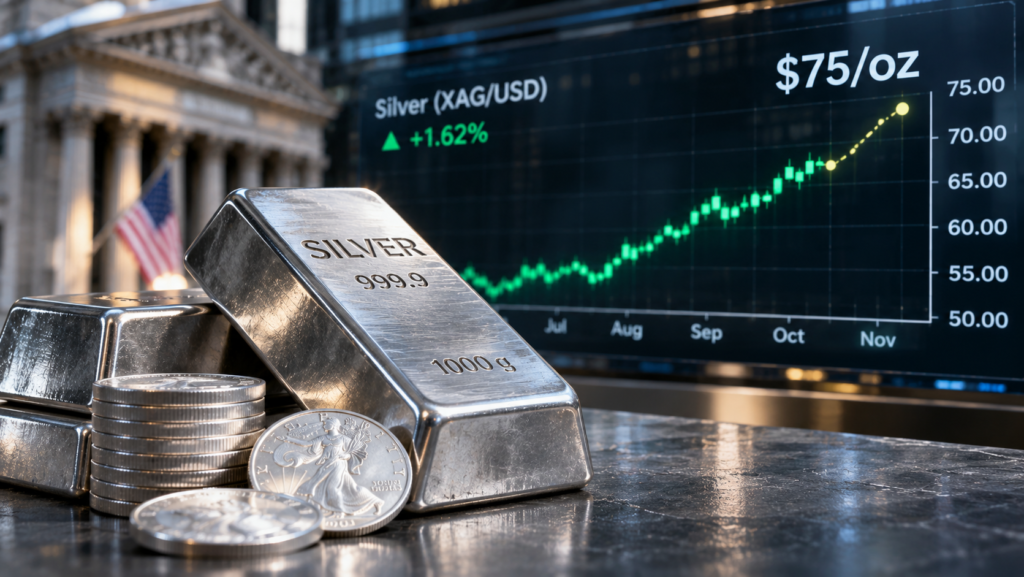
Summary: Bank of America sees silver potentially reaching an average of $75 per ounce in 2027 as macroeconomic pressure eases and investment demand recovers. However, weakening solar demand, ETF outflows and a changing global supply balance could complicate the recovery.
◉ Bank of America expects silver to reach an average of $75 per ounce during the second and third quarters of 2027.
◉ A stronger US dollar, higher oil prices and expectations of Federal Reserve rate increases have been major headwinds for precious metals.
◉ Investment flows and solar-sector demand could determine whether silver returns to a structural supply deficit in 2027.
Bank of America Sees Silver Recovery
Silver is entering another important phase as investors reassess the precious metal’s outlook following an exceptionally volatile year.
Bank of America expects prices to average $75 per troy ounce during the second and third quarters of 2027, supported by an improvement in the macroeconomic environment and a potential recovery in investment demand.
The forecast comes after a substantial correction from the extraordinary rally earlier in 2026. Silver reached approximately $121.65 per ounce in January before losing a significant portion of its gains.
By November 13, silver had fallen to around $48.74 per ounce, reflecting a combination of monetary tightening expectations, dollar strength and concerns about industrial consumption.
The bank’s outlook suggests that the current weakness could eventually give way to a recovery, although the path is likely to depend on several variables.
Importantly, $75 represents a projected quarterly average, not a guaranteed price target or an expected immediate move.
Macroeconomic Conditions Drive The Outlook
The monetary environment remains one of the most important influences on silver.
Higher interest-rate expectations increase the opportunity cost of holding precious metals, which do not generate interest or dividends.
The US dollar has also strengthened considerably, creating additional pressure on dollar-denominated commodities.
Geopolitical uncertainty has contributed to higher energy prices and inflation expectations, complicating the Federal Reserve’s monetary policy outlook.
Bank of America’s analysts believe that an easing of these pressures could improve the environment for precious metals.
A reduction in geopolitical tensions, more stable energy prices and a less restrictive monetary outlook could collectively support renewed interest in silver.
The relationship between gold and silver is also relevant. If gold stabilises while manufacturing activity remains relatively resilient, silver could benefit from improving industrial and investment sentiment.
Supply And Demand Remain Divided
Despite Bank of America’s constructive price outlook, silver’s underlying fundamentals remain complicated.
The bank expects the global market to move from a deficit of approximately 8,600 tonnes in 2025 to a surplus of 910 tonnes in 2026, before returning to a deficit of around 852 tonnes in 2027.
Investment flows are a major part of this change.
Physically backed silver ETFs attracted approximately 8,600 tonnes of inflows in 2025, but have experienced outflows of around 1,500 tonnes so far in 2026. According to the bank’s analysis, this reversal has been sufficient to move the market into surplus.
The Silver Institute presents a somewhat different picture. Its November assessment projects a sixth consecutive annual supply deficit in 2026, estimated at 35 million ounces.
However, expected ETF outflows of 45 million ounces could more than offset that deficit when investment flows are included.
The distinction matters because silver held in physically backed funds can return to the market when investors sell their positions. Consequently, the headline industrial and physical-market deficit does not necessarily translate into an immediate shortage.
Solar Demand Faces Structural Changes
The solar industry remains one of the most important uncertainties for silver.
Photovoltaic manufacturers have historically been major industrial consumers of the metal. However, elevated prices are accelerating efforts to reduce silver consumption per solar cell and explore copper-based alternatives.
In China, solar installations declined by approximately 129 gigawatts year over year during January–September 2026, according to the figures cited in Bank of America’s analysis.
The slowdown is particularly important because China represents a major source of global photovoltaic manufacturing and silver consumption.
At the same time, industrial demand outside solar remains comparatively resilient. The Silver Institute expects this segment to grow 4.5% to 492 million ounces in 2026.
This includes applications linked to automotive electrification, charging infrastructure, electronics and electrical equipment.
AI Data Centres Offer A New Demand Source
Artificial intelligence infrastructure is emerging as an additional source of industrial silver demand.
Bank of America expects global data-centre capacity to increase from approximately 130 gigawatts in 2026 to 240 gigawatts by 2030.
Silver demand associated with this sector could more than double, rising from approximately 270 tonnes in 2026 to slightly above 600 tonnes.
The metal is used in electrical contacts, power-management equipment, cooling systems and other components requiring high electrical conductivity.
Nevertheless, the expected growth should be viewed in context. Even at more than 600 tonnes, data-centre demand would account for less than 2% of global silver consumption.
This makes AI infrastructure a growing contributor, but not a sufficient replacement for weaker solar demand or changing investment flows.
What Comes Next For Silver?
Silver’s outlook is increasingly dependent on the interaction between monetary policy, industrial consumption and investment demand.
Three developments will be particularly important:
- Federal Reserve policy: Whether inflation and energy-price pressures ease enough to reduce expectations of further interest-rate increases.
- ETF investment flows: Whether investors return to physically backed silver funds after substantial outflows during 2026.
- Industrial demand: Whether AI infrastructure and electrification growth can compensate for declining photovoltaic consumption.
Bank of America’s $75 outlook represents a potential recovery scenario built around improving macroeconomic conditions and a return to a market deficit in 2027.
However, the difference between its projected surplus in 2026 and deficit in 2027 highlights how sensitive silver remains to relatively small changes in investor positioning.
The next major phase for silver may therefore be determined less by mine production alone and more by whether financial investors return to a market already undergoing significant industrial transformation.
Silver Market Snapshot
November 17, 2026 · Latest reported market estimates
| Indicator | Figure |
|---|---|
| Silver price, November 13 close | $48.74/oz |
| January 2026 record | $121.65/oz |
| BofA Q2–Q3 2027 forecast | $75/oz |
| BofA 2026 market balance | +910 tonnes |
| BofA 2027 market balance | -852 tonnes |
| 2026 ETF outflows | ~1,500 tonnes |
| Data-centre silver demand, 2030 | 600+ tonnes |
Sources
- Investing.com – Silver could hit $75 an ounce next year, November 16 Investing.com
- PV Magazine – Silver prices find $50 floor as solar industry accelerates shift toward copper, November 16 pv magazine Global
- The Silver Institute – 2026 Silver Market Outlook globenewswire.com
- Reuters – Global silver demand outlook Reuters