[df_language_switch slug=”nvidia-odstop-huang-napoved-cene-delnice”]
Summary: Jensen Huang’s sudden departure has triggered a major reassessment of NVIDIA’s leadership, valuation and future position in the AI industry. With institutional analysts cutting price targets and volatility rising, investors are examining how far the world’s leading AI chipmaker could fall.
◉ After more than three decades at the helm of NVIDIA, Jensen Huang has reportedly stepped down as CEO, president and board member, marking a potential turning point in the company’s leadership and future direction.
◉ Several investment firms have reduced their price targets, with Melius cutting its target from $315 to $185 and RBC reducing its target from $330 to $230.
◉ Technical analysis points to the $135–150 region as a potential downside area if selling pressure continues, while options traders are also positioning for a longer-term recovery.
◉ NVIDIA’s November 17 earnings report will be a major test of whether its AI growth story can remain intact during the leadership transition.
A sudden change at the top
NVIDIA is entering one of the most consequential periods in its corporate history. On November 12, the company announced that co-founder Jensen Huang had resigned as president, chief executive officer and a member of its board of directors, effective immediately.
The decision marks a dramatic change for a business that Huang helped build from a graphics-chip developer into one of the central suppliers of the global artificial intelligence industry.
NVIDIA appointed Chief Financial Officer Colette Kress as interim CEO. She will retain her financial responsibilities while the board searches for a permanent successor. Harvey C. Jones, a long-standing board member, was appointed the company’s first-ever chairman.
The announcement followed a period of intense scrutiny surrounding Huang, including reported personal relationships and questions raised in media coverage about possible foreign intelligence and export-control exposure. These allegations and related investigations have added a governance and political dimension to the company’s leadership transition.
The company has stated that its experienced leadership team remains committed to maintaining customer commitments and executing its existing product roadmap.
For investors, however, the issue extends beyond the appointment of an interim executive. Huang was closely associated with NVIDIA’s long-term strategy, relationships with major technology customers and its position at the centre of the AI infrastructure expansion.
The market reaction
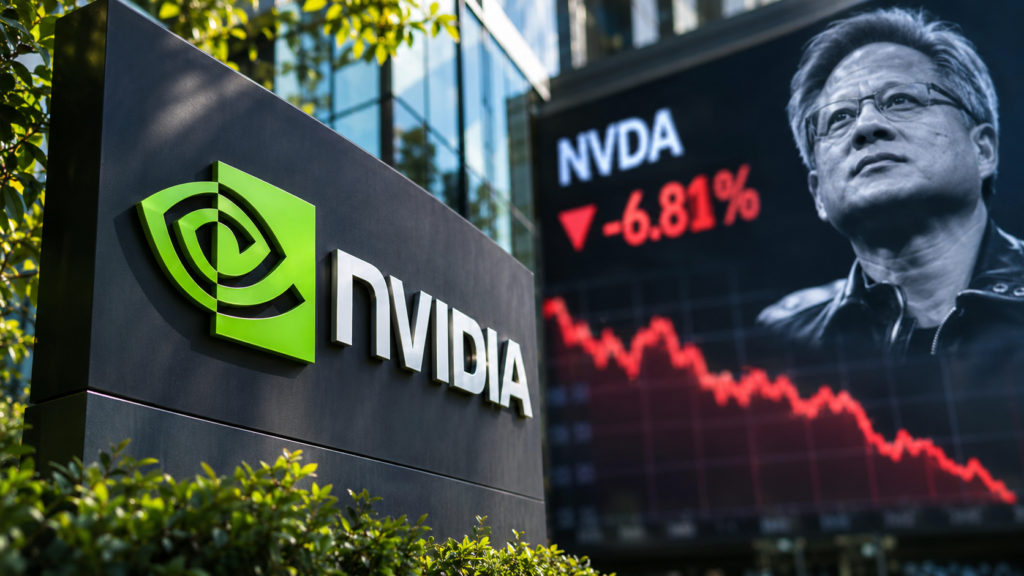
The leadership announcement intensified an existing decline. NVIDIA shares had already retreated substantially from their October 6 record high of $239.24. MarketWatch reported that the decline exceeded 30%, while Thursday’s session brought another sharp selloff.
Reuters reported that shares finished November 12 at $165.40, down 4.84%, after recovering from lower intraday levels. The company’s market value had fallen by hundreds of billions of dollars during the week.
The market reaction reflects several overlapping concerns: the sudden loss of its founder-CEO, uncertainty about succession, corporate governance questions and the possibility that political scrutiny could affect the company’s international business.
At the same time, NVIDIA’s valuation has changed considerably. A separate market analysis put the shares at approximately 12 times expected earnings, the lowest valuation multiple since 2012. That comparison makes the stock appear cheaper on a historical earnings basis, but it does not automatically mean that the market has reached a bottom.
Wall Street cuts its targets
The response from investment firms has been mixed, although several have reduced their expectations following the leadership announcement.
| Investment firm | Previous target | Revised position |
|---|---|---|
| Melius Research | $315 | $185 – Hold |
| RBC Capital | $330 | $230 – Outperform |
| BMO Capital | $340 | $240 – Outperform |
| Goldman Sachs | — | $220 – Buy |
| Baird | — | $200 – Neutral |
| StoneX | $335 | Target suspended – Hold |
The revisions reveal different interpretations of the same event.
Melius has taken a particularly cautious position, reducing its target by approximately 41%. Its concerns extend beyond the immediate management transition and include NVIDIA’s longer-term earnings valuation beyond 2027.
RBC reduced its target by approximately 30%, while maintaining an Outperform rating. Its analysis highlighted governance uncertainty and potential congressional scrutiny, but also pointed to underlying demand that continues to exceed supply.
BMO lowered its target by approximately 29%, retaining an Outperform rating. Goldman Sachs maintained a Buy rating with a $220 target, arguing that NVIDIA’s existing backlog and product roadmap could limit the immediate financial impact.
StoneX took a different approach, suspending its $335 target and downgrading the shares from Buy to Hold. Its analyst indicated that the change reflected valuation uncertainty rather than an immediate revision to earnings estimates.
The distinction matters: these are analyst valuation targets, not predictions that the share price will reach those levels during the next trading sessions.

Where could NVIDIA fall?
The technical picture has become increasingly important as investors search for levels where selling pressure might stabilise.
MarketWatch identified the $135–150 region as a potential support area if NVIDIA breaks below its March 2026 low of $165.17.
The stock’s relative strength index fell to approximately 23.95, its most oversold reading since June 2019. Such a reading indicates exceptionally strong recent selling pressure, although oversold conditions do not guarantee an immediate recovery.
Three price areas stand out in the current market discussion:
- $150: An initial psychological and technical reference point.
- $135–144: A deeper support region identified in recent market commentary and technical analysis.
- $120–130: An additional stress-test scenario if selling accelerates and broader AI-sector sentiment deteriorates. This is an analytical scenario, not an established Wall Street consensus target.
The downside discussion should also be viewed against the company’s longer-term earnings potential. A lower valuation multiple could continue to pressure the shares even if NVIDIA remains profitable and its revenue expands.
Options traders see another side
Not all market participants are positioning for a prolonged decline.
Options activity reported on November 12 showed that some investors were extending bullish positions into 2027 while reducing or restructuring downside protection.
Several notable transactions included approximately $18.9 million in net proceeds from restructuring put positions, an $18.8 million investment in call spreads designed to benefit from a recovery of around 16% by March, and purchases of approximately 50,000 January call options.
The activity suggests that some institutional traders are treating the leadership crisis as a period of elevated uncertainty rather than a permanent deterioration in NVIDIA’s competitive position.
Nevertheless, the options market is pricing in significantly greater volatility. Ninety-day implied volatility increased to approximately 52%, compared with around 33% one month earlier.
The contrast is important: the equity market is reassessing leadership and valuation risk, while parts of the derivatives market are positioning for a longer-term recovery.
The AI business remains the central question
The leadership crisis comes at a time when NVIDIA remains one of the most important companies in the global AI infrastructure market.
Its GPUs and networking systems support major cloud providers, data-centre operators and developers of advanced AI models. Demand for accelerated computing remains a central driver of investment across the technology industry.
However, the market is increasingly examining the financial structure behind that expansion.
Several questions are becoming more important:
- Can NVIDIA maintain its relationships with the world’s largest technology customers?
- Will AI infrastructure investment continue growing at its current pace?
- Could financing arrangements between chip suppliers, cloud providers and AI companies create additional financial risks?
- Will US export restrictions further limit NVIDIA’s access to international markets, particularly China?
- Can the company’s existing management team maintain its product roadmap and execution without Huang?
These questions extend beyond NVIDIA itself. The company is deeply connected to the wider semiconductor, cloud computing and AI investment ecosystem.
November 17: The next major test
NVIDIA is scheduled to publish its third-quarter fiscal 2027 results on November 17.
The announcement will be particularly important because investors will be assessing both financial performance and management continuity.
Attention is expected to focus on data-centre revenue, demand for Blackwell systems, gross margins, forward guidance and the strength of customer orders.
The subsequent earnings conference call will also provide an opportunity for interim CEO Colette Kress to explain how the company intends to maintain its strategy during the search for a permanent successor.
Strong results could demonstrate that NVIDIA’s operating performance remains resilient despite the leadership change. However, financial strength alone may not immediately eliminate concerns about governance, succession and the company’s future strategic direction.
A new chapter for NVIDIA
NVIDIA’s situation represents more than an ordinary executive departure. The company is confronting a leadership transition at a time when its valuation, international relationships and importance to the AI economy are under close scrutiny.
The recent analyst revisions demonstrate how quickly expectations can change when investors begin questioning the leadership structure behind a high-growth technology business.
The $135–150 region has emerged as an important potential downside area in current market commentary, while $120–130 represents a more severe hypothetical correction scenario. At the same time, institutional options activity indicates that some investors continue to position for a recovery into 2027.
Ultimately, the next phase will depend on whether NVIDIA can demonstrate that its technology, management structure and customer relationships are strong enough to sustain its position in the global AI industry without its founder at the helm.
The November 17 earnings announcement will provide the first major opportunity to assess that transition through the company’s financial performance and management outlook.
Sources
- NVIDIA – Official CEO transition announcement, November 12, 2026
- Reuters – Options traders position for longer-term recovery, November 12, 2026
- MarketWatch – NVIDIA selloff and potential downside support, November 12, 2026
- Reuters – NVIDIA valuation falls to a 14-year low, November 12, 2026
- RBC Capital – Revised NVIDIA price target
- StoneX – NVIDIA rating downgrade
- Melius Research – Revised NVIDIA price target
- BMO Capital – Revised NVIDIA price target
- Editorial Disclosure & Transparency