Summary: Friday the 13th has witnessed one of Wall Street’s most dramatic crashes and one of its strongest single-day rallies. Historical evidence suggests that market fundamentals, investor psychology and liquidity matter far more than the calendar.
◉ October 13, 1989: Wall Street suffered a major market shock, with the Dow Jones falling 191 points and approximately $190 billion in market value disappearing.
◉ March 13, 2020: The Dow surged 9.36%, recording one of its strongest single-day gains, despite the global pandemic crisis.
◉ Historical market data does not establish Friday the 13th as a reliable bearish signal. Actual economic conditions and market structure remain more important.
The Date That Haunts Markets
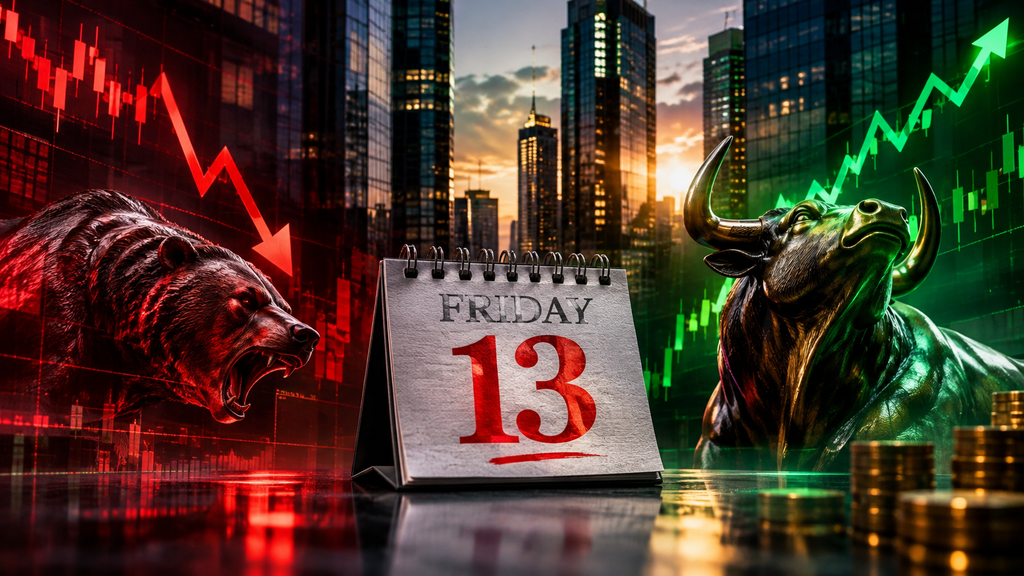
Friday the 13th has long carried a reputation for bad luck. In financial markets, however, the date has developed an unusual historical record: it has been associated with both extraordinary losses and remarkable recoveries.
As investors follow another Friday the 13th on November 13, 2026, the historical evidence offers an opportunity to examine whether the calendar has any genuine relationship with market performance — or whether memorable events have simply reinforced a popular superstition.
The answer is more complicated than the myth suggests.
1989: The Mini-Crash
One of the most significant financial events associated with the date occurred on October 13, 1989.
US securities and futures markets experienced extraordinary volatility after financing for a proposed leveraged buyout of UAL, the parent company of United Airlines, came into doubt.
The news triggered a rapid deterioration in market sentiment. Trading in UAL shares was halted, stock-index futures came under intense selling pressure and several market mechanisms were activated as prices moved sharply lower.
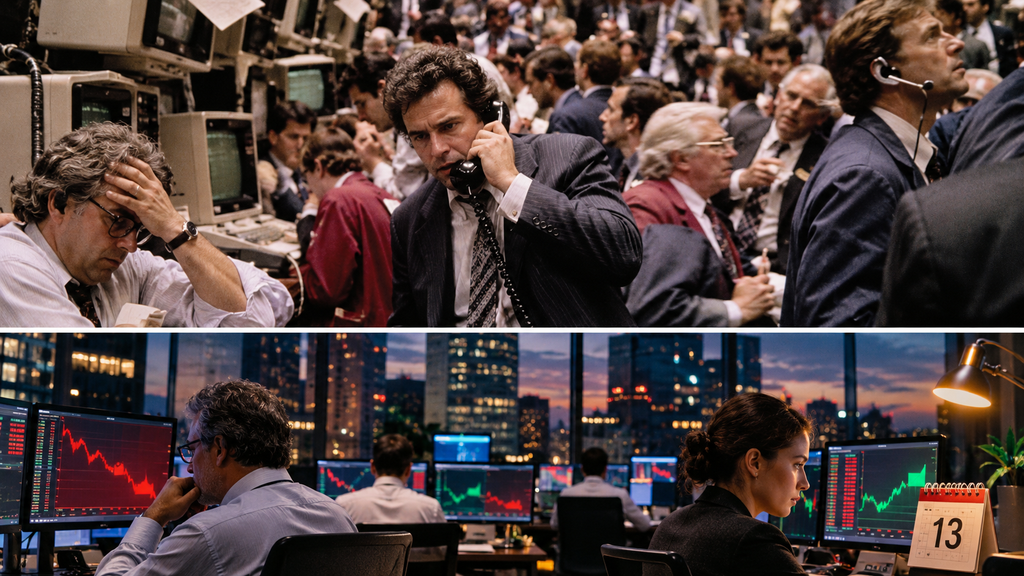
The Dow Jones Industrial Average finished the session down 191 points, approximately 6.9%. The estimated market-value loss reached $190 billion, with $160 billion disappearing during the final 90 minutes of trading.
The episode demonstrated how quickly uncertainty surrounding a major corporate transaction could spread through interconnected financial markets.
It also highlighted the growing influence of futures trading, index arbitrage and automated trading strategies in periods of extreme volatility.
Importantly, the event was not caused by the date. The underlying trigger was a financing failure that undermined market confidence.
2020: The Opposite Reaction
Three decades later, Friday the 13th produced a completely different outcome.
On March 13, 2020, the Dow Jones Industrial Average advanced 1,985 points, gaining 9.36%. The S&P 500 climbed approximately 9.29%, while the Nasdaq Composite advanced around 9.34%.
The rally followed a period of extraordinary market turbulence as the COVID-19 pandemic threatened global economic activity.
President Donald Trump’s declaration of a national emergency and expectations of government support helped restore some confidence during the session.
However, the recovery did not erase the damage accumulated during the week. The Dow remained down approximately 10.4% for the week, illustrating the difference between a powerful daily rebound and a genuine improvement in the broader market environment.
The contrast with 1989 is striking: the same calendar date became associated with two completely opposite market outcomes.
November 2026: What Markets Are Showing Today
The latest trading developments on November 13, 2026, provide another useful example of why economic fundamentals matter more than calendar superstition.
Indian equity markets traded lower during Friday’s session. The BSE Sensex declined approximately 0.54%, while the NSE Nifty 50 lost around 0.71%.
Two important factors contributed to the pressure:
- Rising crude oil prices: Brent crude moved towards $96 per barrel, increasing concerns about India’s energy import bill and inflation.
- Persistent inflation: Consumer inflation remained above the Reserve Bank of India’s upper tolerance threshold, raising expectations of further monetary tightening.
European equities also experienced some weakness on Friday, although the broader European market remained on track for a weekly gain of more than 2%.
These developments illustrate a familiar market relationship: energy prices, inflation expectations, monetary policy and corporate earnings can influence asset prices regardless of the date.
Does Friday the 13th Affect Returns?
The relationship between superstition and investment performance has attracted academic and financial research for decades.
Interestingly, the available findings do not consistently support the idea that Friday the 13th is bad for stocks.
A November 13, 2026, investment commentary from Baird highlighted an unusual observation: over the previous 13 years, the S&P 500 reportedly averaged a 0.44% gain on Friday the 13th, compared with a 0.05% average gain across all trading days.
This is an interesting historical comparison, but the sample is relatively small. It cannot establish that the date produces superior returns or that the pattern will continue.
Other historical research has also examined the relationship between calendar anomalies and investor behaviour. The results vary depending on the market, period and methodology.
One possible explanation is confirmation bias. Investors tend to remember dramatic losses associated with a particular date more easily than ordinary trading sessions when nothing unusual happens.
In financial markets, memorable events can create powerful narratives without establishing a statistically reliable pattern.
The Real Risk Behind Market Volatility
The historical events of 1989 and 2020 reveal something more important than superstition.
Markets can experience sharp movements when liquidity deteriorates, financing becomes uncertain or investors rapidly reassess economic expectations.
In 1989, uncertainty surrounding a major leveraged buyout contributed to extraordinary selling pressure.
In 2020, pandemic fears, government intervention and rapidly changing expectations produced extreme movements in both directions.
Modern markets have additional sources of complexity, including algorithmic trading, leveraged exchange-traded funds, derivatives and interconnected global investment strategies.
These mechanisms can accelerate price movements when investors simultaneously attempt to reduce exposure.
Friday the 13th therefore provides an interesting historical framework, but it does not explain why markets rise or fall.
Conclusion: Myth Versus Market Reality
The financial history of Friday the 13th is a reminder of how easily memorable events can become attached to popular beliefs.
October 1989 delivered a dramatic market decline. March 2020 brought an extraordinary recovery. November 2026 provides another opportunity to examine the difference between market narratives and measurable economic developments.
There is no established evidence that Friday the 13th independently determines stock market direction.
For financial markets, the more meaningful questions remain the same: What is happening to liquidity, interest rates, inflation, corporate profitability and investor confidence?
The calendar may create the headline. The underlying economics determine the market.
Sources
- US Government Accountability Office — October 1989 Market Volatility (1990).
- Yahoo Finance — Wall Street’s March 13, 2020 Rally.
- The Guardian — The Sinister Power of Friday 13th (November 13, 2026).
- Baird Wealth — Five for Friday, November 13, 2026.
- Business Today — Friday the 13th: Sensex and Nifty Fall (November 13, 2026).
- Reuters — European Stocks, Dollar and Global Markets (November 13, 2026).
- Denarni Fokus — Editorial Disclosure & Transparency