Summary: Artificial intelligence is moving beyond market analysis and into the negotiation of financial transactions. BNY and Microsoft have completed a first-of-its-kind US Treasury bill trade in which autonomous AI agents negotiated the terms before human traders approved the transaction, signalling a potential shift in institutional fixed-income markets.
◉ BNY and Microsoft completed an industry-first pilot transaction in which two AI agents negotiated the terms of a US Treasury bill trade.
◉ The agents exchanged offers and counteroffers within predefined trading limits, while human traders retained authority over final approval and execution.
◉ The technology could eventually extend to repo transactions, foreign-exchange payments and collateral negotiations, potentially changing how institutional financial markets operate.
AI Agents Take on Bond Negotiations
Artificial intelligence is beginning to enter one of the most established areas of financial markets: fixed-income trading.
BNY, formerly known as The Bank of New York Mellon, and Microsoft have completed a pilot transaction in which their respective AI agents independently negotiated the terms of a US Treasury bill trade.
The development is significant because the technology goes beyond conventional algorithmic trading.
Traditional electronic trading systems execute predefined instructions, match orders or process market data. The new approach allows autonomous agents to exchange proposals, assess counteroffers and search for mutually acceptable transaction terms.
In this case, neither side relied on an AI system to make the final trading decision. Human traders reviewed and approved the negotiated terms before the transaction was executed through existing institutional systems.
The distinction is important: AI is moving from supporting traders to participating directly in the commercial negotiation process.
How the Microsoft Trade Worked
Microsoft’s treasury department provided its AI agent with predefined instructions describing the acceptable conditions for the transaction.
BNY developed the Agentic Negotiation Protocol (ANP), a framework designed to allow authorised agents from different institutions to communicate securely.
The protocol acts as a control layer between the participants.
It verifies the parties involved, checks transaction parameters and allows agents to exchange offers and counteroffers within approved boundaries.
Once both agents reached an agreement, the proposed terms were independently submitted to a central ledger to confirm that both parties had reached the same understanding.
Human traders then reviewed and approved the transaction. Final execution and booking remained within the institutions’ established trading infrastructure.
This structure preserves human accountability while introducing automation into a process that has traditionally required direct interaction between financial professionals.
Beyond Traditional Algorithmic Trading
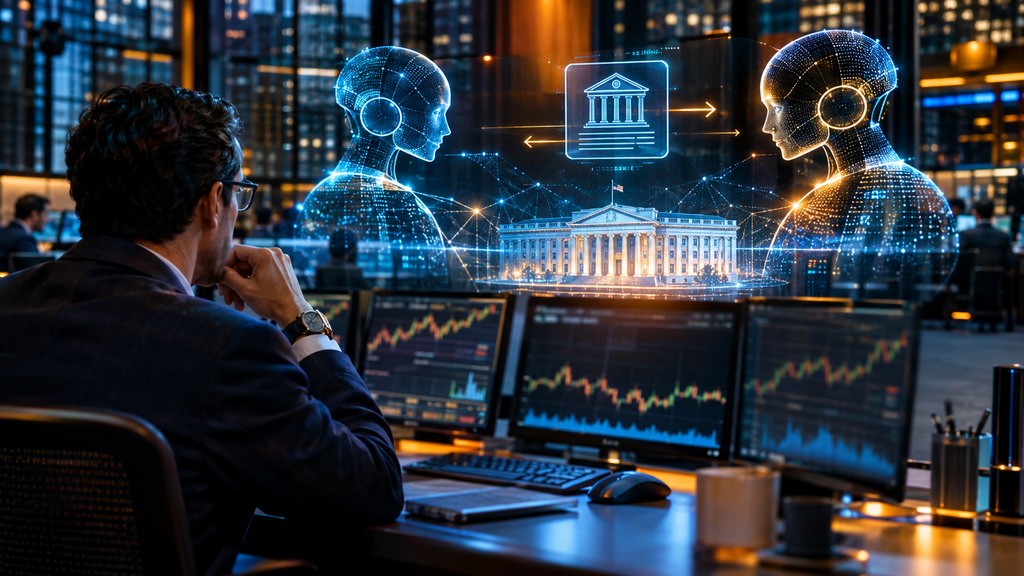
The broader significance lies in the difference between executing instructions and negotiating an agreement.
Financial institutions have used algorithms for years to execute orders, identify liquidity and process market information.
However, allowing independent systems representing different institutions to negotiate commercial terms introduces another layer of automation.
BNY plans to continue testing its protocol and explore additional applications across capital markets.
Potential areas include repurchase agreements (repo), foreign-exchange payments, collateral terms and contractual negotiations.
If successfully expanded, the technology could reduce the operational costs associated with transactions that currently require extensive communication between counterparties.
It could also make certain financial-market activities accessible to institutions that previously lacked the human resources required to participate efficiently.
A New Layer of Financial Market Automation
The development comes as other financial technology providers are also introducing AI into fixed-income trading.
Tradeweb, one of the major electronic trading platforms, is testing an AI-powered assistant called Tara with approximately a dozen firms trading global government debt.
The system is designed to help traders identify suitable dealers and navigate bond transactions more efficiently.
While Tara focuses on assisting traders, the BNY-Microsoft initiative takes automation further by allowing agents representing separate institutions to negotiate directly.
Together, these developments illustrate how AI is gradually becoming embedded in the infrastructure of institutional financial markets.
Human Traders Remain in Control
Despite the technological progress, the latest transaction does not represent the replacement of human bond traders.
The agents operated within predefined parameters, while human professionals retained responsibility for approving and executing the transaction.
This distinction is particularly important in fixed-income markets, where transactions can involve complex pricing, counterparty relationships, liquidity constraints and settlement requirements.
Financial institutions must also ensure that automated negotiations remain transparent, auditable and compliant with internal risk-management procedures.
The ability to reconstruct negotiations, verify counterparties and confirm identical transaction terms will be essential as these systems expand.
What It Means for Financial Markets
The BNY-Microsoft transaction represents an early demonstration of how autonomous AI agents could change the operational structure of capital markets.
If the technology proves scalable, financial institutions could eventually automate parts of the negotiation process across several asset classes.
Potential benefits include lower transaction costs, faster execution of negotiated deals and improved access to financial markets for institutions with limited trading resources.
However, broader adoption will depend on reliability, cybersecurity, regulatory acceptance and the ability to manage automated systems during periods of market stress.
The next stage of development will not simply involve making AI agents faster. It will require establishing trusted systems in which different institutions can negotiate securely without losing control over financial decisions.
The first transaction between BNY and Microsoft offers a glimpse of that future. AI is no longer limited to analysing financial markets. It is beginning to participate in the transactions that keep them operating.
Sources
- Bloomberg – AI Agents in Bond Market Arrive With a Stealthy Microsoft Trade.
- BNY – Official Announcement of First AI-Negotiated US Treasury Trade.
- Bloomberg Law – Tradeweb Rolls Out AI Assistant for US Treasury Traders.
- Pittsburgh Business Times – BNY and Microsoft Complete Industry-First AI Trade.
- Editorial Disclosure & Transparency.