Summary: US stock futures struggle to extend Wall Street’s powerful rebound as Nvidia’s extraordinary surge loses momentum, leaving investors focused on AI valuations, Federal Reserve policy and upcoming inflation data.
◉ Nvidia’s 31.5% surge triggered Wall Street’s strongest session since April 2025.
◉ US index futures turned lower as investors reassessed the sustainability of the technology-led recovery.
◉ Upcoming inflation data and expectations of a December Fed rate hike remain central market catalysts.
Wall Street’s Dramatic Reversal
US equity markets experienced one of their strongest sessions in months on Monday, November 23, as investors returned aggressively to technology and semiconductor stocks following a period of heavy selling.
The S&P 500 advanced 4.73% to 7,237.17 points, while the Nasdaq Composite jumped 6.51% to 24,089.56. The Dow Jones Industrial Average gained 3.01%, closing at 49,595.31.
The rally ended a seven-session losing streak for the S&P 500 and recovered more than half of the losses accumulated during the previous week’s correction.
However, the mood became more cautious during overnight trading. Futures initially showed limited direction before Tuesday’s session, with Nasdaq-linked contracts displaying greater weakness than those tracking the broader market.
By Tuesday morning, the Nasdaq-100 futures had fallen approximately 1%, while S&P 500 and Dow futures also moved lower.
The shift highlighted the difference between a powerful short-covering rally and a sustainable improvement in market fundamentals.
Nvidia Leads the Recovery
At the centre of Monday’s recovery was Nvidia.
The semiconductor giant surged 31.5%, closing at $165.05 and adding approximately $950 billion to its market capitalisation.
The extraordinary move followed the company’s decision to reinstate founder Jensen Huang as president and chief executive, reversing a leadership change that had contributed to uncertainty surrounding the company.
The announcement restored confidence among investors who view Nvidia as one of the most important companies in the global artificial intelligence infrastructure cycle.
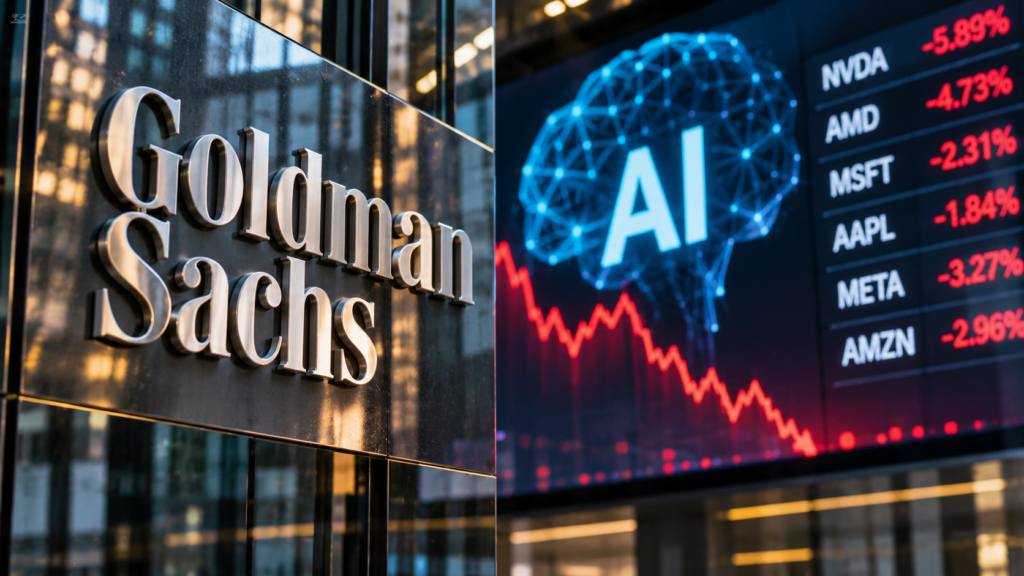
The recovery extended across the semiconductor industry. Advanced Micro Devices, Micron and other technology companies benefited from renewed buying interest, while semiconductor-focused exchange-traded funds recorded particularly strong gains.
The Nasdaq’s outperformance demonstrated how heavily the broader US market remains influenced by a relatively concentrated group of technology and AI-related companies.
Nevertheless, Nvidia shares began surrendering part of Monday’s advance in premarket trading on Tuesday, illustrating how quickly sentiment can reverse after an unusually large single-session move.

AI Investment Faces New Questions
Despite the rebound, the underlying debate surrounding artificial intelligence investment remains unresolved.
Major technology companies continue committing enormous amounts of capital to data centres, advanced processors, cloud infrastructure and electricity capacity.
The expansion has created significant revenue opportunities for semiconductor manufacturers and infrastructure suppliers. However, investors are increasingly examining whether the scale of current investment can generate sufficient long-term earnings and cash flow.
The latest volatility reflects a growing distinction between confidence in AI’s long-term economic potential and the valuations currently assigned to companies expected to benefit from it.
A recovery driven primarily by improved sentiment may therefore face resistance unless accompanied by stronger evidence of sustainable earnings growth.
Federal Reserve Adds Uncertainty
Monetary policy represents another major influence on the direction of US equities.
Markets are increasingly focused on the Federal Reserve’s December meeting, with futures pricing reflecting expectations of a 25-basis-point rate increase.
Recent comments from New York Federal Reserve President John Williams reinforced concerns that inflation remains a significant challenge and that additional monetary tightening cannot be ruled out.
Wednesday’s Personal Consumption Expenditures price index, the Federal Reserve’s preferred inflation measure, is particularly important.
The figures could influence expectations surrounding borrowing costs, Treasury yields and equity valuations.
Higher interest rates generally place additional pressure on growth-oriented companies because a greater proportion of their expected earnings lies further in the future.
Market Direction Remains Uncertain
The latest trading pattern illustrates the fragile balance currently shaping Wall Street.
On one side, Nvidia’s recovery and renewed semiconductor demand demonstrate that investor appetite for AI-related companies remains substantial.
On the other, the speed of Monday’s rally, followed by weaker futures trading, suggests that confidence has not yet fully recovered.
The next phase of the market will depend on whether corporate earnings, AI infrastructure demand and economic conditions can support the latest rebound.
For now, Wall Street is facing a critical test: whether the Nvidia-led recovery can develop into a broader and more durable advance, or whether the latest surge represents another temporary interruption in an increasingly volatile market.