Summary: AMD shares face renewed selling pressure after a surprise short-seller report raised questions about the company’s outlook. The development adds another layer of uncertainty to the semiconductor sector as investors reassess AI valuations and competition.
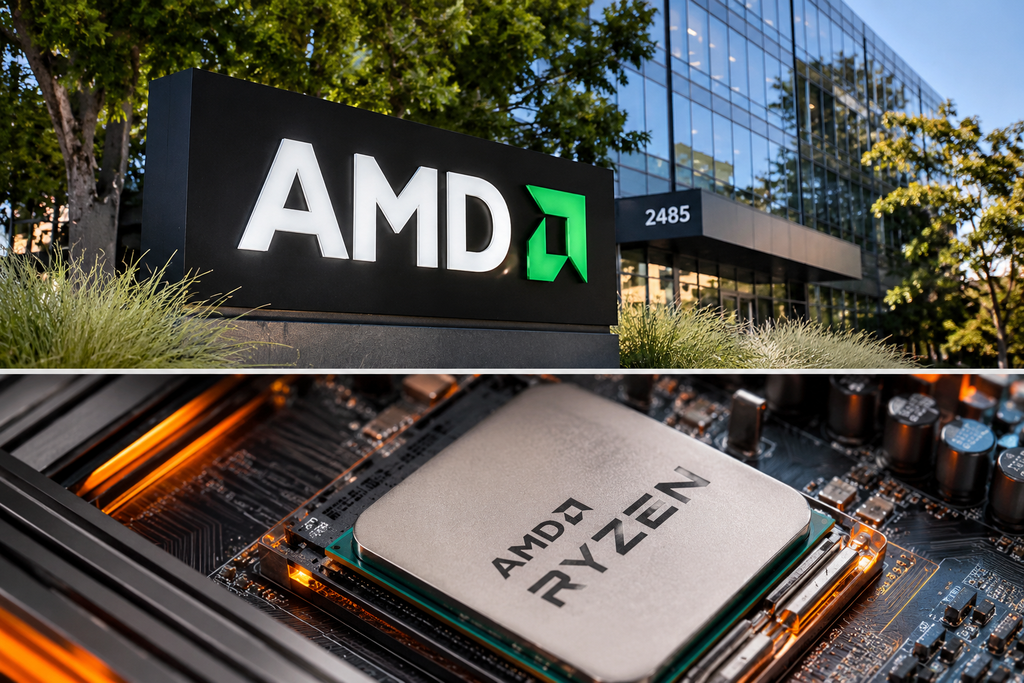
◉ A new short-seller report has intensified pressure on AMD shares, bringing the company’s fundamentals under fresh scrutiny.
◉ The debate centres on AI growth expectations, competitive positioning and the sustainability of semiconductor valuations.
◉ The market reaction highlights the growing influence of short-selling research on sentiment surrounding high-profile AI companies.
China Exposure Moves Into Focus
The latest pressure on Advanced Micro Devices is connected to a series of allegations concerning the company’s commercial relationships with Chinese technology businesses.
Hunterbrook Media published an investigation claiming that newer versions of AMD firmware appeared in software updates distributed by IEIT Systems, a Chinese server manufacturer placed on the US Department of Commerce’s Entity List in March 2025.
The investigation focused on firmware used to operate AMD-based servers. According to the report, an October 19, 2026 software update published by IEIT contained AMD code in a version issued after the Chinese company had been blacklisted.
The investigation also identified three businesses allegedly connected to the same supply chain: Maginfra in China, Kaytus in Singapore and Aivres in California. These companies sell servers incorporating AMD processors.
A separate allegation concerned licensing income. Hunterbrook claimed that AMD reported $67 million in licensing revenue during 2025 that it traced to two Chinese semiconductor ventures previously placed on the US blacklist.
These claims have not been independently verified. AMD rejected the report’s characterization of its business relationships and stated that it complies with applicable US export-control laws.
AI Growth Meets Regulatory Risk
The timing of the investigation is particularly significant.
AMD has positioned its data-centre business as a major driver of future growth, seeking to expand its presence in the market for AI accelerators and high-performance computing.
The company has previously communicated an ambition to grow data-centre AI revenue by more than 80% annually over the next three to five years.
However, this expansion depends partly on access to international markets, customers and a global semiconductor supply chain.
US export restrictions create an additional layer of uncertainty. Any tightening of regulations affecting advanced processors, server technology or commercial relationships could influence AMD’s ability to serve certain customers.
The issue is not limited to potential direct restrictions on chip shipments. Questions surrounding software, licensing arrangements, distribution networks and end-user verification could also attract regulatory attention.
For a company competing against Nvidia in the AI accelerator market, uncertainty around China exposure introduces another variable into its growth expectations.
Customer Financing Adds Another Concern
The controversy extends beyond export controls.
A separate publication from Hunterbrook’s research network raised questions about AMD’s use of data-centre lease guarantees and financial arrangements supporting customers purchasing its computing products.
The concern centres on the possibility that some AI infrastructure customers may rely on financing structures that become vulnerable if demand for computing capacity weakens.
If cloud providers expand too aggressively and subsequently struggle to lease their infrastructure profitably, financial commitments connected to those arrangements could become more important.
This is a broader issue across the AI industry. The rapid expansion of data-centre infrastructure has created substantial demand for chips, servers, networking equipment and computing capacity. However, the long-term economics of these investments depend on sustained customer demand and utilisation.
The allegations do not establish that AMD has incurred losses or violated financial regulations. They do, however, introduce questions about the relationship between reported AI demand, customer financing and the durability of infrastructure spending.
Market Reaction Reflects Valuation Sensitivity
AMD shares fell approximately 8% on November 19, after losing as much as 11% during the trading session. The decline followed an earlier period of strong performance, during which investors increasingly viewed AMD as one of the principal beneficiaries of expanding AI infrastructure investment.
The reaction also demonstrates how quickly sentiment can change when regulatory uncertainty intersects with elevated growth expectations.
Short sellers have an economic incentive to benefit from falling share prices. Hunterbrook Capital disclosed that it held a short position in AMD, making the distinction between allegations, independently verified evidence and the company’s response particularly important.
The market is therefore assessing two separate questions: whether the allegations could result in regulatory consequences and whether AMD’s longer-term AI growth expectations adequately reflect its exposure to geopolitical and commercial risks.
What Comes Next
The immediate focus is likely to remain on AMD’s response, the possibility of further regulatory scrutiny and whether additional information emerges regarding the relationships identified in the investigation.
The broader semiconductor sector is also exposed to the same geopolitical environment. Companies supplying advanced processors and AI infrastructure must navigate increasingly complex restrictions governing technology exports to China.
For AMD, the challenge is maintaining its growth ambitions while demonstrating that its international commercial relationships remain compliant with US regulations.
The latest selloff does not independently establish a deterioration in AMD’s underlying business. Instead, it highlights how regulatory exposure, financing structures and market expectations can combine to create significant volatility in high-growth semiconductor stocks.
Sources
- Reuters – AMD shares slide as report says China links could invite US scrutiny.
- Financial Times – AMD shares fall after short seller report on China links.
- Business Insider – AMD stock plunges after short-seller report.
- Yahoo Finance – AMD stock falls after Hunterbrook investigation.
- Editorial Disclosure: Denarni Fokus – Editorial Disclosure & Transparency.