Slovenia is advancing more than €15.6 million in new road and municipal transport investments, with major projects targeting Komenda’s business zone and nine municipalities. The developments highlight how improved connectivity could influence regional economic activity, commercial property demand and long-term real estate development.
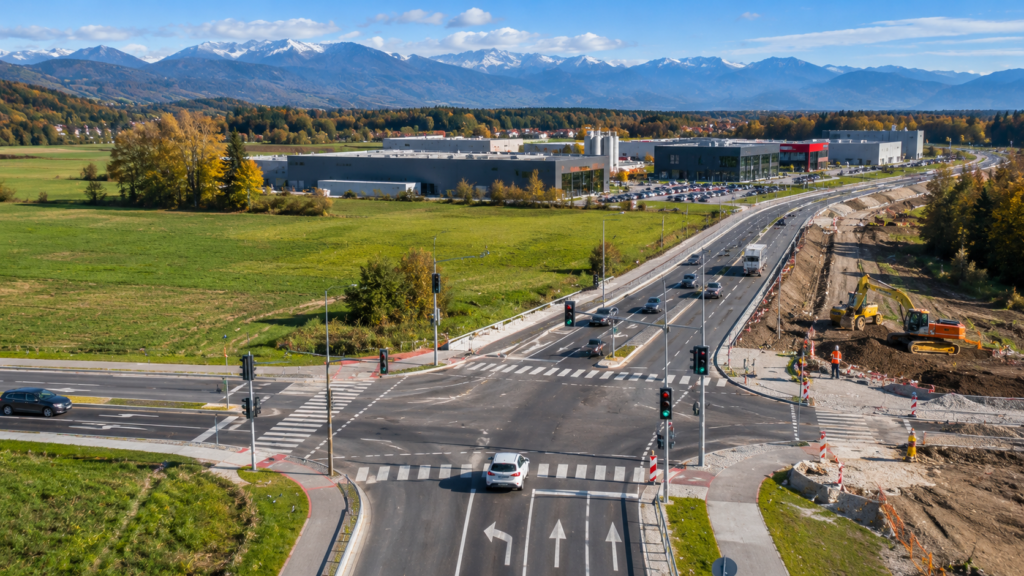
◉ An €8.84 million road reconstruction has started between Vodice and Moste, improving access to the Komenda business zone over a 1.8-kilometre section.
◉ Nine municipalities will receive €3.7 million in government co-financing for transport projects worth €6.8 million, covering cycling infrastructure, pedestrian areas and public transport.
◉ Improved regional connectivity could strengthen the attractiveness of commercial land, industrial facilities and residential locations, although the actual property-market impact will depend on implementation and local demand.
Infrastructure Moves Closer to Business
Slovenia is moving forward with a series of infrastructure investments that could reshape accessibility across several municipalities, with particular significance for the commercial and industrial property market around Ljubljana.
One of the most significant developments is the start of construction on the Vodice–Moste road section, designed to improve access to the Komenda business zone.
The project carries a contractual value of €8.84 million and covers more than 1.8 kilometres between the Vodice bypass and Žeje near Komenda. Completion is scheduled within 18 months from the contractor’s introduction to the project.
The reconstruction includes two new signalised intersections, one at the existing entrance to the business zone and another at the connection to a new access road. Additional parallel routes will also be constructed alongside the state road.
The investment forms part of the wider Želodnik–Mengeš–Vodice road connection, which is intended to link the Styrian and Gorenjska motorway corridors while reducing traffic pressure on settlements along the route.
For businesses operating in Komenda, improved road access represents an important development. Industrial and logistics facilities depend heavily on reliable transport connections, particularly when companies need to move goods, coordinate deliveries and maintain access for employees.
The improved connection could also increase the development potential of surrounding commercial land, although this will depend on available plots, zoning regulations, utility connections and future demand from businesses.
Komenda’s Commercial Property Potential
The Komenda business zone is strategically positioned within the wider Ljubljana economic region.
Its location provides access to important transport routes connecting the capital with northern Slovenia and neighbouring markets. However, accessibility remains one of the factors influencing the competitiveness of industrial and logistics locations.
The latest road investment addresses part of this challenge.
For commercial property owners and potential investors, infrastructure improvements can influence several important considerations:
- Logistics efficiency: Better road connections can reduce travel complexity for commercial vehicles and improve access to distribution facilities.
- Business attractiveness: Companies evaluating industrial locations frequently consider transport accessibility alongside land availability and operating costs.
- Development potential: Improved infrastructure can make previously less accessible commercial plots more attractive for future development.
- Employment accessibility: Better connections can expand the practical commuting area for businesses seeking employees.
However, infrastructure investment does not automatically translate into higher property prices. The relationship between new roads and real estate values depends on the scale of development, available supply, environmental conditions and the extent to which businesses actually expand into the area.
The Komenda project is therefore relevant not only as a transport development but also as part of the broader economic infrastructure supporting commercial activity around Ljubljana.
€3.7 Million for Nine Municipalities
A separate infrastructure programme announced on 9 November adds another €3.7 million in state co-financing for local transport improvements.
Nine municipalities signed agreements covering projects with a combined investment value of €6.8 million.
The participating municipalities are Borovnica, Domžale, Kočevje, Krško, Muta, Ravne na Koroškem, Sodražica, Ormož and Škofljica.
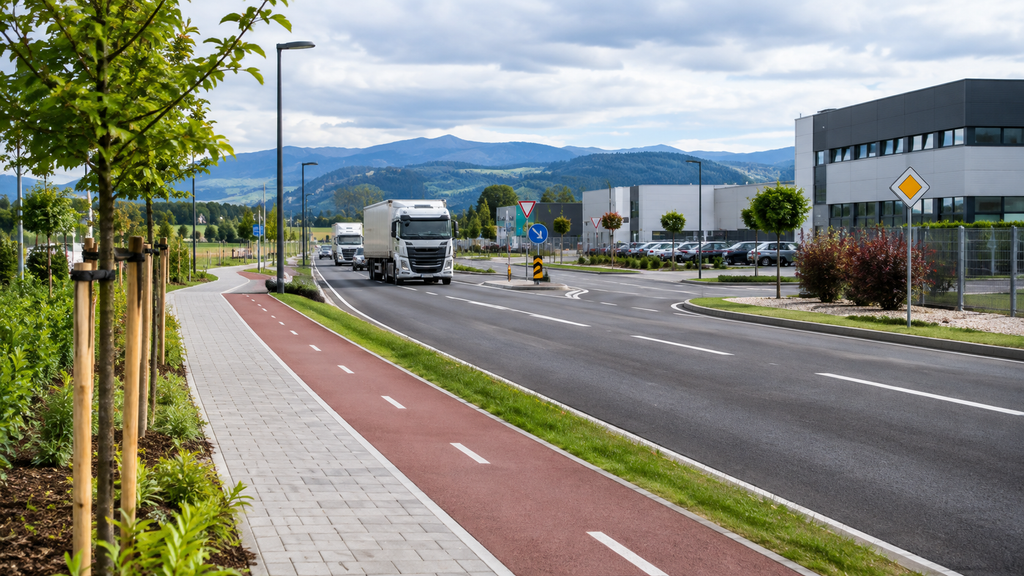
The projects focus on improving pedestrian and cycling infrastructure, public transport accessibility and local traffic arrangements.
Several investments stand out.
In Borovnica, the municipality will establish a shared traffic space, while Krško will introduce a new pedestrian zone.
Škofljica and Sodražica will upgrade their bus terminal facilities, with the objective of improving accessibility and passenger comfort.
Meanwhile, Domžale, Ravne na Koroškem and Muta will establish or expand public bicycle-sharing systems.
Together, these systems will include 32 stations and 133 bicycles.
The projects represent a different category of infrastructure investment compared with the Komenda road reconstruction. Rather than focusing primarily on regional road connectivity, they concentrate on everyday mobility and the quality of local transport networks.
For residential property markets, these improvements may be relevant because access to public transport, pedestrian infrastructure and cycling networks can influence the attractiveness of neighbourhoods and the convenience of daily life.
A Wider Infrastructure Funding Programme
The latest agreements also form part of a considerably larger public investment framework.
According to the government, 58 projects had already been approved during the first application round of the wider public call.
Their combined investment value stands at €73.3 million, with €41.6 million secured for implementation.
The entire programme makes more than €81.5 million available through European cohesion policy funding and the Climate Fund.
This broader funding framework is important because local transport infrastructure often develops through multiple investment phases rather than individual construction projects.
The combination of regional roads, cycling networks, pedestrian areas and public transport facilities can gradually improve connectivity across municipalities.
For Slovenia, where economic activity and employment remain concentrated around several major urban and industrial centres, these connections can influence how businesses select locations and how residents evaluate the accessibility of different communities.
What It Could Mean for Slovenia’s Real Estate Market
The latest announcements highlight an important relationship between infrastructure development and real estate: transport accessibility is one of the factors that can influence the long-term attractiveness of a location.
The Komenda investment has a relatively direct connection to commercial and industrial property because it improves access to an established business zone.
The municipal programme has a broader potential impact, particularly on residential locations where improved pedestrian infrastructure, cycling facilities and public transport can contribute to neighbourhood accessibility.
However, the property-market implications are unlikely to be uniform.
Industrial property may benefit from improved freight connectivity, while residential areas may gain from better local mobility. Commercial development will also depend on the availability of suitable land, planning permissions and the willingness of businesses to expand.
There is also a distinction between announcing an investment and completing it. Construction schedules, execution costs and the actual delivery of infrastructure will determine when the benefits become visible.
The next 18 months will therefore be particularly relevant for the Komenda road project, while the nine municipal agreements will provide another indication of how quickly local infrastructure development progresses.
For investors following Slovenia’s commercial and residential property markets, the developments offer another reason to examine infrastructure spending alongside construction activity, business expansion and regional planning.
The central question is not simply how much public money is being invested, but whether these projects translate into more accessible locations, stronger economic activity and sustainable demand for real estate.
Sources
- Ministry of Infrastructure and Energy – Komenda road investment, 9 November 2026 Portal GOV.SI
- Government of Slovenia – Nine municipal transport investment agreements, 9 November 2026 Portal GOV.SI
- Portal24 – Coverage of the €3.7 million municipal funding programme Portal24
- Editorial Disclosure & Transparency