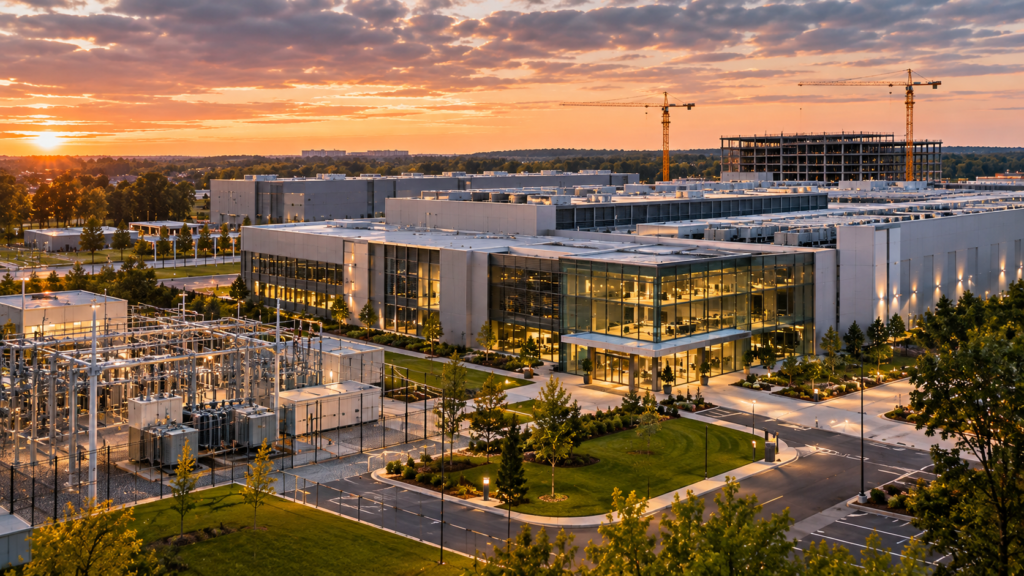
Short description: Blackstone is reshaping its real estate portfolio, selling approximately $7 billion in non-core properties while directing billions into AI data centres. The shift highlights how artificial intelligence is changing institutional property investment, commercial real estate valuations and the global REIT market.
◉ Blackstone Real Estate Income Trust sold approximately $7 billion in non-core assets during 2026 and has redirected capital towards data centres and industrial properties.
◉ BREIT invested $9.1 billion in QTS data-centre developments during the first nine months of 2026, with data centres reaching 29% of its real estate asset value.
◉ The portfolio shift reflects a wider transformation in global property investment, as AI infrastructure attracts institutional capital while traditional real estate sectors face changing demand and financing conditions.
A Major Shift in Property Investment
Blackstone is accelerating one of the most significant portfolio transformations in the global commercial real estate market, placing artificial intelligence infrastructure at the centre of its investment strategy.
Through Blackstone Real Estate Income Trust (BREIT), the investment manager has sold approximately $7 billion in non-core properties during 2026, including its remaining self-storage and manufactured housing portfolios.
At the same time, the company has substantially increased its exposure to data centres through QTS, its digital infrastructure platform.
The figures illustrate the scale of the shift. During the first nine months of 2026, BREIT deployed $9.1 billion into QTS data-centre developments, representing a 129% increase compared with the $4 billion deployed during the same period of 2025.
This is more than a conventional portfolio adjustment. It reflects a growing institutional preference for property assets connected to long-term technology infrastructure demand.
Data Centres Become BREIT’s Largest Sector
The most striking development is the increasing weight of data centres within BREIT’s portfolio.
As of September 30, 2026, the QTS investment represented 29% of BREIT’s real estate asset value, compared with 22.5% at the end of March.
This made data centres the fund’s largest individual property allocation, exceeding industrial real estate at 20% and multifamily housing at 17%.
The change is particularly significant because data centres have traditionally represented a relatively specialised segment of commercial property.
Their growing importance reflects the expansion of cloud computing, artificial intelligence training, enterprise computing and digital infrastructure requirements.
BREIT’s exposure is also supported by its position in QTS. The fund reported a 34.8% ownership interest in the platform at the end of September.

AI Infrastructure Drives Development
The investment strategy is closely connected to the growing infrastructure requirements of major technology companies.
Training and operating advanced AI systems requires increasingly sophisticated computing facilities, substantial electricity capacity, cooling systems and secure high-performance infrastructure.
QTS is positioning itself to capture this demand through an extensive development pipeline.
According to Blackstone, its development pipeline reached approximately $30 billion, with projects pre-leased, in substantially all cases, to investment-grade technology tenants under leases extending at least 15 years.
The company also reported that QTS leasing activity approximately doubled year over year during the third quarter.
Long-term leasing commitments provide greater visibility into potential future rental income, although development completion, power availability and tenant concentration remain important considerations.
Traditional Property Faces Capital Rotation
Blackstone’s strategy also highlights the changing investment landscape across traditional real estate.
Self-storage, manufactured housing, multifamily and industrial properties remain important institutional investment categories. However, capital allocation increasingly reflects differences in expected rental growth, financing costs and long-term demand.
The decision to exit remaining self-storage and manufactured housing holdings suggests that BREIT is prioritising sectors it considers to have stronger growth potential.
This does not necessarily indicate a structural decline in traditional property markets. Rather, it demonstrates how institutional investors are reassessing the relative attractiveness of different real estate segments.
The rotation towards data centres also creates a new relationship between property investment and the technology industry.
Data Centre Financing Expands
The financing market is developing alongside the expansion of digital real estate.
On November 6, Reuters reported that ING was offering approximately $500 million in data-centre loans for sale, including financing connected to major US data-centre operators.
The transaction illustrates the growing scale and complexity of financing arrangements behind AI infrastructure.
However, the market is not without uncertainty. Data-centre projects require substantial upfront investment, long construction timelines and access to reliable electricity.
Recent political opposition to large facilities also demonstrates that local infrastructure constraints, environmental concerns and electricity costs can influence development decisions.
In November, a North Dakota community voted against a proposed measure requiring additional reviews and public hearings for major industrial and data-centre developments, illustrating the increasingly important role of local acceptance.
Real Estate ETFs Reflect A Different Market
The growing institutional appetite for AI infrastructure contrasts with the performance pressures affecting parts of the listed real estate market.
On November 7, real estate ETFs experienced declines following comments by Federal Reserve Chair Jerome Powell about persistent stress in commercial property markets.
The Vanguard Real Estate ETF (VNQ), one of the largest listed property funds, was down approximately 0.2% during the reported session. The Schwab U.S. REIT ETF (SCHH) and Real Estate Select Sector SPDR Fund (XLRE) also moved lower.
The development highlights an important distinction between private real estate investment and publicly traded REIT valuations.
Private funds can allocate capital directly towards individual development projects and negotiate long-term leasing agreements. Listed REITs, meanwhile, remain exposed to daily market pricing, interest-rate expectations and broader equity-market sentiment.
Consequently, the growing attractiveness of data-centre real estate does not automatically translate into gains across the entire listed property sector.
The Next Phase Of Global Real Estate
Blackstone’s repositioning provides an important indication of where institutional property capital is moving.
Data centres are increasingly competing with traditional commercial property for investment allocations, supported by demand for cloud computing, AI infrastructure and digital services.
However, the sector carries risks that differ from conventional real estate. Electricity availability, construction costs, technological changes, tenant concentration and financing requirements can all influence project economics.
BREIT itself has acknowledged these risks in its disclosures.
The central development is that global real estate investment is becoming increasingly connected to the infrastructure supporting the digital economy.
Blackstone’s strategy illustrates how AI is changing not only the technology industry, but also the ownership, financing and future direction of global real estate.
Sources
- CRE Daily – BREIT Funnels $7 Billion Into Data Centres
- Blackstone – BREIT Q3 2026 Investor Update
- SEC – Blackstone Q3 2026 Filing
- Reuters – ING Offers $500 Million in Data Centre Loans
- ETF.com – VNQ and Real Estate ETFs Decline
- The Washington Post – Community Opposition to Data Centres
- Denarni Fokus – Editorial Disclosure & Transparency