Artificial intelligence is transforming the energy industry as technology companies move beyond buying electricity and begin securing their own generation capacity. Anthropic’s reported $3.4 billion agreement for gas-fired generators highlights the growing importance of power infrastructure in the global AI race.
◉ Anthropic has reportedly secured commitments for 1.7 GW of gas-fired generators in a deal valued at approximately $3.4 billion.
◉ AI companies are increasingly pursuing dedicated power generation to overcome electricity shortages, grid connection delays and equipment constraints.
◉ The shift is creating new investment opportunities across natural gas, turbines, power equipment, electricity infrastructure and energy storage.
The Energy Behind AI
Artificial intelligence is increasingly becoming an energy-intensive industrial business.
The expansion of large language models, advanced computing systems and AI services is creating demand for data centres capable of operating continuously at enormous computing capacity. Behind every AI interaction is an extensive physical infrastructure requiring electricity, cooling systems, backup generation and reliable connections to energy networks.
That requirement is beginning to reshape the relationship between technology companies and traditional energy producers.
The latest example comes from Anthropic, which has reportedly agreed to commitments worth approximately $3.4 billion for 1.7 gigawatts of gas-fired generators supplied through equipment orders originally placed by Texas-based OnePWR Solutions.
The agreement, reportedly reached in late September, includes engineering and construction capabilities required to install the equipment. Anthropic is not acquiring OnePWR itself.
The scale of the transaction is significant. Rather than depending exclusively on electricity purchased through conventional utility arrangements, an AI developer is securing substantial power-generation equipment directly.
Reuters reported that it could not independently verify the transaction, while Anthropic and OnePWR did not immediately comment.
The development illustrates how electricity availability is becoming a strategic consideration alongside access to advanced processors, computing capacity and data-centre locations.
Why Companies Want Their Own Power
The traditional model of data-centre development relies heavily on connections to the electricity grid. However, the rapid expansion of AI infrastructure is placing increasing pressure on existing power networks.
In several major data-centre markets, developers face lengthy grid connection queues, infrastructure limitations and uncertainty over when sufficient electricity will become available.
For companies investing billions in computing infrastructure, waiting several years for a connection can create substantial commercial disadvantages.
Behind-the-meter generation offers an alternative.
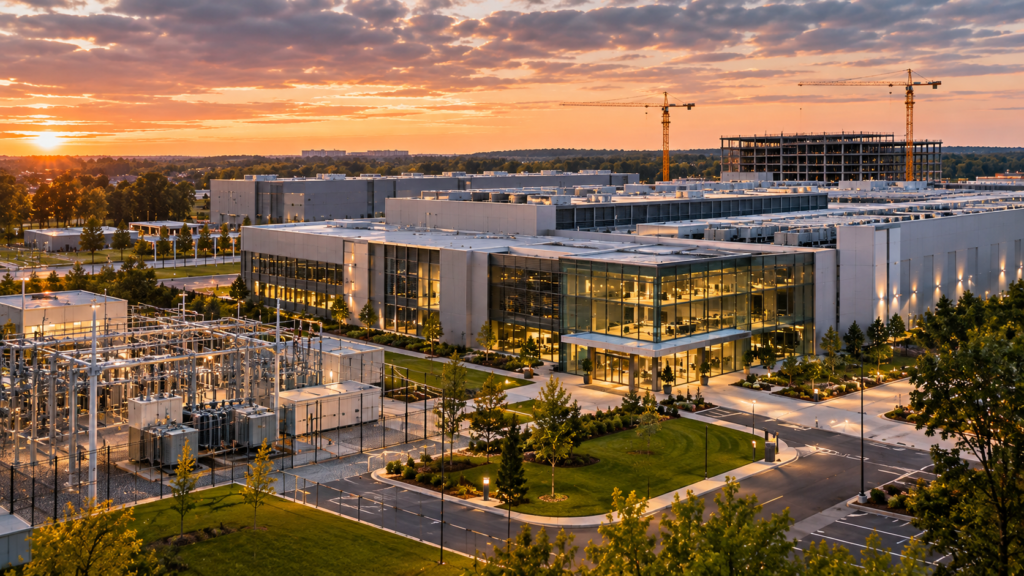
Under this model, electricity is produced close to the data centre and can be supplied directly to its operations. Natural gas generators are particularly attractive because they can provide continuous electricity and are generally faster to deploy than entirely new large-scale nuclear facilities.
Industry developments are already demonstrating this direction.
Recent coverage of the sector has highlighted growing demand for gas turbines, reciprocating engines and battery energy storage systems. These technologies can operate together, providing continuous generation while helping manage fluctuations in electricity demand.
The emerging model is therefore not simply about installing backup generators. It is increasingly about building dedicated energy infrastructure as part of the data-centre development itself.
A New Market for Energy Equipment
Anthropic’s reported agreement also highlights another important issue: the availability of power-generation equipment.
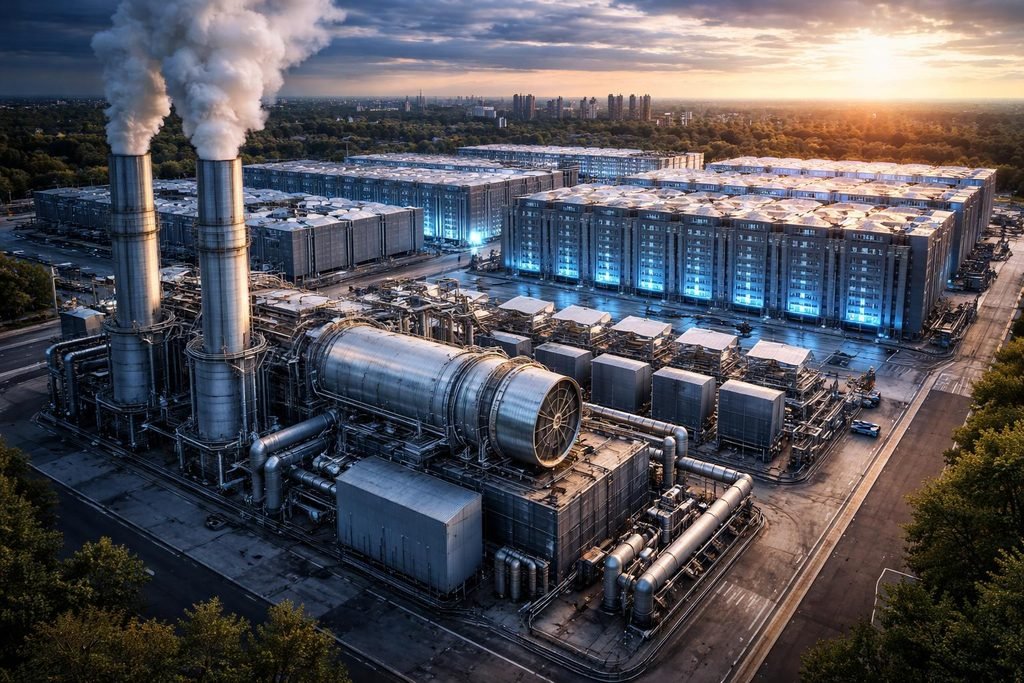
Large gas turbines and specialised generators require substantial manufacturing capacity, engineering expertise and installation resources. As technology companies compete for equipment, securing manufacturing slots and delivery schedules is becoming increasingly valuable.
This creates opportunities for established industrial suppliers.
Manufacturers of turbines, generators, electrical equipment, transformers, cooling systems and battery storage technology are becoming important participants in the AI infrastructure expansion.
Natural gas producers and pipeline operators may also benefit as data-centre developers seek reliable fuel supplies for dedicated power plants.
The investment opportunity extends beyond technology companies themselves. A growing portion of the AI infrastructure economy is connected to traditional industrial and energy businesses.
Natural Gas Returns to the Spotlight
The growing use of natural gas introduces a complicated dimension to the AI expansion.
Gas-fired generation offers flexibility and reliability, particularly when renewable sources cannot independently provide continuous electricity. However, greater consumption could increase pressure on regional gas markets and pipeline infrastructure.
The environmental implications are equally significant.
Long-term dependence on natural gas could increase greenhouse gas emissions, particularly if new generation facilities operate continuously rather than serving only as backup capacity.
Technology companies therefore face a balancing challenge between securing sufficient electricity, controlling operating costs and meeting their environmental commitments.
Renewables, nuclear energy and battery storage are likely to remain important parts of the broader energy strategy. However, their deployment timelines, availability and integration requirements differ significantly across markets.
The result could be a diversified energy model in which natural gas provides firm generation while renewable electricity, nuclear power and storage contribute to the wider supply system.
The Infrastructure Investment Cycle
Anthropic’s reported transaction reflects a broader change in how the AI industry approaches infrastructure investment.
The competitive advantage may increasingly depend not only on who develops the most advanced AI models, but also on who can secure the electricity required to operate them.
For energy companies, equipment manufacturers and infrastructure developers, this creates a potentially substantial new source of demand.
For investors, the development also introduces a different way of evaluating the AI economy. Electricity generation, fuel supply, grid infrastructure and industrial equipment are becoming increasingly connected to the financial performance and expansion capacity of technology businesses.
The next phase of artificial intelligence may therefore be shaped as much by power plants and energy networks as by processors and software.
AI is no longer just a technology infrastructure story. It is becoming an energy infrastructure story.
Sources
- Reuters – Anthropic’s reported $3.4 billion generator deal Reuters+1
- Financial Times – Anthropic’s gas-fired power agreement ft.com+1
- Power Engineering – Gas turbines and batteries for AI data centres Power Engineering
- IDCNOVA – Data centre energy and power developments IDCNOVA
- Denarni Fokus – Editorial Disclosure & Transparency