Short description
Nvidia, AMD and other semiconductor stocks recovered on Friday after a historic AI-driven selloff. However, regulatory uncertainty, data-centre investment concerns and shifting market expectations continue to challenge the sector’s recovery.
◉ Leading Friday’s semiconductor rebound, AMD surged 11%, while Intel shares climbed 8%.
◉ Recovering 4.2% after its steepest single-day drop since April 2025, the Philadelphia Semiconductor Index rebounded, while Nvidia shares gained nearly 3%.
◉ Investors are reassessing AI infrastructure spending, US regulatory risks and the sustainability of data-centre expansion.
A Sharp Market Reversal
US semiconductor stocks staged a significant recovery on Friday, November 6, following one of the sector’s most aggressive selloffs in recent years.
The rebound came after Thursday’s dramatic decline, when investors rapidly reduced exposure to artificial intelligence-related companies amid growing uncertainty surrounding future data-centre investments and potential regulatory changes in the United States.
The recovery was led by Advanced Micro Devices (AMD), whose shares climbed approximately 11%. Intel gained 8%, Micron Technology advanced 5%, and Sandisk added 4%.
Nvidia shares recovered nearly 3%, while Broadcom recorded a more modest gain of less than 1%.
The Philadelphia Semiconductor Index (SOX) rose 4.2% on Friday, recovering part of the ground lost during the previous session.
Despite the recovery, the broader market picture remained mixed. The Nasdaq Composite gained 1.1%, the S&P 500 advanced 0.31%, while the Dow Jones Industrial Average declined 0.46%.
The contrasting performance suggests that investors were returning selectively to technology and semiconductor companies rather than embracing a broad market recovery.
What Triggered The Selloff?
The immediate pressure came from changing expectations surrounding US political and regulatory policy.
Following Democratic victories in the midterm elections, investors began reassessing the potential impact of tighter regulation on artificial intelligence infrastructure and data-centre construction.
The concerns were particularly relevant for semiconductor manufacturers whose growth expectations increasingly depend on sustained investment in AI computing capacity.
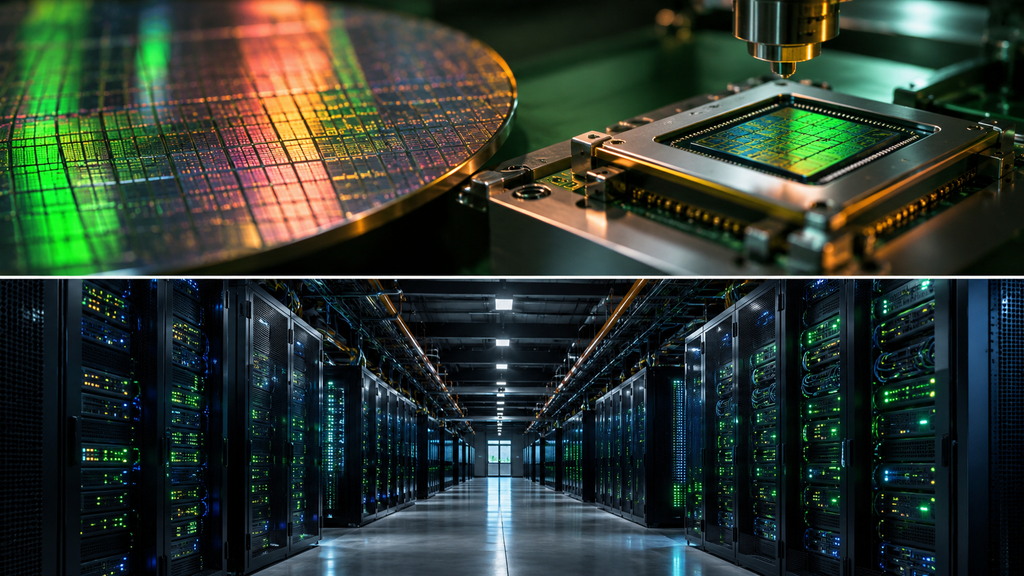
Data centres require enormous quantities of advanced processors, networking equipment and memory. Any delay in construction or reduction in infrastructure spending could influence the revenue expectations of companies across the semiconductor supply chain.
However, the market reaction also reflected broader concerns about inflation, interest rates and the scale of capital expenditure required to support the global AI expansion.
AI Demand Remains The Bigger Question
The latest recovery does not necessarily indicate that the underlying concerns have disappeared.
The distinction between demand for artificial intelligence and the pace of infrastructure investment remains important.
Technology companies may continue increasing their AI computing requirements even if regulatory restrictions, electricity availability, construction costs or local opposition slow individual data-centre projects.
Importantly, a slower expansion in one US market does not automatically translate into weaker global demand. Major cloud providers operate internationally and can adjust the geographical distribution of their infrastructure investments.
For semiconductor manufacturers, the central question is therefore not simply whether AI demand will continue growing, but how quickly that demand translates into actual infrastructure spending and chip orders.
AMD’s recent business performance illustrates the strength of the underlying market. The company reported third-quarter 2026 revenue of $13.38 billion, representing year-over-year growth of approximately 44.7%. Its Data Center segment recorded particularly strong growth of 97%. finance.yahoo.com
A Recovery Still Facing Uncertainty
Another important development was the more measured position expressed by Texas Governor-elect Gina Hinojosa regarding data-centre development.
Her comments suggested that the objective was not necessarily to stop data-centre construction altogether, but to introduce stronger protections for local communities.
This distinction helped reduce some immediate fears that political changes could fundamentally undermine the US AI infrastructure expansion.
Nevertheless, regulatory uncertainty remains an important factor for investors assessing long-term semiconductor valuations.
The market will also be monitoring upcoming corporate earnings, capital expenditure announcements and guidance from major cloud infrastructure providers.
What Comes Next For Semiconductor Stocks?
Friday’s rebound demonstrated how quickly sentiment can change in a sector where valuations are closely connected to future expectations.
The semiconductor industry remains central to the development of artificial intelligence, cloud computing and advanced digital infrastructure. However, strong long-term demand does not eliminate the possibility of significant short-term price volatility.
Investors are now facing a more complicated market environment in which technological growth, political decisions, infrastructure constraints and monetary policy increasingly influence the same group of companies.
The latest rebound may represent the beginning of renewed confidence, but confirmation will require more than a single positive trading session.
For Nvidia, AMD and their competitors, the next phase of the AI investment cycle will depend on whether infrastructure spending continues to support the ambitious growth expectations already reflected in semiconductor valuations.
SEO Information
| SEO element | Content |
|---|---|
| SEO Title | Nvidia and AMD Rebound After AI Selloff |
| Meta Description | Nvidia and AMD recover after a historic semiconductor selloff. Explore the AI investment outlook, data-centre concerns and market recovery. |
| Focus Keyword | Nvidia and AMD stocks |
| Secondary Keywords | AI stocks, semiconductor stocks, Nvidia shares, AMD shares, AI investment |
| URL Slug | nvidia-amd-rebound-ai-selloff |