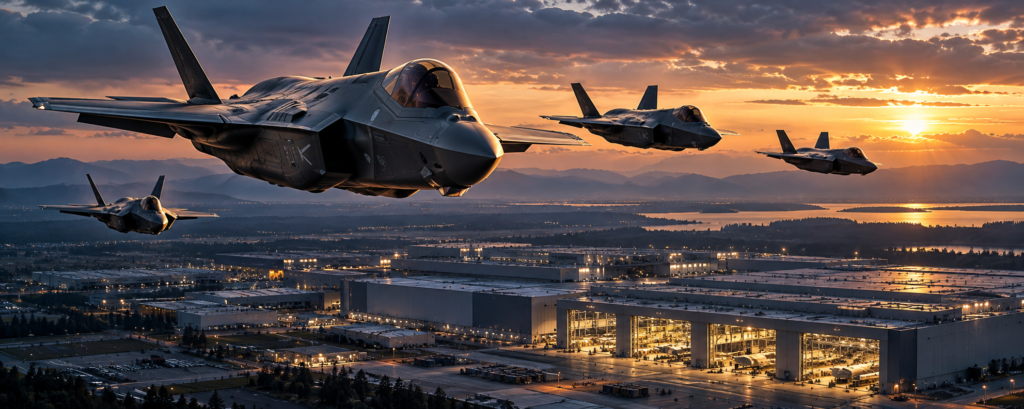
Lockheed Martin’s decade-long F-35 framework is strengthening the company’s revenue visibility and supporting a more optimistic analyst outlook. However, congressional approval, funding, production costs and execution remain critical uncertainties. Investing.com
◉ A decade of planned production strengthens revenue visibility. The framework covers at least 850 US F-35 aircraft over 10 years, alongside spare parts, upgrades and fleet sustainment.
◉ Morgan Stanley sees reduced programme risk. The agreement helped support an upgrade of Lockheed Martin, reflecting greater confidence in the F-35 programme’s long-term position.
◉ Political approval remains the key hurdle. The framework is not yet a final contract; multiyear contracting authority and the necessary appropriations are still required.
A Longer F-35 Horizon
The F-35 programme has become central to the long-term outlook for Lockheed Martin, and a newly announced procurement framework offers greater visibility into future production.
Announced on October 22, 2026, the agreement between Lockheed Martin and the US Department of Defense outlines a 10-year framework covering at least 850 US aircraft, with additional provisions for international customers, initial spare parts, modification kits and sustainment.
The planned production rate remains 156 aircraft annually across the programme’s Lots 21–30. Crucially, the framework is intended to replace fragmented annual purchasing decisions with a more predictable multiyear approach.
For a defence manufacturer operating complex global supply chains, predictability can influence investment decisions, supplier commitments and factory utilisation. It can also make production planning more efficient by allowing suppliers to order materials and expand capacity with greater confidence.
However, the framework does not establish a final contract value or settle all pricing and delivery terms. Those details remain subject to the formal contracting process.
Why Investors Are Reassessing
The agreement is significant because it addresses a strategic uncertainty surrounding Lockheed Martin’s largest aircraft programme.
Investors had been assessing whether defence spending priorities might shift toward missiles and other weapons systems at the expense of fighter aircraft. A longer-term F-35 framework reduces some of that uncertainty by reinforcing the programme’s role in US and allied defence planning.
Morgan Stanley responded by upgrading Lockheed Martin to Overweight from Equal-weight and raising its price target to $835 from $690, according to reporting published on October 26.
The investment case is not based solely on additional aircraft. It also reflects the potential value of a more predictable production schedule and continued demand for support, upgrades and spare parts throughout the aircraft’s operational life.

The Financial Impact
The framework could support a more stable operating environment across Lockheed Martin’s aeronautics business and its extensive supplier network.
Lockheed Martin has said the arrangement will support approximately 317,000 US jobs and generate around $79 billion in annual economic activity over the next decade. The company also expects more predictable procurement to improve purchasing efficiency and reduce supply-chain bottlenecks. Lockheed Martin Corp
The potential financial benefits extend beyond aircraft deliveries. The F-35 requires continuing maintenance, spare parts, software-related upgrades and modifications. These activities create opportunities for recurring revenue, although their profitability depends on contract terms, execution and operating costs.
Lockheed Martin must also commit substantial resources to expanding capacity and improving programme efficiency. The company has indicated that it will self-fund at least $7 billion in initiatives supporting the programme under the framework.
This creates a balance between long-term opportunity and near-term financial demands. Greater production visibility can support investment planning, but the benefits will depend on whether operational improvements translate into stronger cash generation.
Political And Execution Risks
Despite the positive market reaction, the agreement remains conditional.
Congress must provide the necessary multiyear contracting authority and funding before the framework can become a formal contract. Pricing, schedules and final contractual terms must also be established.
Production targets introduce another challenge. Maintaining an annual rate of 156 aircraft requires coordination across a complex international supply chain, where component shortages, manufacturing delays and cost overruns can affect delivery schedules.
Fleet readiness is another important consideration. A larger production commitment does not automatically resolve maintenance backlogs or improve the availability of aircraft already in service.
For investors, the distinction between an announced framework and a funded, executable contract is fundamental. The former improves visibility; the latter determines the timing and terms under which revenue can be recognised.
What Comes Next?
The F-35 framework reinforces the programme’s long-term strategic importance and provides Lockheed Martin with a clearer production horizon.
The next milestones are congressional authorisation, funding approval, final contract negotiations and evidence that manufacturing capacity and supply-chain performance can support planned deliveries.
The wider defence sector is also evolving. Governments are balancing spending on combat aircraft with demand for missiles, air defence, drones and other advanced capabilities. Lockheed Martin’s ability to serve several of these priorities may shape its longer-term competitive position.
The central question is whether greater contractual visibility can translate into improved execution, stronger margins and sustainable cash generation.
The framework provides a potentially important foundation, but its financial value will ultimately depend on implementation rather than the announcement alone.