Short description
Slovenia’s residential property market continues to reach new price records, with used apartments rising 8% and building land becoming 15% more expensive in the first half of 2026. Ljubljana remains the country’s most expensive market, while rising construction costs and limited supply continue to shape the outlook.
◉ The median price of a used apartment in Slovenia reached €3,520 per square metre, while Ljubljana climbed to €5,630.
◉ Residential building land recorded the strongest increase, rising 15% compared with the second half of 2025, highlighting growing pressure on future housing development.
◉ Approximately €1.84 billion in property transactions were recorded during the first half of 2026, while higher mortgage rates could slow transaction activity in the coming months.
Slovenia’s Property Market Reaches Another Milestone
Slovenia’s residential property market continues to demonstrate remarkable price resilience, despite affordability concerns and increasingly difficult conditions for households entering the housing market.
The latest figures published by the Surveying and Mapping Authority of the Republic of Slovenia (GURS) show that residential property prices reached new historical highs during the first half of 2026.
Used apartments became 8% more expensive compared with the second half of 2025, while house prices increased by 4%. Building land for residential construction recorded an even stronger increase of 15%.
The total value of Slovenian real estate transactions reached approximately €1.84 billion during the six-month period, covering around 15,500 purchase agreements.
The figures indicate that the market remains active, although rising prices are increasingly changing the relationship between property ownership, household purchasing power and investment returns.
An important distinction is that the latest report covers completed transactions during the first half of 2026. Its publication in November does not mean that the underlying price data represent November market conditions.
Ljubljana Remains Slovenia’s Most Expensive Market
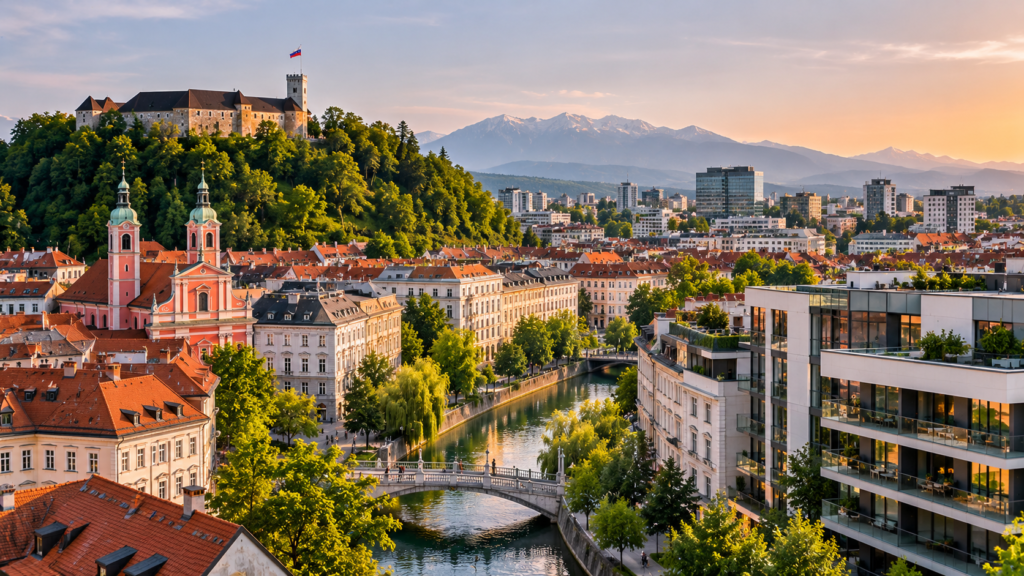
Ljubljana continues to dominate the national residential property market in terms of prices.
The median price of a used apartment in the capital reached €5,630 per square metre, making it significantly more expensive than other major Slovenian urban markets.
The coastal region followed with a median of €5,070 per square metre. Northern Ljubljana surroundings reached €4,580, while southern Ljubljana surroundings recorded €4,170.
Kranj and its surrounding area reached approximately €4,090 per square metre.
Maribor also crossed an important threshold. The median price of a used apartment reached €3,010 per square metre, exceeding €3,000 for the first time.
Celje followed closely at €2,980 per square metre.
| Market | Median used apartment price |
|---|---|
| Ljubljana | €5,630/m² |
| Slovenian Coast | €5,070/m² |
| Northern Ljubljana surroundings | €4,580/m² |
| Southern Ljubljana surroundings | €4,170/m² |
| Kranj and surroundings | €4,090/m² |
| Maribor | €3,010/m² |
| Celje | €2,980/m² |
These figures demonstrate how property prices are spreading beyond the capital. Ljubljana remains the leading market, but other regional centres are also experiencing significant increases.
Building Land Becomes More Expensive
One of the most important developments in the GURS report is the 15% increase in residential building land prices.
This matters because land acquisition is one of the fundamental components of residential development costs.
When land becomes more expensive, developers face higher initial investment requirements before construction even begins. Combined with rising labour costs, construction materials and financing expenses, this can make new residential projects more difficult to deliver profitably.
The pressure is particularly relevant in Ljubljana and its surrounding municipalities, where demand for housing remains strong and suitable development locations are limited.
The land-price increase could therefore influence the economics of future residential construction, including the pricing of new apartments entering the market.
Housing Supply Remains the Central Challenge
Despite continued price growth, the availability of new housing remains one of Slovenia’s most important structural challenges.
According to the reported GURS figures, approximately 2,550 new residential units were completed during the first half of 2026. Around 3,300 additional units were under construction at the end of the period, with approximately 4,600 more planned in the coming years.
However, planned projects do not automatically translate into completed homes. Construction timelines, financing, land availability, permitting procedures and development costs all influence how quickly new supply reaches the market.
The Bank of Slovenia’s October Financial Stability Report also highlights the imbalance between housing demand and supply, particularly in Ljubljana, coastal areas and other tourist destinations.
The central bank reported that residential property prices increased by more than 9% year-on-year during the first half of 2026. Residential rents also accelerated, reaching annual growth of 10.4% in the second quarter.
These developments suggest that the pressure extends beyond property ownership and is increasingly affecting the rental market.
Mortgage Rates Could Change Transaction Activity
Although prices continue to rise, the next phase of the market may not necessarily produce the same level of transaction activity.
GURS has highlighted the potential impact of higher mortgage interest rates on residential property purchases.
Financing costs directly influence how much households can borrow and the size of monthly repayments. Even when property prices remain stable or continue increasing, more expensive mortgages can reduce the number of financially viable buyers.
This creates an important distinction between property prices and transaction volumes.
A market can continue recording higher prices while the number of completed transactions begins to decline. This can happen when available supply remains limited but borrowing capacity becomes increasingly constrained.
For Slovenia, this is particularly relevant because residential property demand has historically been supported by employment levels, wage growth and the availability of housing credit.
If financing becomes more expensive, the market could experience slower turnover without necessarily seeing an immediate correction in property valuations.
GURS Valuations Enter Another Important Phase
Another development attracting attention in Slovenia’s property market concerns the country’s official mass valuation system.
On October 23, GURS announced that draft updated valuation models had been prepared to reflect market conditions as of January 1, 2026.
The consultation and coordination process with municipalities and professional stakeholders runs from November 2 to December 2, 2026.
The existing generalised property values still reflect the previous valuation reference date of January 1, 2025.
This distinction is important because official generalised values are not necessarily identical to the prices at which individual properties are actually sold.
The difference between administrative valuations and market transaction prices can influence discussions involving taxation, property records, financing and asset valuation.
The updated models represent another important step in Slovenia’s efforts to maintain a more current overview of its residential and commercial property stock.
What Comes Next for Slovenian Real Estate?
Slovenia’s property market enters the final months of 2026 with a combination of record prices, limited housing supply and changing financing conditions.
Ljubljana remains the country’s most expensive residential market, but price growth and investment activity are increasingly relevant across other cities and regional areas.
The 15% increase in building land prices also highlights a longer-term challenge. Without sufficient development land and economically viable construction projects, the supply of new housing could struggle to keep pace with demand.
At the same time, higher mortgage rates could gradually reduce purchasing capacity and slow transaction activity.
The central question for 2027 is therefore whether new residential construction can expand sufficiently to ease supply constraints, or whether limited availability will continue supporting elevated property prices.
For investors, developers and households, Slovenia’s property market is becoming increasingly dependent on the relationship between land availability, construction economics, financing costs and demographic demand.
The latest figures show that the market has not yet reached a clear turning point. Instead, it continues to evolve around a structural imbalance between the demand for housing and the supply of properties available at affordable prices.
Sources
- GURS – First-Half 2026 Slovenian Real Estate Market Report
- Svet24 – Slovenian Property Prices Reach New Records (November 5)
- Bank of Slovenia – Financial Stability Report, October 2026
- TopNepremicnine – GURS Valuations and Market Prices (November 6)
- Statistical Office of Slovenia – Residential Housing Price Indices
- Editorial Disclosure: Denarni Fokus – Editorial Disclosure & Transparency