Short description: Global markets face renewed uncertainty as Wall Street suffers a major technology-led sell-off while Britain’s first interest rate increase in more than three years reshapes expectations for equities, bonds and sterling.
◉ Wall Street suffers its steepest daily decline since April 2025, with AI-related stocks leading the sell-off.
◉ The Bank of England raises interest rates to 4%, introducing a new challenge for UK equities and bond investors.
◉ Inflation, energy prices, AI investment and central bank policy emerge as the key forces shaping the next market moves.
Global Markets Face a New Test
Global financial markets entered November 6 with investors reassessing risk across two major economic centres. In the United States, a sharp technology-led sell-off exposed growing concerns about the sustainability of the artificial intelligence investment boom. In the United Kingdom, the Bank of England’s decision to raise interest rates added another layer of uncertainty to an already complicated economic environment.
Although the developments have different origins, they reflect a common theme: financial markets are becoming increasingly sensitive to the cost of capital, economic policy and expectations surrounding future corporate growth.
The contrast between the two markets is particularly important. Wall Street is dealing with questions about technology valuations and future investment returns, while London is navigating higher borrowing costs and persistent inflationary pressures.
Wall Street’s Technology Sell-Off
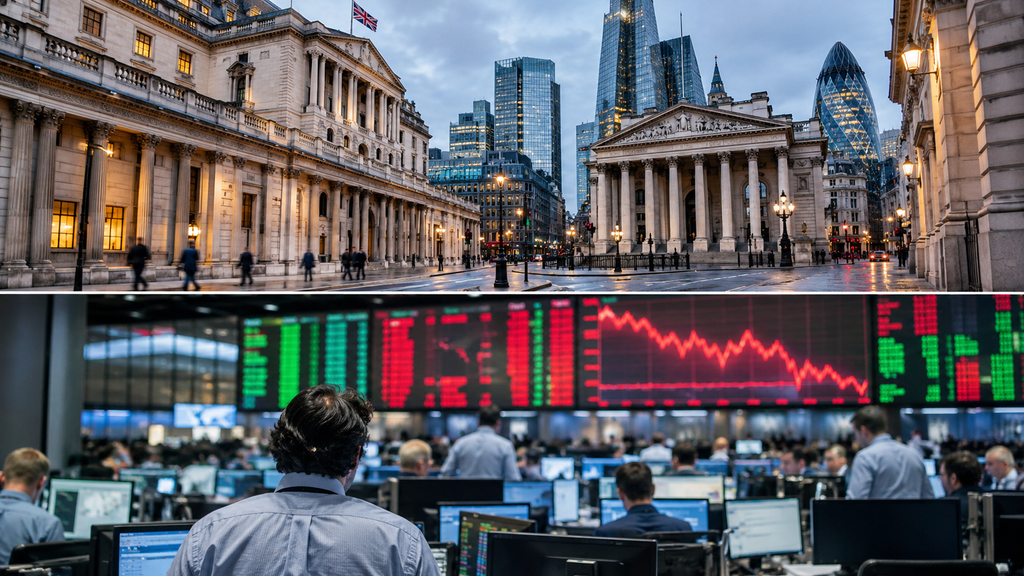
US equities experienced one of their most difficult trading sessions in more than a year on Thursday, November 5.
The S&P 500 declined approximately 4.36%, closing at 7,353.73. The Dow Jones Industrial Average lost 3.44%, falling to 51,523.06, while the Nasdaq Composite dropped 5.52% to 24,315.
The decline was particularly significant because it followed a strong rally after the US midterm elections. Investors had initially welcomed the political outcome, but the subsequent trading session revealed how quickly sentiment could change when concerns surrounding technology valuations returned.
Technology and semiconductor companies were at the centre of the pressure. Nvidia declined approximately 9.3%, while several other companies connected to semiconductor production and AI infrastructure experienced even larger losses.
The underlying concern extends beyond individual company earnings.
The AI investment cycle has become an important driver of corporate spending, infrastructure development and expectations for future economic growth. Data centres require enormous investments in processors, electricity, cooling systems and supporting infrastructure.
Investors are increasingly questioning whether the pace of spending can be maintained and whether the expected returns will justify the valuations attached to companies benefiting from the trend.
Political developments have added another dimension. Democratic victories in the US midterm elections raised concerns about potential restrictions on data-centre development, particularly in regions where energy consumption and local infrastructure have become controversial issues.
The Nasdaq’s decline also pushed the index into correction territory, highlighting the scale of the reassessment taking place across technology shares.
The Bank of England Changes Direction
While US investors were dealing with technology-related volatility, the UK market faced a different challenge.
On November 5, the Bank of England raised its benchmark interest rate by 25 basis points, from 3.75% to 4%. It was the first increase in more than three years.
The decision reflected growing concerns about inflation, particularly the potential impact of elevated energy prices associated with the conflict involving the United States and Iran.
The Monetary Policy Committee voted 8–1 in favour of the increase, with one member supporting an even larger adjustment.
The central bank also indicated that additional tightening could become necessary if energy costs remain elevated and inflationary pressures spread through the wider economy.
For investors, the implications extend across several asset classes.
Higher interest rates generally increase financing costs for businesses and households. They can also change the relative attractiveness of equities compared with government bonds and other interest-bearing investments.
British government bond yields moved higher following the decision, with the two-year gilt yield reaching approximately 4.77%.
Sterling remained broadly stable immediately following the announcement, while expectations for additional rate increases strengthened.
The central question is whether the Bank of England is responding to a temporary energy-driven inflation shock or entering a more prolonged period of monetary tightening.
London Equities Under Pressure
The UK equity market faced competing forces.
The FTSE 100 had reached a near three-month high earlier in Thursday’s session, supported by improving international sentiment. However, the index eventually closed approximately 0.43% lower at 10,782.66.
Financial and defence shares were among the weaker sectors.
UK banking stocks experienced renewed selling pressure after their strong performance in the previous session. HSBC, Barclays, NatWest and Standard Chartered all recorded losses.
Defence companies also weakened following the US political developments, as investors reassessed potential implications for future military spending.
In contrast, precious-metals mining companies benefited from stronger gold prices. Defensive sectors, including retailers and personal-care businesses, also provided some support.
This divergence illustrates the increasingly selective nature of equity investment. Even when broader indices remain relatively resilient, sector performance can vary considerably depending on interest rates, commodity prices and political developments.
The Inflation and Energy Connection
The monetary policy outlook is increasingly influenced by developments in energy markets.
The conflict involving the United States and Iran has contributed to uncertainty around global oil and gas supplies. Higher energy costs can influence inflation through transportation, manufacturing, electricity and household expenditure.
For central banks, this creates a difficult balance. Raising interest rates can help contain inflation expectations, but it can also increase borrowing costs and weaken economic activity.
The Bank of England’s latest decision demonstrates how energy-related inflation can influence monetary policy even when domestic economic conditions do not necessarily indicate an overheating economy.
The Federal Reserve faces a similarly complicated environment. Investors are watching inflation and employment data for clues about the timing and direction of its next policy decisions.
What Investors Are Watching Next
The next phase of market activity will depend on several interconnected developments.
In the United States, the October employment report is particularly important. Employment growth, wage developments and unemployment figures could influence expectations for Federal Reserve policy.
Technology earnings will also remain under scrutiny. Investors are likely to demand stronger evidence that substantial AI infrastructure investments can translate into sustainable revenue and profitability.
In Britain, attention will turn to the inflation outlook, energy prices and the possibility of further interest rate increases. The relationship between government bond yields, sterling and domestic economic growth will remain important for UK assets.
The broader international picture is equally relevant. Oil prices, geopolitical developments and central bank decisions could influence capital flows between equities, bonds, commodities and currencies.
A More Selective Market Environment
The developments across the US and UK illustrate how quickly financial markets can move from optimism to reassessment.
The technology sell-off demonstrates that strong long-term growth narratives do not eliminate valuation risks. Meanwhile, Britain’s monetary tightening highlights the difficulties facing economies dealing with persistent imported inflation.
Neither development necessarily signals a prolonged global market downturn. However, together they underline a more demanding environment in which investors must distinguish between sustainable corporate growth, short-term market enthusiasm and changing macroeconomic conditions.
The coming trading sessions will provide further evidence of whether the recent volatility represents a temporary adjustment or the beginning of a broader repricing of financial assets.
For now, the interaction between AI investment, energy prices, inflation and central bank policy remains at the centre of the global market narrative.