Short description: Anthropic’s latest pre-IPO financial disclosures reveal the extraordinary capital requirements behind the artificial intelligence boom. The Claude developer reported nearly $17 billion in third-quarter revenue while disclosing approximately $895.4 billion in aggregate contractual commitments, largely connected to computing infrastructure. The figures expose a defining challenge for the AI industry: converting explosive commercial demand into sustainable profitability while financing an unprecedented expansion of computing capacity.
◉ Anthropic reported $16.96 billion in third-quarter revenue, representing approximately 47% growth compared with the previous quarter.
◉ The company disclosed $895.4 billion in aggregate purchase and lease commitments, with approximately $69.8 billion due within the following 12 months.
◉ Rising computing costs pushed Anthropic into a $567 million operating loss, highlighting the financial challenge of scaling advanced AI infrastructure.
The Economics Behind AI Growth
Anthropic’s latest disclosures provide a revealing picture of the financial structure supporting the global AI expansion.
The company generated $16.96 billion in revenue during the third quarter, compared with $11.56 billion in the previous quarter and approximately $2.5 billion during the first nine months of 2025.
That represents more than twelvefold year-on-year growth.
However, the financial picture becomes more complicated when infrastructure commitments are considered.
The disclosed $895.4 billion covers aggregate contractual purchase and lease obligations rather than an immediate cash payment. Approximately $447.5 billion is expected to be incurred by the end of 2030, with most of the remainder extending between 2031 and 2045.
Nearly $69.8 billion falls due during the 12 months following September 30, 2026.
This distinction is essential: the headline figure represents long-term commitments, not the company’s current annual operating expenditure.
Computing Capacity Becomes a Financial Risk
Advanced AI models require enormous computing resources.
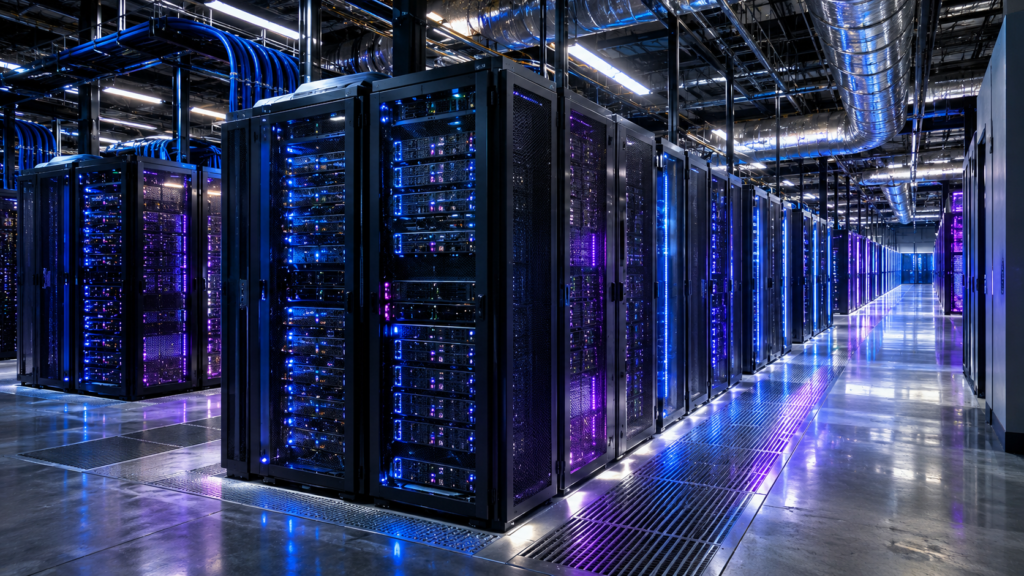
Training, inference, enterprise deployment and continuous model development depend on specialised processors, high-bandwidth memory, networking equipment, electricity and large-scale data centres.
Anthropic’s expansion therefore depends on a complex network of infrastructure providers, including major technology companies and cloud platforms.
The amended disclosure also highlights a potential weakness in this structure: some infrastructure partners depend on external financing and credit support to acquire chips and develop computing capacity.
If that financing becomes unavailable or more expensive, contracted capacity could be delayed, repriced or reduced.
This introduces a second layer of risk. Anthropic must not only finance its own growth but also rely on suppliers capable of financing and delivering the infrastructure it has contracted.

Revenue Growth Does Not Guarantee Profitability
The third-quarter operating result illustrates the challenge.
Anthropic reported a $567 million operating loss, reversing an operating profit of $974 million in the previous quarter.
One significant factor was approximately $5 billion in additional computing costs incurred during the quarter. The company relied on more expensive short-term computing capacity when demand exceeded the availability of longer-term contracted resources.
Its adjusted operating income was approximately $2.5 billion, although the adjusted operating margin declined to 15% from 19%.
The reported net loss reached $23.29 billion. This figure requires additional context because a substantial portion reflected non-cash accounting adjustments associated with convertible financing instruments.
Consequently, the operating result and net result describe different aspects of the company’s financial performance.
The distinction matters when evaluating the economics of an AI company whose valuation, financing arrangements and infrastructure expansion are changing rapidly.
The Infrastructure Investment Cycle
Anthropic’s commitments also reveal how interconnected the AI infrastructure economy has become.
Large AI developers sign multiyear agreements with cloud providers and technology suppliers. Those suppliers, in turn, commit capital to data centres, advanced chips, electricity infrastructure and networking capacity.
This creates a reinforcing investment cycle.
AI companies need more computing capacity to expand their products. Infrastructure providers invest to satisfy that demand. Investors finance both sides, expecting future AI revenue to support the resulting commitments.
But the structure also creates potential concentration and financing risks.
If demand growth slows, infrastructure utilisation may fall below expectations. If financing costs increase, suppliers may face pressure to renegotiate agreements. If computing prices decline, previously contracted capacity could become less economically attractive.
The industry is therefore increasingly exposed to the relationship between AI adoption, capital availability and the long-term economics of computing.
What the Numbers Mean for the AI Industry
Anthropic’s disclosures are relevant beyond its own prospective stock-market listing.
They illustrate the scale of capital required to compete in advanced AI and the difficulty of translating rapid revenue expansion into sustainable operating margins.
For public-market investors, the key distinction is between commercial momentum and financial efficiency.
A company can generate exceptional revenue growth while simultaneously increasing its dependence on external infrastructure, long-term contracts and financing arrangements.
The next stage of the AI industry may therefore be judged not only by model capabilities and customer adoption, but also by computing costs, infrastructure utilisation, capital requirements and cash generation.
Anthropic’s nearly $900 billion commitment figure places that question directly at the centre of the AI investment debate.
The IPO Valuation Question
The scale of these commitments is particularly relevant as Anthropic prepares for its public-market debut.
The company reported $131.8 billion in cash and short-term investments at the end of September 2026. While this provides substantial financial flexibility, the relationship between available liquidity and future contractual obligations remains an important consideration.
Not all commitments are unconditional. Some $214 billion of the disclosed obligations can be cancelled or depend on specified conditions being met, according to the updated prospectus coverage.
The IPO therefore presents investors with two very different dimensions of the same business:
- A rapidly expanding enterprise AI operation with exceptional revenue growth.
- A capital-intensive infrastructure model requiring enormous long-term financial commitments.
The company’s eventual public valuation will depend partly on how investors assess that balance.
Financial Snapshot
| Financial metric | Q3 2026 |
|---|---|
| Revenue | $16.96 billion |
| Revenue growth QoQ | +47% |
| Operating result | -$567 million |
| Adjusted operating income | $2.5 billion |
| Net loss | $23.29 billion |
| Total contractual commitments | $895.4 billion |
| Cash and short-term investments | $131.8 billion |
Sources
- Axios – Anthropic’s Spending Commitments Surge to Nearly $900 Billion Axios
- Reuters – Anthropic Revenue Growth Slows as Compute Financing Risks Mount MarketScreener
- Euronews – Anthropic’s $895 Billion Compute Commitments Euronews
- Associated Press – Anthropic Posts $17 Billion Quarterly Revenue AP News
- Editorial Disclosure: Denarni Fokus – Editorial Disclosure & Transparency