Short description: Meta is expanding its Muse AI agent to Apple Watch and Android Wear OS, bringing voice interaction, messaging and personal task management directly to smartwatches. The move strengthens Meta’s ambition to make AI agents part of everyday digital life.
◉ Meta Muse is now accessible through Apple Watch and Wear OS, extending the AI agent beyond smartphones and tablets.
◉ Users can communicate with Muse through text, voice dictation and direct voice calls from compatible smartwatches.
◉ The expansion signals a broader competition to make AI agents continuously accessible across everyday devices, rather than limiting them to standalone applications.
Meta Brings AI to the Wrist
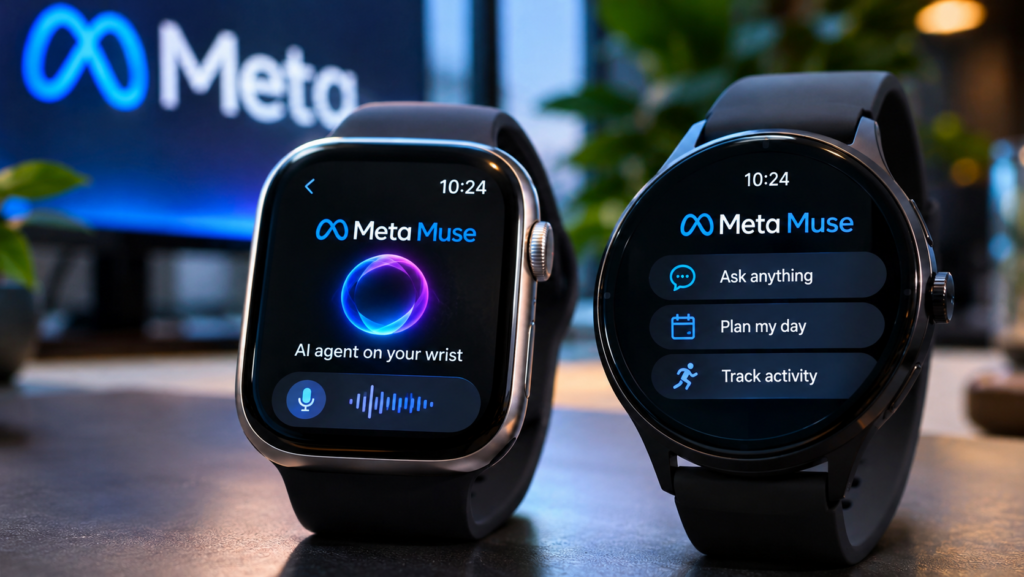
Meta is expanding the distribution of its personal AI agent, Muse, with support for Apple’s smartwatch platform and Google’s Wear OS.
Announced on November 9, the expansion allows users to interact with Muse directly from their wrists, without having to open the assistant on a smartphone.
The smartwatch application supports three primary interaction methods: text messaging, voice dictation and direct voice calls. Users can also add a Muse shortcut to their watch face, providing faster access to the assistant.
The development represents another step in Meta’s strategy to make Muse available across multiple devices and digital environments.
Instead of positioning AI as something users access only when opening an application, Meta is moving towards a model in which its assistant remains accessible throughout the day.
From Digital Assistant to Personal Agent
Muse was introduced in September 2026 as Meta’s personal AI agent, designed to perform tasks rather than simply answer questions.
Powered by Meta’s Muse Spark model, the platform is designed to interact with connected services, manage tasks and coordinate activities on behalf of users.
Its capabilities include managing email, organising schedules, researching information, planning travel and assisting with purchases.
Meta has also developed a dedicated secure virtual environment for Muse, allowing the agent to operate through its own browser and connected services.
The company says users retain control over permissions and that approval is required for sensitive actions, such as sending emails or completing purchases.
Bringing these capabilities to smartwatches introduces a new access point for an assistant designed to work beyond traditional conversational interactions.

Why Smartwatches Matter
The smartwatch market offers an interesting opportunity for AI companies.
Unlike smartphones, which users frequently need to unlock and navigate, smartwatches provide immediate access through a relatively small interface.
This makes them particularly suitable for short instructions, reminders, voice interactions and time-sensitive notifications.
For Meta, the strategic value extends beyond the number of additional devices supported.
A smartwatch can become an everyday entry point into a broader AI ecosystem. Users could potentially ask Muse to check their calendar, follow up on a task or provide information while travelling, exercising or working.
The watch itself does not need to perform every operation. More complex tasks can be processed through the connected AI infrastructure.
This separation between the device used to communicate and the infrastructure performing the work is central to the emerging personal-agent model.
The Competition for Wearable A
Meta’s decision to support both major smartwatch ecosystems is strategically significant.
Apple already operates a mature ecosystem connecting the iPhone, Apple Watch and other devices. Google, meanwhile, continues developing Wear OS alongside its broader Android and Gemini AI strategy.
Meta is taking a different approach by distributing its own AI assistant across platforms that it does not control.
This creates an interesting competitive dynamic.
Rather than requiring consumers to purchase Meta hardware, the company can potentially reach users through devices they already own.
The approach also creates a potential distribution advantage: the assistant can build usage and familiarity without depending entirely on sales of new hardware.
Muse is also part of Meta’s wider wearable ambitions. At its September Connect event, the company presented plans to bring Muse to its AI glasses and introduced Muse Charm, a dedicated companion device designed to provide direct access to the assistant.
The smartwatch expansion therefore fits into a larger strategy of making Muse available wherever users interact with technology.
The Business Model Behind Personal AI
As AI agents become more capable, technology companies are competing not only for application downloads but also for repeated daily interactions.
A successful personal agent could become an important interface for accessing services, managing information and completing transactions.
For Meta, this creates opportunities to strengthen user engagement across its ecosystem and potentially develop additional subscription-based AI services.
However, the business model also introduces important challenges.
Users must trust an assistant that can access personal information, communicate with external services and perform actions on their behalf.
Privacy, security, reliability and transparency will therefore remain central to the adoption of agentic AI.
The smaller smartwatch interface makes this especially important. Users need clear information about what an agent is doing, what permissions it has and when human approval is required.
What Comes Next?
Meta’s expansion of Muse to Apple Watch and Wear OS illustrates how the AI industry is moving beyond the smartphone screen.
The next phase of competition could increasingly involve assistants operating across watches, glasses, computers, smartphones and dedicated AI hardware.
The companies that successfully combine accessibility, useful automation, strong privacy protections and integration with existing services may gain an important advantage.
Meta is attempting to establish Muse as a persistent personal AI companion rather than another application users occasionally open.
Its arrival on smartwatches is a relatively small product expansion, but strategically it represents a much larger ambition: making AI agents part of the everyday technology experience.
Sources
- TechCrunch – Meta’s AI Agent Muse Lands on Apple Watch and Wear OS (November 10, 2026).
- MacRumors – Meta’s Muse AI Agent Comes to Apple Watch (November 9, 2026).
- ITmedia – Meta Muse Supports Apple Watch and Wear OS (November 10, 2026).
- Meta – Introducing Muse: The World’s First Personal AI Agent.
- Editorial Disclosure: Denarni Fokus – Editorial Disclosure & Transparency