Short description: Barrick Mining exceeded third-quarter earnings expectations as higher realised gold prices lifted revenue and profitability. The company maintained its 2026 gold and copper production forecasts, while rising operating costs and lower processed ore grades remain important factors for investors.
◉ Adjusted earnings reached $0.82 per share, beating the analyst consensus of $0.79.
◉ Despite a 22% year-over-year revenue gain, third-quarter sales came in at $5.07 billion, falling short of the $5.13 billion market consensus.
◉ Gold output totalled 816,000 ounces, with the company maintaining its annual production forecast of 2.90–3.25 million ounces.
◉ Adjusted net earnings increased 37% to $1.35 billion, supported by higher realised gold prices.
◉ Gold all-in sustaining costs rose to $1,911 per ounce, highlighting the growing importance of cost control despite stronger bullion prices.
Earnings Beat Meets Revenue Expectations
Barrick Mining delivered a stronger-than-expected third-quarter earnings performance, reinforcing the contribution of elevated gold prices to the profitability of major mining companies.
The company reported adjusted earnings of $0.82 per share, exceeding the analyst consensus of $0.79.
Revenue reached $5.07 billion, representing 22% growth compared with the same quarter last year. However, the figure remained slightly below the market estimate of $5.13 billion.
The difference between earnings and revenue performance is important. Barrick generated stronger profitability despite narrowly missing its sales forecast, reflecting the impact of higher realised gold prices and its operating performance.
Adjusted net earnings increased 37% year over year to $1.35 billion, while attributable adjusted EBITDA advanced 22% to $2.47 billion.
The figures demonstrate how favourable commodity pricing can translate into stronger earnings, although production costs and operational efficiency remain critical variables.
Gold Prices Support Revenue Growth
The main driver behind Barrick’s stronger financial performance was the increase in realised gold prices.
The average realised gold price reached $4,243 per ounce, up 23% from the corresponding period in 2025. This allowed the company to generate higher revenue despite producing slightly less gold than a year earlier.
Gold production totalled 816,000 ounces, compared with 829,000 ounces in the third quarter of 2025. On a year-to-date basis, attributable production reached 2.331 million ounces.
The production comparison requires some context: Barrick reported that output increased 6% year over year when excluding divested assets. The difference reflects changes in the company’s portfolio rather than only the performance of its continuing mines. Barrick Reports Third Quarter 2026 Results+1
The increase in realised gold prices illustrates the earnings sensitivity of large mining companies to movements in bullion markets.
However, higher gold prices also influence royalty payments and other production-related expenses, meaning that stronger selling prices do not translate directly into equivalent increases in operating margins.

Production Costs Remain a Challenge
One of the most important details in the quarterly results was the increase in all-in sustaining costs (AISC).
Barrick reported gold AISC of $1,911 per ounce, compared with $1,538 a year earlier, an increase of approximately 24%.
The company attributed the increase primarily to:
- Lower grades of ore processed.
- Higher royalties associated with elevated gold prices.
- Increased diesel costs.
- Higher sustaining capital expenditure.
Total cash costs increased to $1,386 per ounce, from $1,137 in the prior-year quarter.
This is an important distinction for assessing mining profitability. Gold prices may rise substantially, but mining companies must also manage extraction costs, energy consumption, labour expenses and the quality of available ore.
Barrick’s ability to maintain production discipline while managing these pressures will remain an important factor in its future operating performance.
Mining Operations Deliver Mixed but Improving Results
Barrick highlighted several operational developments across its portfolio.
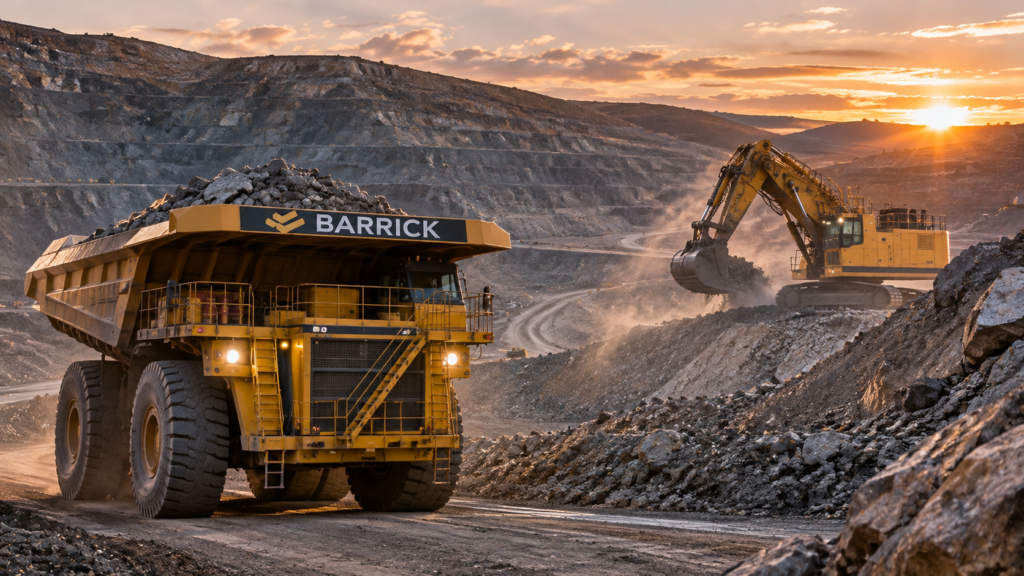
Cortez benefited from the continued ramp-up of the Goldrush project, while the Gold Quarry roaster at Carlin recorded its strongest quarterly performance.
The Loulo-Gounkoto complex also delivered an important improvement, increasing production by 16% compared with the second quarter.
Its ramp-up remains ahead of schedule, according to the company.
These developments demonstrate that production growth is not solely dependent on existing mining operations. New projects, processing improvements and operational optimisation can also influence future output.
Barrick is continuing to advance its longer-term growth pipeline while maintaining its existing production targets.
2026 Production Guidance Unchanged
Despite the year-over-year decline in reported gold production, Barrick maintained its full-year 2026 production outlook.
| Production metric | 2026 guidance |
|---|---|
| Gold production | 2.90–3.25 million oz |
| Gold guidance midpoint | 3.08 million oz |
| Copper production | 190,000–220,000 tonnes |
The company also maintained its gold AISC guidance of $1,760–$1,950 per ounce.
Its copper production target remains unchanged despite quarterly production of 50,000 tonnes, compared with 55,000 tonnes in the same period last year.
Maintaining the guidance indicates management’s confidence in the expected production contribution from its mines during the final quarter.
The fourth quarter will therefore be important for assessing whether the company can deliver within its full-year production range. Barrick Reports Third Quarter 2026 Results+1
Shareholder Returns and Balance Sheet
Barrick continued to generate substantial cash flow and return capital to shareholders.
Operating cash flow reached $2.49 billion during the quarter, while attributable free cash flow totalled $640 million.
The company returned approximately $1.04 billion to shareholders through $761 million in share repurchases and its quarterly dividend.
The board declared a dividend of $0.175 per share, payable on 15 December 2026 to shareholders of record on 30 November.
Barrick also ended the quarter with net cash of approximately $900 million, compared with $300 million in the third quarter of 2025.
The combination of cash generation, share repurchases and a stronger net cash position provides an additional perspective on the company’s financial performance beyond adjusted earnings alone. Barrick Reports Third Quarter 2026 Results+1
What Investors Are Watching Next
Barrick’s latest results highlight the opportunities and challenges facing major gold producers in a strong bullion-price environment.
The most important factors for the coming quarters include:
- Gold prices: Whether elevated realised prices continue supporting revenue and operating cash flow.
- Production volumes: Whether the company delivers its 2026 guidance, particularly through the final quarter.
- Cost inflation: Whether higher royalties, diesel expenses and sustaining capital requirements continue putting pressure on AISC.
- Project execution: Whether Goldrush and Loulo-Gounkoto maintain their operational progress.
- Capital returns: Whether strong cash generation continues supporting dividends and share repurchases.
The wider gold-mining sector is also facing an important profitability test. Higher bullion prices have improved revenue across the industry, but the sustainability of margins increasingly depends on how effectively companies control production costs.
Strong Earnings, but Execution Remains Key
Barrick’s third-quarter results demonstrate the financial benefit of higher gold prices, with adjusted earnings exceeding expectations and revenue increasing by 22%.
The unchanged production outlook provides continuity, while the company’s cash generation and shareholder distributions reinforce its financial position.
Nevertheless, the increase in all-in sustaining costs highlights a challenge that cannot be overlooked. Stronger gold prices alone do not guarantee proportionate improvements in mining profitability.
For Barrick, the next stage will depend on maintaining operational discipline, controlling costs and converting its project pipeline into sustainable production growth.
The distinction between benefiting from a strong gold market and delivering stronger underlying mining economics will remain central to the company’s financial performance.