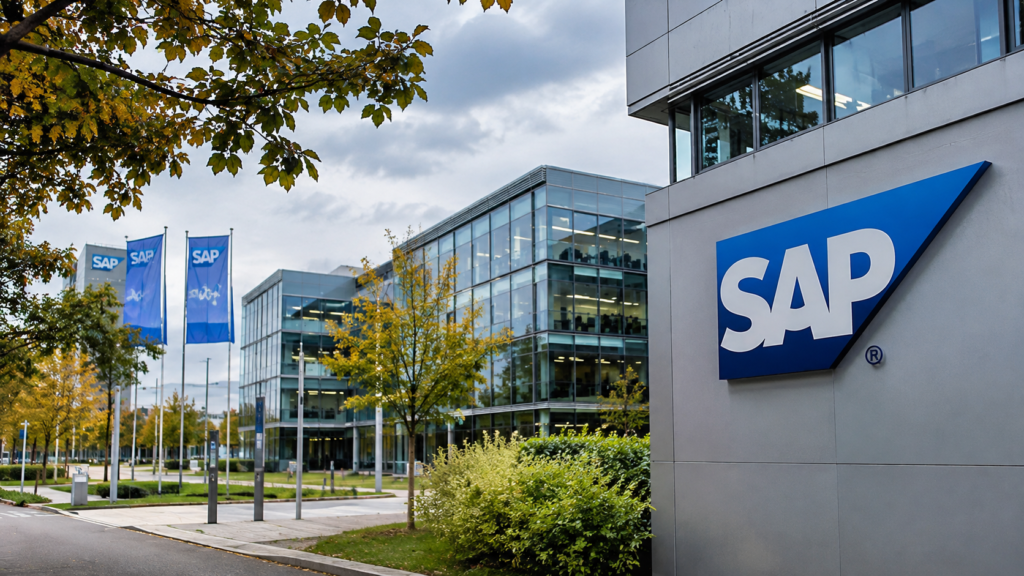
Short description: SAP shares advanced after JPMorgan upgraded the German software group, arguing that the transition from experimental AI projects to large-scale enterprise deployment could strengthen established software providers. The shift puts data, security, integration and measurable returns at the centre of the AI investment cycle.
◉ JPMorgan upgraded SAP to Overweight from Neutral and increased its December 2028 price target to €275 from €175.
◉ SAP shares gained approximately 2.1% in early German trading as investors reassessed the company’s position in the enterprise AI market.
◉ The next phase of AI adoption could favour software companies with established business data, governance systems and deep integration into corporate operations.
◉ AI deployment costs, cybersecurity and the ability to demonstrate measurable productivity gains remain important challenges for enterprise customers.
From AI Experiments to Commercial Deployment
Artificial intelligence is entering a different phase of corporate adoption. After two years of intense experimentation, businesses are increasingly evaluating how AI systems can operate inside their existing processes, execute tasks and generate measurable financial returns.
This transition is becoming an important factor in the valuation of established enterprise software companies.
SAP shares rose approximately 2.1% in early German trading on Monday after JPMorgan upgraded the stock from Neutral to Overweight. The bank raised its price target to €275 for December 2028, compared with its previous €175 target for December 2027.
The central argument behind the upgrade is that the commercialisation of enterprise AI could benefit companies that already control critical business workflows and information systems.
While developing an AI demonstration or prototype is relatively straightforward, deploying autonomous agents across finance, procurement, human resources and supply chains requires considerably more infrastructure.
Companies need reliable data, access permissions, operational context, integration with existing applications and systems that can monitor the actions performed by AI agents.
This creates a potentially important competitive advantage for established enterprise software providers.
Why Business Data Matters
The development of increasingly capable AI models has intensified competition across the technology industry. However, access to powerful models alone does not guarantee successful enterprise deployment.
A corporate AI agent must understand how a business operates, which information it can access, what procedures it must follow and which actions require human approval.
SAP is positioning its Business Data Cloud, Business Technology Platform, Signavio and Knowledge Graph as part of this infrastructure.
These products connect business information and operational processes, allowing AI systems to work with structured corporate data rather than relying exclusively on general-purpose language models.
The company’s strategy also extends beyond its own software environment, with growing support for information from non-SAP systems.
This matters because large enterprises rarely operate through a single technology provider. Their information is distributed across different applications, databases, cloud platforms and legacy infrastructure.
The ability to connect these environments could become an important differentiator as AI agents move into production.

The Three Challenges of Enterprise AI
The investment thesis increasingly revolves around three operational requirements: context, control and cost.
1. Context and data quality
AI agents need access to accurate and relevant information to perform complex tasks. In corporate environments, this means understanding financial records, contractual obligations, supply-chain relationships and internal procedures.
SAP’s established position in enterprise resource planning gives it access to business processes that are difficult to replicate through standalone AI applications.
2. Security and governance
Autonomous agents introduce new operational and cybersecurity risks. Unlike conventional chatbots, agents can interact with systems, retrieve information and execute actions.
Organisations therefore need clear permissions, audit trails and mechanisms for human supervision.
SAP’s Joule assistant is designed to operate within existing customer permissions and governance structures. This approach could be particularly relevant for financial institutions, manufacturers and government organisations where operational controls are essential.
3. Cost and return on investment
The economics of AI deployment remain a significant challenge.
The analyst research cited in the upgrade highlighted findings that 67% of organisations with AI agents in production had exceeded their budgets. It also referenced expectations that agent-related costs could increase substantially by 2028, even as individual AI model token prices decline.
This creates a distinction between cheaper AI models and cheaper business automation.
A company may pay less for each individual AI interaction while spending more overall as it deploys thousands of agents across its operations.
For SAP, the opportunity lies in connecting AI pricing to completed tasks, optimising model selection and using business context to improve execution efficiency.
Cloud Growth Supports the Investment Thesis
The argument for SAP is not based exclusively on future AI opportunities. Its cloud business already provides an important financial foundation.
SAP reported third-quarter 2026 cloud revenue growth of 26%, while its current cloud backlog reached €24.1 billion, an increase of 28% year over year and 26% at constant currencies.
Total revenue increased 13%, while non-IFRS operating profit advanced 18%.
These figures indicate that demand for SAP’s cloud infrastructure remains an important component of its growth profile.
JPMorgan’s revised estimates reflect greater confidence in the company’s ability to maintain margins while expanding its AI and cloud offering.
The bank increased its 2027 earnings-per-share estimate to €8.38 from €8.20 and raised its 2026–2028 non-IFRS EBIT and EPS forecasts by low-to-mid single digits.
Its longer-term thesis anticipates approximately 17% annual non-IFRS EPS growth through 2028.
However, cloud backlog should not be confused with immediately recognised revenue. The conversion of contracted demand into actual sales, together with customer retention and profitability, remains central to evaluating the quality of growth.
The Competitive Landscape Is Changing
SAP is not operating in isolation.
Microsoft, Oracle, Salesforce and other technology providers are investing heavily in enterprise AI, cloud infrastructure and autonomous agents.
The competitive environment is moving beyond the capabilities of individual AI models towards the integration of intelligence into existing business operations.
This creates different opportunities for software companies.
Model developers compete on performance, speed and cost. Cloud providers compete on infrastructure and computing capacity. Enterprise software providers compete on business integration, data access, workflow ownership and governance.
SAP’s advantage is its established presence in critical corporate systems, but this does not guarantee that customers will choose its AI products over competing solutions.
The decisive question is whether businesses will expand their spending with established software providers as AI becomes embedded in daily operations, or redirect more of their budgets towards independent AI platforms.
What the Market Is Watching
Monday’s share-price reaction demonstrates that investors are reassessing the relationship between artificial intelligence and traditional enterprise software.
For much of the recent AI investment cycle, established software companies faced concerns that powerful general-purpose models could weaken demand for traditional applications.
The emerging enterprise-agent model introduces a different possibility: AI could increase the importance of the systems that hold corporate data and manage business processes.
That shift could benefit companies with established customer relationships, extensive integrations and trusted operational infrastructure.
Nevertheless, the investment case still depends on execution. The conversion of cloud backlog, commercial adoption of Joule, operating margins and measurable customer productivity gains will be more important over time than the number of AI announcements.
SAP’s challenge is to demonstrate that its existing enterprise position can translate into a meaningful share of the commercial AI market.
The broader technology sector is approaching an important transition: from selling access to artificial intelligence towards delivering measurable business outcomes.
For enterprise software companies, that transition could redefine competitive advantages, revenue models and long-term valuations.