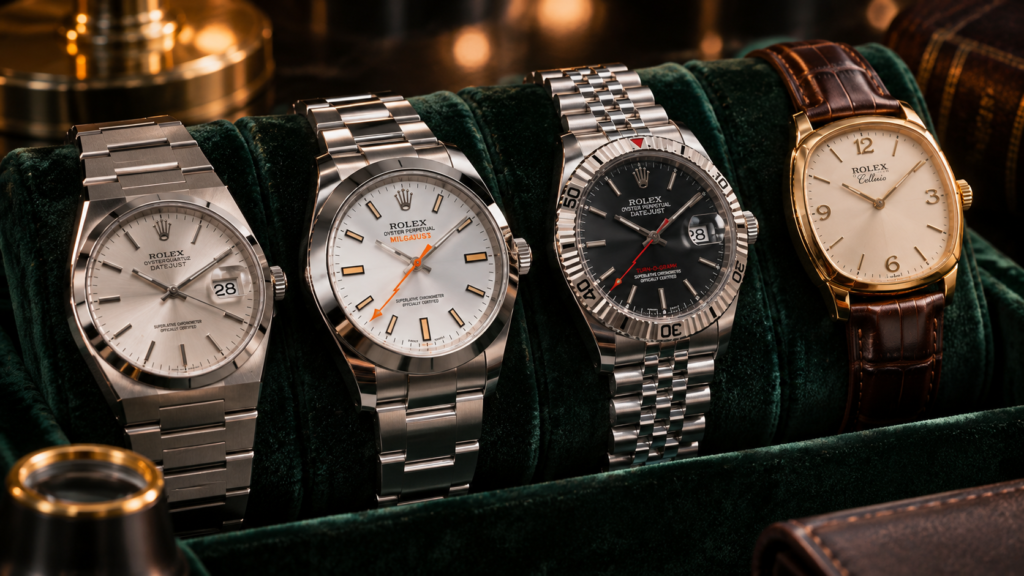
Summary: Collectors are increasingly looking beyond the Submariner and Daytona for distinctive Rolex references with unusual histories, engineering and design. Five models — the Turn-O-Graph, Explorer II, Oysterquartz, Milgauss and Cellini Danaos — illustrate why less mainstream watches deserve greater attention in the secondary market.
◉ The Datejust Turn-O-Graph, Explorer II 16570 and Oysterquartz 17000 offer distinctive Rolex engineering and historical significance beyond the brand’s most popular sports models.
◉ The discontinued Milgauss and Cellini Danaos appeal to collectors interested in unusual designs, specialist movements and less conventional Rolex history.
◉ The growing attention towards discontinued references reflects a broader collector interest in originality, condition, rarity and historical relevance rather than brand recognition alone.
A Different Side of Rolex
For many watch enthusiasts, collecting Rolex revolves around a familiar group of models: the Submariner, Daytona and GMT-Master II.
These collections have established strong international recognition, supported by decades of brand history, extensive demand and considerable visibility in the secondary market.
However, the Rolex catalogue contains a much broader history than its most recognisable professional watches.
A growing number of collectors are exploring references that have traditionally received less attention. Some offer unusual movements, others reflect important moments in the company’s development, while several simply provide a different interpretation of Rolex design.
Five references stand out in this category.

Five Models Worth Rediscovering
1. Datejust Turn-O-Graph – Ref. 116264
Introduced in its original form in 1953, the Turn-O-Graph holds an important place in Rolex history as the company’s first serial-production watch with a rotating timing bezel.
The later Ref. 116264 combines traditional 36mm Datejust proportions with an 18-carat white-gold rotating bezel, a red seconds hand and distinctive red date numerals.
Powered by the Calibre 3135, it combines everyday practicality with a feature more commonly associated with professional sports watches.
Its appeal lies in this unusual combination of dress-watch aesthetics and functional timing capability.
2. Explorer II – Ref. 16570
Produced from 1989 to 2011, the Explorer II 16570 represents an important generation of Rolex professional watches.
Its 40mm case, fixed 24-hour bezel and additional GMT hand provide a practical second-time-zone function.
Depending on production period, the model uses either Calibre 3185 or the later Calibre 3186.
The white Polar dial is particularly recognisable, although black-dial versions also have an established collector following.
Compared with the more expensive GMT-Master II family, the 16570 offers a different interpretation of Rolex travel-watch engineering, with a slimmer and more understated appearance.
3. Oysterquartz Datejust – Ref. 17000
Perhaps the most unusual model in this selection is the Oysterquartz.
Introduced during the quartz era, the Ref. 17000 combines Rolex’s integrated-bracelet design language with an in-house quartz movement.
Its angular 36mm case and distinctive bracelet give it an appearance quite different from conventional Oyster models.
The Oysterquartz also represents an important chapter in Rolex’s response to the quartz revolution.
Its Calibre 5035 was developed specifically for the Oysterquartz platform, reflecting the company’s decision to engineer its own sophisticated electronic movement rather than simply adopt an externally supplied solution.
For collectors interested in technical history, this reference offers a particularly different side of Rolex.
4. Milgauss – Ref. 116400
The Milgauss was developed for environments exposed to strong magnetic fields.
Its specialised internal magnetic shielding and distinctive lightning-bolt seconds hand make it one of Rolex’s most recognisable technical designs.
The modern generation was discontinued in 2023, adding another dimension to its collector appeal.
The standard crystal versions, particularly the white-dial configuration, offer a different aesthetic from the more frequently discussed green-sapphire GV models.
The combination of scientific heritage, unusual design and discontinued production gives the Milgauss a distinctive position within the Rolex catalogue.
5. Cellini Danaos – Ref. 4243
The Cellini Danaos represents a completely different interpretation of Rolex.
Instead of focusing on water resistance and sports functionality, this collection prioritises formal watchmaking and traditional dress-watch proportions.
The Ref. 4243 features a cushion-shaped precious-metal case, an elegant dial and a manually wound movement.
Its understated character makes it particularly interesting for collectors who appreciate Rolex’s less familiar design history.
The Cellini collection has historically occupied a different market position from the Oyster sports models, and the Danaos remains an example of how far Rolex was willing to move beyond its familiar design language.
The Market Is Looking Beyond the Icons
There is a broader development behind this renewed interest.
The secondary Rolex market is not exclusively driven by the most recognisable professional models. Datejust, Explorer and discontinued references also attract substantial transaction activity.
For collectors, this creates a more diverse landscape in which individual references can be assessed according to their technical characteristics, historical relevance and condition.
The Oysterquartz is a particularly good example. Its integrated-bracelet design and in-house quartz movement reflect a period when the Swiss watch industry faced a fundamental technological challenge.
The Milgauss offers a different story, with its specialised magnetic protection and scientific origins.
Meanwhile, the Explorer II 16570 benefits from the enduring appeal of practical GMT functionality in a relatively restrained case.
These watches may not receive the same attention as a Daytona, but they offer compelling reasons for collectors to explore them.
Rarity Is Not the Same as Value
An overlooked Rolex is not automatically an undervalued one.
A discontinued reference may be relatively uncommon without necessarily having strong collector demand. Equally, a model with an unusual movement or interesting history may remain commercially overlooked despite offering considerable horological significance.
Condition and originality are particularly important in this segment.
Collectors pay attention to:
- Original dials, hands and movement components.
- Unpolished cases with clearly defined edges.
- Bracelet condition and wear.
- Documented servicing and ownership history.
- Correct reference-specific components.
For Oysterquartz models, battery-compartment condition is another important consideration. A previous battery leak can cause damage that is expensive to repair.
For the Turn-O-Graph and other precious-metal models, preserving the original case geometry and bezel definition is particularly important.
These details can have a substantial impact on long-term desirability and resale value.
A Broader Definition of Rolex Collecting
The growing interest in less mainstream references reflects a more sophisticated approach to luxury-watch collecting.
The Submariner and Daytona remain central to Rolex’s international identity, but they do not represent the entire history of the manufacture.
The Turn-O-Graph recalls the development of rotating timing bezels. The Explorer II represents practical professional watchmaking. The Oysterquartz documents Rolex’s response to a major technological transformation, while the Milgauss demonstrates the brand’s approach to magnetic resistance.
The Cellini Danaos, meanwhile, illustrates a more formal and traditional side of the company.
Together, these watches reveal a broader picture of Rolex’s history and offer collectors alternatives to the familiar icons.
The interesting question for the secondary market is whether growing awareness will translate into stronger demand and more pronounced price differentiation for these overlooked references.
For now, their appeal lies in something increasingly important to experienced collectors: individuality, historical character and technical identity.
Sources
- WatchPro USA – Five Underrated Rolex Watches That Collectors Often Overlook Today.
- WatchPro – Five Underrated Rolex Watches: Technical Details and Collector Appeal.
- Chrono24 Magazine – Collectible Rolex Watches: Models That Used to Be Unpopular.
- Bob’s Watches – Most Underrated Rolex Watches.
- Denarni Fokus – Editorial Disclosure & Transparency.