[df_language_switch slug=”bosanski-plinovod-pod-vprasajem”]
Summary: Bosnia and Herzegovina’s proposed Southern Gas Interconnection is facing renewed financing and political uncertainty as US support for the Trump-linked project comes under scrutiny. The approximately €1.5 billion infrastructure plan is designed to connect Bosnia with Croatia’s gas network and the Krk LNG terminal, reducing dependence on Russian natural gas.
◉ The Southern Gas Interconnection could provide Bosnia and Herzegovina with an alternative natural gas supply route through Croatia and the Krk LNG terminal.
◉ US-linked AAFS Infrastructure & Energy was selected as the project’s investor and developer, but financing, feasibility studies and implementation arrangements remain unresolved.
◉ European regulatory concerns and uncertainty surrounding American political backing are adding further complications to the project’s financing and construction outlook.
A Strategic Energy Project Faces Uncertainty
Bosnia and Herzegovina’s proposed Southern Gas Interconnection is facing another challenge as uncertainty surrounding its financing and political backing threatens to delay one of Southeast Europe’s most important energy infrastructure projects.
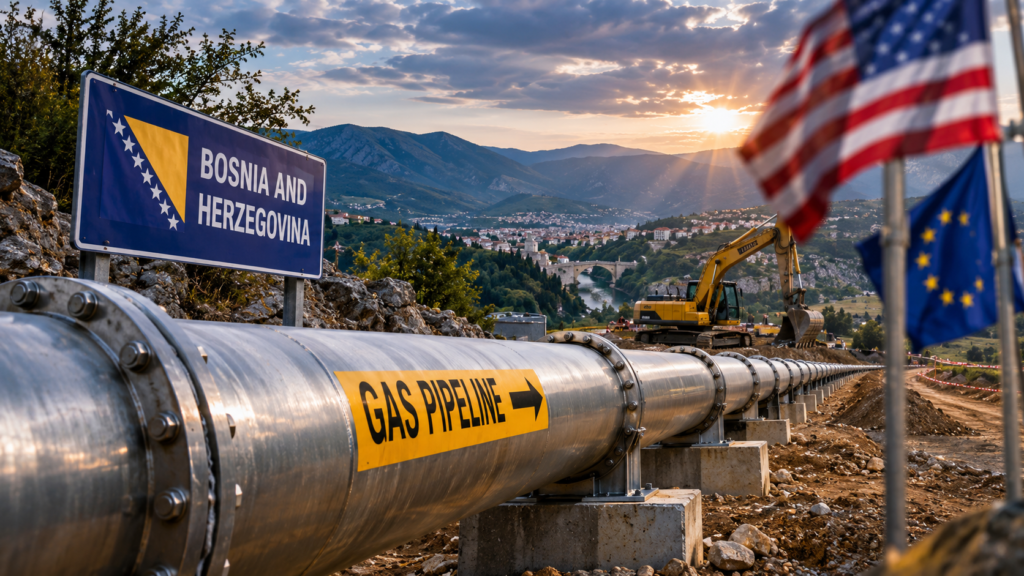
The pipeline is designed to connect Bosnia’s gas transmission network with Croatia, providing access to the liquefied natural gas terminal on the Adriatic island of Krk.
The project would create an alternative supply route for a country that currently receives almost all its natural gas from Russia through Serbia and Bulgaria.
Its strategic importance extends beyond the energy market. The pipeline is also part of wider US and European efforts to diversify natural gas supplies, strengthen regional energy security and reduce dependence on Russian energy imports.
However, political support and investment commitments have not yet translated into a fully secured construction financing package.
The project has been estimated at approximately €1.5 billion, although its final investment requirements and financing structure remain subject to further development.
The Trump Connection
The project attracted international attention after Bosnia’s Federation Parliament adopted legislation designating US-based AAFS Infrastructure & Energy as its investor and developer.
The company is associated with Jesse Binnall, a former personal attorney to Donald Trump, and Joseph Flynn, the brother of former US national security adviser Michael Flynn.
The arrangement generated scrutiny from American lawmakers, particularly Democrats on the House Foreign Affairs Committee.
A congressional report raised questions about the circumstances surrounding AAFS’s involvement, the company’s infrastructure experience and the lack of a conventional competitive tender.
AAFS has defended its participation, stating that Bosnian officials approached the company about the project and that its engagement with US diplomatic representatives followed normal business procedures.
The Trump administration has presented the pipeline within a broader strategy of promoting American commercial interests and expanding US energy exports.
However, diplomatic support, private investment and direct US government financing are three separate matters. There is no basis to treat them as interchangeable.

Financing Remains The Main Obstacle
The financial structure is becoming one of the project’s most important challenges.
AAFS has proposed an investment-led development model involving private capital and potential strategic financial partners.
However, several practical questions remain unresolved, including the availability of feasibility documentation, the final pipeline route, construction costs and long-term financing commitments.
Recent reporting in Bosnia also identified disagreements over access to existing feasibility studies and the reservation of transportation capacity within Croatia’s gas network.
Croatia reportedly wants assurances regarding project financing and long-term capacity reservations before the infrastructure moves forward.
These requirements could create additional financial obligations for Bosnia, even before the pipeline becomes operational.
The result is a project with significant strategic importance but an investment structure that still requires clarification.
European Union Funding Concerns
European regulatory requirements add another layer of complexity.
In April 2026, the European Union warned that Bosnia’s legislation designating AAFS as the project’s investor could conflict with European energy-market rules.
The concerns included competition, transparency, infrastructure access and compliance with EU energy legislation.
The EU also warned that the arrangements could jeopardise approximately €1 billion in funding available under the Western Balkans Growth Plan.
This creates a difficult position for Sarajevo.
Bosnia needs alternative energy infrastructure, but it also depends on European financial assistance and progress towards EU membership.
The pipeline could strengthen energy diversification while creating regulatory complications if its ownership, concession and operating arrangements are not aligned with European requirements.
Why Croatia And The Krk LNG Terminal Matter
The Southern Interconnection would connect Bosnia to Croatia’s existing gas transmission infrastructure and provide access to the Krk LNG terminal.
This would allow Bosnia to purchase natural gas from a broader international market, including LNG originating from the United States and other global suppliers.
The strategic implications include:
- Reduced dependence on a single external gas supplier.
- Greater access to international LNG markets.
- Improved regional energy connectivity.
- Potential investment in gas infrastructure and industrial development.
Nevertheless, building a pipeline does not automatically guarantee energy independence. Long-term supply agreements, competitive import prices and sufficient transportation capacity would remain essential.
What Comes Next?
The next phase will depend on whether the parties can resolve the outstanding financial, regulatory and technical questions.
| Key indicator | Current position |
|---|---|
| Estimated project investment | Approximately €1.5bn |
| Selected developer | AAFS Infrastructure & Energy |
| Main connection | Bosnia–Croatia |
| LNG access | Krk terminal, Croatia |
| Construction financing | Not fully established |
| Feasibility documentation | Outstanding questions |
| EU regulatory concerns | Unresolved |
| Construction timetable | Subject to further preparation |
Three developments deserve particular attention: clarification of US support, completion of the feasibility work and agreement on the financing and transportation arrangements with Croatia.
The central question is whether the project can attract sufficient institutional and private capital while satisfying European regulatory requirements.
For Southeast Europe, the outcome could influence the future balance between American investment, European financial support and regional energy diversification.
The Southern Interconnection has become more than a pipeline project. Its progress will demonstrate whether geopolitical support, private investment and European regulatory requirements can be combined to deliver a commercially viable energy corridor in the Western Balkans.
Sources
- Bloomberg – US Funding for Trump-Linked Bosnian Gas Pipeline Is in Jeopardy, November 17
- Reuters – Environmental Groups Challenge US-Backed Balkan Gas Projects Reuters
- Radio Free Europe – EU Warns Bosnia Gas Project Could Threaten €1 Billion in Aid RadioFreeEurope/RadioLiberty
- Semafor – House Democrats Prepare Oversight of Trump’s Balkans Policy Semafor
- eKapija – Southern Interconnection Faces Financing and Feasibility Questions, November 9 me.ekapija.com
- Bosnia and Herzegovina Ministry of Foreign Affairs – US Energy Cooperation, November 10 mvp.gov.ba
- Editorial Disclosure & Transparency