Summary: Goldman Sachs strategists warn that the artificial intelligence stock correction may not have reached its bottom. Despite substantial losses across technology shares, investors still need evidence that massive AI infrastructure investments can generate sustainable profits before a convincing market recovery can emerge.
◉ Goldman Sachs strategist Christian Mueller-Glissmann believes it is too early to buy the AI selloff, arguing that investors need stronger evidence of future profitability.
◉ Goldman’s basket of AI-focused stocks has fallen approximately 32% since early October, compared with a 6% decline across other S&P 500 companies.
◉ Heavy infrastructure spending, elevated valuations and crowded investor positioning are creating additional risks for technology stocks, even after the recent correction.
Goldman Questions the Bottom
The latest decline in artificial intelligence shares is raising an important question for financial markets: has the correction created an attractive entry point, or is another phase of selling still ahead?
Goldman Sachs strategist Christian Mueller-Glissmann believes investors should remain cautious.
His assessment centres on the gap between the enormous capital being committed to artificial intelligence infrastructure and the profits that companies ultimately need to generate from those investments.
Technology companies have announced increasingly ambitious spending programmes covering advanced semiconductors, data centres, networking equipment and computing infrastructure.
However, the market is becoming less willing to reward investment announcements alone.
Investors increasingly want evidence that expenditure is translating into recurring revenue, operating margins and sustainable free cash flow.
This change in expectations is important because much of the AI market’s previous valuation expansion was built around assumptions of continued rapid growth.
The Scale of the AI Correction
The latest figures illustrate how significantly sentiment has changed.
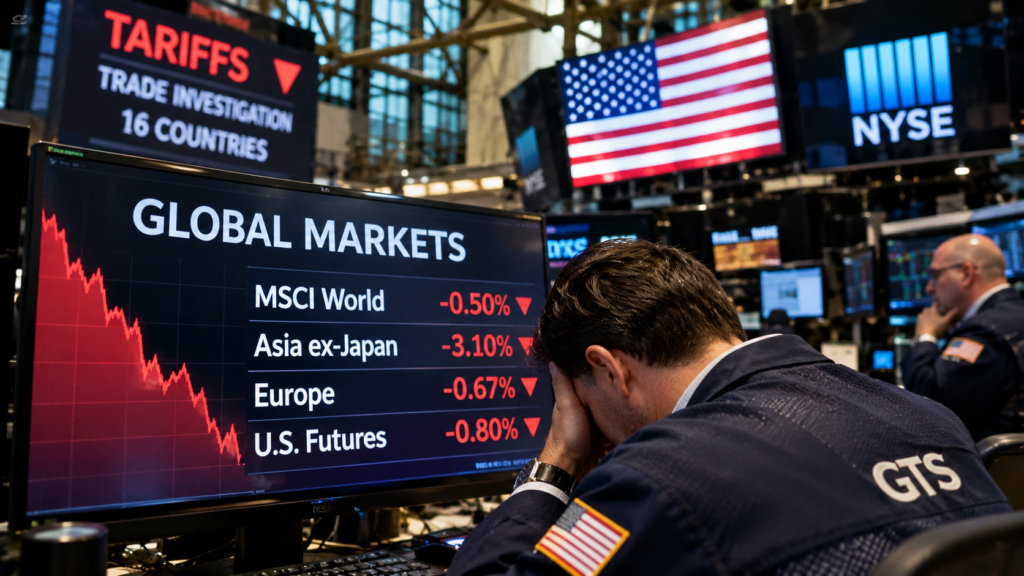
Goldman’s AI-focused stock basket has declined approximately 32% since early October, while the remaining S&P 500 constituents have lost around 6% over the same period.
The difference highlights the concentration of the current correction.
Rather than an equally distributed decline across the entire equity market, investors are repricing companies most closely associated with the artificial intelligence investment cycle.
The broader market has also deteriorated. On November 25, the Nasdaq-100 fell approximately 4.3%, with its potential daily market-value loss exceeding $1.5 trillion.
Nvidia declined around 8.4%, while several major technology companies and AI infrastructure providers experienced additional selling pressure.
The weakness is particularly notable because some companies have continued reporting strong financial results and raising their business forecasts.
The market is increasingly questioning whether good operating performance is sufficient to justify existing valuations.

Infrastructure Spending Becomes the Main Concern
One of the central issues is the scale of investment required to maintain the AI expansion.
Hyperscalers and specialist computing providers are committing enormous amounts of capital to data centres, advanced chips and electricity infrastructure.
These investments are intended to support rapidly growing demand for AI computing capacity.
However, the financial structure behind the expansion is becoming increasingly important.
Some infrastructure providers rely heavily on borrowing to finance new capacity. This introduces additional sensitivity to interest rates, credit conditions and future utilisation rates.
Recent market developments illustrate the pressure.
AI infrastructure companies CoreWeave and Nebius experienced substantial share-price declines, while CoreWeave’s 2031 bond yield approached 18%.
This suggests that concerns are spreading beyond equity valuations into the financing conditions of companies supporting the AI investment cycle.
The central question is no longer simply how much computing capacity can be built, but whether future demand and pricing can generate sufficient returns to justify the capital expenditure.
Three Conditions for Recovery
Goldman’s broader market framework identifies several developments that could help establish a more sustainable recovery in technology shares.
1. Evidence of AI profitability
The first requirement is clearer evidence that AI investments are producing measurable financial returns.
Investors want to see stronger monetisation, improving margins and sustainable revenue growth rather than relying exclusively on projections of future demand.
2. A more supportive Federal Reserve
Interest-rate expectations remain important for highly valued technology companies.
A more accommodative monetary policy could reduce financing costs and improve the valuation environment for growth stocks.
Conversely, persistent inflation and restrictive monetary conditions could continue putting pressure on long-duration technology valuations.
3. Reduced investor positioning
The third consideration is the extent to which investors have already reduced their exposure.
Crowded positions can amplify market declines when investors attempt to exit similar investments simultaneously.
A more substantial reduction in positioning could eventually create conditions for stabilisation, although it would not independently guarantee a market bottom.
These conditions demonstrate why a large percentage decline is not necessarily sufficient evidence that a stock or sector has become attractively valued.
Wall Street Reassesses AI Leaders
The latest correction has affected several different parts of the AI ecosystem.
Semiconductor manufacturers remain exposed to changes in expectations surrounding future computing demand.
Data-centre operators face questions about financing requirements, electricity availability and infrastructure utilisation.
Cloud providers must demonstrate that AI-related services can generate sufficient incremental revenue to justify higher capital expenditure.
Even companies reporting strong results are facing increased scrutiny.
This represents a change in market behaviour. Previously, announcements of expanding AI investment frequently supported technology valuations. Investors are now examining the relationship between spending, cash generation and returns on invested capital.
The distinction could become increasingly important as the industry moves from its initial infrastructure expansion towards a more commercially competitive phase.
The Broader Market Implications
The AI correction also has consequences beyond the technology sector.
Major technology companies represent a substantial proportion of US equity benchmarks. Their share-price movements therefore influence broader index performance, institutional portfolios and passive investment products.
A prolonged decline in AI-related shares could affect market sentiment even among companies with limited direct exposure to artificial intelligence.
There is also a financing dimension. If investors become less willing to fund expensive infrastructure projects, borrowing costs could rise and planned expansion programmes could be reassessed.
This would potentially affect semiconductor suppliers, equipment manufacturers, construction companies, energy providers and data-centre operators.
The current correction is therefore becoming a broader examination of the financial economics supporting the AI investment cycle.
What Comes Next?
The most important question is whether the technology industry can convert its enormous infrastructure commitments into sustainable earnings growth.
The coming reporting periods will provide further information about capital expenditure, cloud revenue, operating margins and demand for advanced computing capacity.
For now, Goldman Sachs’ cautious assessment reflects a market increasingly focused on financial returns rather than technological potential alone.
The AI investment cycle remains a major structural development for the global economy. However, the latest market reaction demonstrates that even transformative technologies are not immune to valuation adjustments.
The next phase of the AI market may depend less on announcements about how much companies intend to spend and more on evidence of what those investments actually earn.
Sources
- Bloomberg – Goldman Strategist Says It’s Too Early to Buy the AI Selloff (25 November 2026).
- Reuters – AI Stocks Slide on Fears Over Infrastructure Buildout Costs (25 November 2026).
- Associated Press – AI Rout Drags Wall Street Lower as Investors Question Technology Valuations (25 November 2026).
- Crypto Briefing – Goldman Sachs Says It’s Too Early to Buy the AI Selloff (25 November 2026).
- Denarni Fokus – Editorial Disclosure & Transparency.