Summary: Global equities retreated on November 25 as renewed US tariff threats against major trading partners intensified market uncertainty. Asian technology shares led the decline, European markets surrendered early gains and US futures pointed lower, while investors also awaited American inflation data that could influence December Federal Reserve policy.
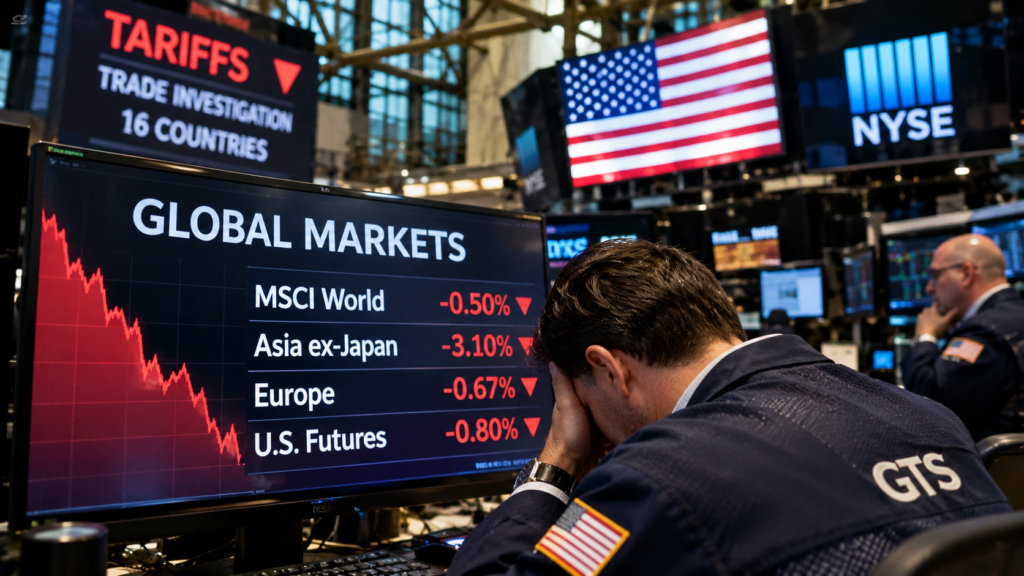
◉ MSCI’s global equity gauge declined 0.5%, while Asian shares outside Japan fell 3.1%, reflecting renewed concerns over international trade and export demand.
◉ Proposed new tariffs targeting 14 trading partners were announced by the US administration following investigations into alleged excess industrial capacity across 16 major economies.
◉ European equities surrendered their morning gains, while S&P 500 futures fell approximately 2% and Nasdaq futures declined around 3%, signalling further pressure on Wall Street.
Trade Tensions Return
Global financial markets came under renewed pressure on Wednesday as investors reassessed the potential consequences of another escalation in US trade policy.
The Trump administration announced a new round of proposed tariffs targeting major trading partners, including China, Japan and the European Union.
The measures follow investigations into alleged excess industrial capacity involving 16 economies. Washington argues that industrial subsidies, government support and manufacturing overcapacity create unfair competitive conditions for American producers.
The announcement represents another significant development in an already complicated international trade environment.
For investors, the concern extends beyond the direct impact of tariffs. Additional trade barriers could increase production costs, disrupt supply chains and weaken demand for internationally traded goods.
The uncertainty is particularly relevant for companies dependent on exports, semiconductor manufacturing, automotive production and cross-border industrial supply networks.
Asia Leads the Sell-Off
Asian equity markets experienced the strongest selling pressure.
MSCI’s broadest index of Asia-Pacific shares outside Japan declined 3.1%, with technology-heavy markets particularly exposed.
Taiwan’s stock market experienced substantial losses, while South Korean equities also retreated sharply.
Major semiconductor companies came under pressure as investors reconsidered the potential consequences of renewed trade restrictions.
The technology sector faces a particularly complicated environment. Beyond tariff uncertainty, investors are questioning the sustainability of artificial intelligence investment spending and the valuations of companies benefiting from the AI expansion.
The combination of these concerns has made Asian technology shares especially sensitive to changes in global risk appetite.

Europe Loses Its Early Momentum
European equities initially demonstrated greater resilience.
The STOXX Europe 600 advanced approximately 0.5% during morning trading, supported by gains in selected consumer and retail companies.
However, the advance subsequently faded as international selling pressure intensified.
Automotive shares remained an important area of attention following recent weakness across the sector.
European manufacturers face particular exposure to international trade restrictions because their production networks frequently involve components sourced from multiple countries and vehicles sold across several major markets.
Additional US tariffs could therefore affect both direct exports and broader supply-chain economics.
Washington Expands Tariff Pressure
The latest measures are part of a broader US investigation into alleged industrial overcapacity among 16 trading partners.
The administration has proposed new headline tariff rates ranging from 20% to 40%, although the actual rates would be capped at lower levels under existing or negotiated trade agreements.
China faces a proposed capped rate of 20% if the current trade truce remains in place, potentially rising to 40% if negotiations fail.
Other affected economies include Vietnam, Japan, South Korea, Taiwan, India, Malaysia, Thailand and members of the European Union.
Importantly, the proposed duties are not immediately effective. The US Trade Representative has indicated that implementation would follow a public hearing scheduled for January 25, 2027.
This leaves markets facing an extended period of uncertainty as companies and investors assess the potential consequences.
Technology Stocks Under Pressure
The tariff developments arrive at an already difficult moment for technology shares.
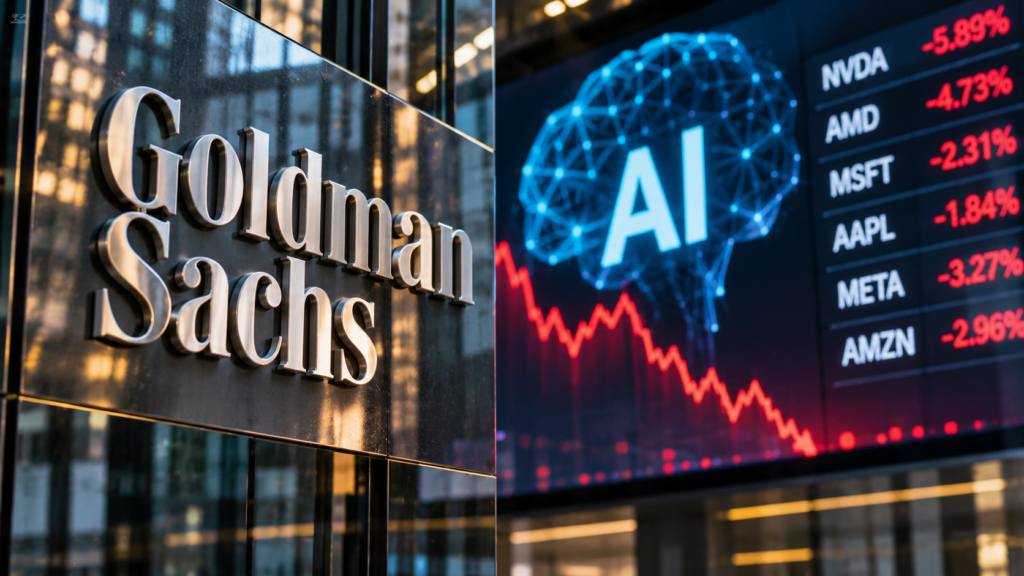
Nvidia declined 5.9% during Tuesday’s session, while AI company Anthropic lost approximately 6.5%, falling below its IPO price.
The technology correction reflects growing questions about the sustainability of artificial intelligence valuations, infrastructure spending and financing arrangements.
Asian semiconductor manufacturers are particularly exposed because their businesses depend heavily on international supply chains and demand from major US technology companies.
The renewed trade tensions could therefore compound existing concerns surrounding the profitability of the AI investment cycle.
Inflation Adds Another Risk
Trade policy is not the only factor influencing investor sentiment.
Markets are also monitoring US Personal Consumption Expenditures (PCE) inflation data, an important indicator for the Federal Reserve.
Additional tariffs could increase import costs and potentially contribute to inflationary pressure.
If inflation proves persistent, the Federal Reserve may face greater difficulty easing monetary conditions.
This creates a complicated environment for equities: companies face potential increases in production costs while investors must simultaneously consider the possibility of tighter financial conditions.
The US dollar strengthened during Wednesday’s trading, while European government bond yields declined as investors sought relatively defensive assets.
What Happens Next?
The immediate focus is shifting towards three developments:
- US trade investigations: Further details on tariff rates, exemptions and implementation timelines could influence global equity positioning.
- US inflation: PCE figures may reshape expectations for the Federal Reserve’s December meeting.
- Technology earnings and investment: Investors will continue evaluating whether AI-related capital expenditure can justify current valuations.
The latest market reaction illustrates how quickly trade policy can become a dominant force in global asset pricing.
The important distinction is that the proposed tariffs have not yet taken effect. Nevertheless, uncertainty surrounding their eventual implementation is already influencing investor behaviour.
For global equities, the combination of trade tensions, technology-sector weakness and restrictive monetary expectations represents a challenging backdrop heading into December.
Sources
- Reuters – World stocks fall as new US tariffs loom, AI rebound fizzles (25 November 2026).
- Reuters – Trump unveils new tariffs to fight excess factory capacity (25 November 2026).
- Reuters via Investing.com – Stocks retreat as AI rebound stumbles, tariff threats loom (25 November 2026).
- The Edge – Taiwan and South Korea lead Asian stocks lower (25 November 2026).
- Denarni Fokus – Editorial Disclosure & Transparency.