Summary: Nvidia has sold more than half of its stake in Nokia, triggering fresh pressure on the Finnish telecommunications company’s shares. The move has raised questions about investor confidence in Nokia’s artificial intelligence ambitions, although analysts see no immediate impact on the companies’ strategic partnership.
◉ They sold 93.53 million Nokia shares during the third quarter of 2026, reducing its holding by 56% to 72.86 million shares worth approximately $738.8 million.
◉ Nokia shares fell approximately 4.2% on November 17, trading around €6.91, as investors reassessed the implications of Nvidia’s reduced exposure.
◉ No immediate impact on Nokia’s operations or AI-RAN partnership with Nvidia is expected, although the sale weakens an important signal of strategic investor confidence, according to analysts at Inderes.
Nvidia’s Stake Reduction Puts Nokia Under Pressure
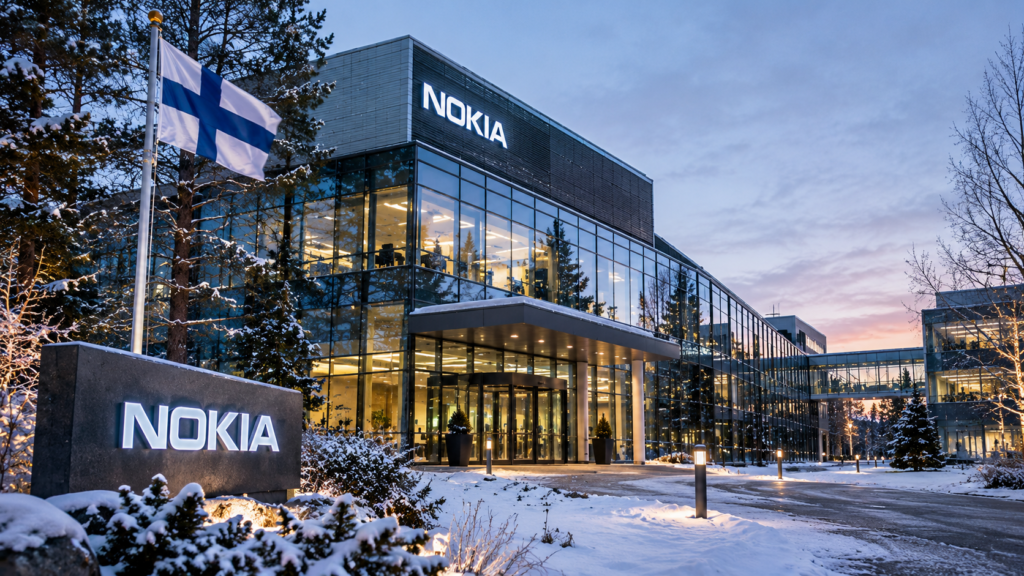
Nokia shares came under renewed selling pressure on Tuesday after a regulatory filing revealed that Nvidia had significantly reduced its investment in the Finnish telecommunications equipment manufacturer.
According to Nvidia’s latest Form 13F filing, the US semiconductor company sold 93.53 million Nokia shares between July and September 2026. Its remaining position stood at 72.86 million shares at the end of September, compared with 166.39 million shares at the end of June.
The remaining stake was valued at approximately $738.8 million as of September 30.
Nokia shares fell around 4.2% on Tuesday, trading near €6.91 on the European market. The decline made the company one of the weaker performers in European equities during the session.
Importantly, Nvidia has not exited its investment. It continues to hold approximately 1.3% of Nokia’s outstanding shares.
From a $1 Billion Investment to a Smaller Position
Nvidia initially announced a $1 billion investment in Nokia in October 2025, acquiring shares at $6.01 each and securing an approximately 2.9% stake in the Finnish company.
The investment formed part of a broader strategic partnership focused on combining Nvidia’s accelerated computing technology with Nokia’s telecommunications infrastructure.
The agreement was particularly significant because it connected two rapidly developing areas of the technology industry: artificial intelligence computing and next-generation mobile networks.
The companies planned to integrate Nokia’s 5G and future 6G network software with Nvidia’s computing platforms. They also agreed to explore the use of Nokia’s optical networking technology and switches within Nvidia’s AI infrastructure.
The timing of the share sale is noteworthy. Nokia’s American depositary receipts reached approximately $16.85 in early June 2026, representing an increase of around 180% from Nvidia’s original purchase price.
According to Finnish investment research firm Inderes, profit-taking following the substantial appreciation is a plausible explanation for the transaction.
Nvidia also reduced several other equity positions during the same reporting period, including its holdings in Intel and Synopsys, while increasing its investment in SpaceX. This broader portfolio adjustment provides additional context for the Nokia transaction.

AI Partnership Remains Intact
The central question for investors is whether Nvidia’s decision to reduce its ownership signals a change in its long-term commitment to Nokia’s artificial intelligence strategy.
So far, there is no indication that the commercial partnership has been terminated or that its existing scope has changed.
Inderes said its initial assessment does not suggest an immediate impact on Nokia’s business operations, order pipeline or AI-RAN cooperation with Nvidia. The research firm also maintained its existing financial estimates for Nokia.
However, the reduction could have implications beyond the immediate financial value of the shares sold.
Nvidia’s original investment was widely viewed as an endorsement of Nokia’s ambitions in AI-powered telecommunications. Its reduced ownership therefore weakens one element of the investment narrative that has supported expectations surrounding Nokia’s future growth.
The distinction between financial ownership and commercial cooperation remains important. Selling shares does not automatically indicate that a technology partnership is losing momentum.
Nokia’s AI Infrastructure Ambitions
Nokia’s strategy extends beyond traditional telecommunications equipment. The company is seeking to establish a stronger position in the infrastructure required to support artificial intelligence, cloud computing and increasingly connected devices.
One of its key initiatives is AI-RAN, which aims to combine radio access networks with accelerated computing capabilities.
The technology could allow telecommunications operators to use network infrastructure for additional AI workloads, creating new opportunities for mobile network operators and infrastructure providers.
The longer-term opportunity is also linked to the development of 6G networks, which are expected to require greater computing capacity, higher data transmission speeds and closer integration between telecommunications and cloud infrastructure.
Nokia is also pursuing opportunities in data-centre networking, optical communications and advanced network switching.
For the company, the commercial challenge is turning these technological developments into measurable revenue growth, stronger margins and sustainable customer demand.
Investors Reassess Nokia’s Valuation
Nokia’s share price has fallen by approximately 50% from its June peak, according to Inderes. The research firm attributes much of the decline to lower valuation multiples rather than a deterioration in the company’s underlying business fundamentals.
This distinction is important when assessing the latest developments.
The reduction in Nvidia’s stake adds another source of uncertainty to a company whose investment narrative has become increasingly connected to the artificial intelligence boom.
Investors must now assess whether Nokia can maintain its growth expectations through commercial execution, new contracts and expanding demand for AI-related network infrastructure.
The company’s ability to demonstrate tangible financial returns from its AI strategy will likely become increasingly important in determining how the market values its shares.
The Bigger Picture
Nvidia’s decision to sell more than half of its Nokia position is a significant development for the European technology sector, but it does not necessarily signal the end of their strategic cooperation.
The transaction highlights the difference between an attractive technology partnership and the financial expectations attached to it.
For Nokia, the challenge is to demonstrate that its ambitions in AI infrastructure, 5G and future 6G networks can translate into sustainable commercial growth.
For investors, the focus will remain on the development of the Nvidia partnership, new customer orders, data-centre opportunities and the company’s ability to deliver measurable results.
The next phase of Nokia’s AI strategy will ultimately be judged less by the identity of its shareholders and more by its ability to convert technological potential into long-term earnings growth.
Read Also
Nvidia Invests $1 Billion in Nokia to Expand AI Network Partnership
Sources
- Yahoo Finance / Investing.com – Nokia Stock Tumbles After Nvidia Cuts Stake by More Than Half, November 17, 2026
- Inderes – Nvidia Sold Over Half of Its Nokia Stake After Share Price Peak, November 17, 2026
- Investing.com – Why Is Nokia Stock Sliding Today?, November 17, 2026
- Investing.com – Nvidia Cuts Intel Stake as SpaceX Becomes Its Largest Disclosed Holding, November 17, 2026
- Nokia – Official Announcement of Nvidia’s $1 Billion Investment and Strategic Partnership
- Editorial Disclosure & Transparency