The Missing Link in Humanoid AI
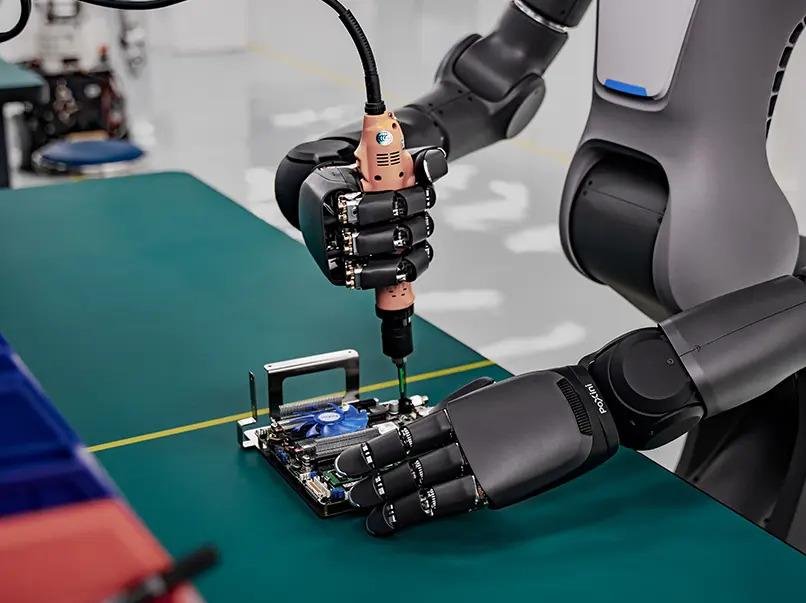
China is building a commanding position in one of the most technically demanding parts of humanoid robotics: the human-like robotic hand. While advances in artificial intelligence have helped robots walk, balance and recognise objects, manipulating those objects with precision remains a major obstacle to commercial deployment.
The distinction matters. A robot may navigate a factory floor or demonstrate impressive athletic movements, but useful work often requires it to grip fragile objects, operate tools, handle components and adapt to unfamiliar situations. Those tasks demand coordinated finger movement, accurate sensing and rapid adjustments in force.
As the humanoid robotics market develops, the ability to manufacture reliable hands at scale could become a strategic advantage for Chinese suppliers.
Why Hands Matter More Than Appearance

A robotic hand combines miniature motors, mechanical joints, tactile sensors and control software in a compact system. Each component must work together closely enough to reproduce movements that humans perform almost automatically.
Too much force can break an object; too little can cause it to slip. A robot also needs to understand where its fingers are positioned and how an object responds when touched.
This makes dexterous hands a critical link between AI reasoning and physical action. Better software alone cannot solve the problem if the hardware cannot execute instructions accurately or consistently.
China’s Manufacturing Advantage
China’s robotics suppliers benefit from a dense manufacturing ecosystem developed through industries including electric vehicles, electronics and industrial automation. Access to motors, sensors, batteries and precision components can shorten development cycles and reduce the cost of producing new hardware.
Specialist companies are increasingly concentrating on robotic hands rather than attempting to manufacture entire humanoid robots. This allows robot makers to source a difficult component from dedicated suppliers instead of developing every subsystem internally.
The emerging supply chain also creates opportunities for businesses producing tactile sensors, actuators and the software used to coordinate complex movements. These less visible components may capture value even if the companies assembling complete humanoid robots change over time.
From Demonstrations to Commercial Work
The next stage is moving beyond carefully controlled demonstrations. Humanoid robots must prove that they can perform useful tasks repeatedly, safely and at a cost that makes commercial sense.
Potential applications include factory assembly, warehouse operations, handling goods, hospitality and selected household tasks. However, performance in a demonstration does not necessarily translate into reliable operation across different environments.
Manufacturers will need to improve durability, reduce maintenance requirements and collect more real-world data to train robots for unfamiliar objects and situations. Tactile sensing is particularly important because vision alone cannot provide all the information needed to grip and manipulate objects safely.
A $5 Trillion Opportunity—with Uncertainty
The potential market for AI-powered humanoid robots is attracting substantial investment, with projections reaching into the trillions of dollars over the coming decade. Such estimates depend on assumptions about production costs, adoption rates and the range of jobs robots can perform.
Robotic hands could become an important source of value within that market. Suppliers that combine precision, affordability and high-volume manufacturing may benefit as robot makers scale production.
But a large projected market does not guarantee large profits. Competition, reliability problems, safety requirements and slower-than-expected customer adoption could all delay commercial returns.
What Comes Next
The competition in humanoid robotics is increasingly about more than building a robot that looks and moves like a person. It is about giving machines the physical skills needed to complete economically useful work.
China’s supplier ecosystem gives its robotics industry a strong manufacturing foundation. Whether that advantage becomes a durable global lead will depend on the ability to deliver reliable hands, improve performance through real-world data and turn technical progress into repeatable commercial applications.
Sources
- Bloomberg — China’s Robotic Hands: Key to the $5 Trillion AI Humanoid Development Race
- The Washington Post — In the Race for AI Dominance, the U.S. Relies on a Surprising Ally: China
- The Guardian — China Wants to Solve the Hardest Problem in Robotics: Making Hands
- TechTarget — China Leads Dexterous Hand Supply for Humanoids