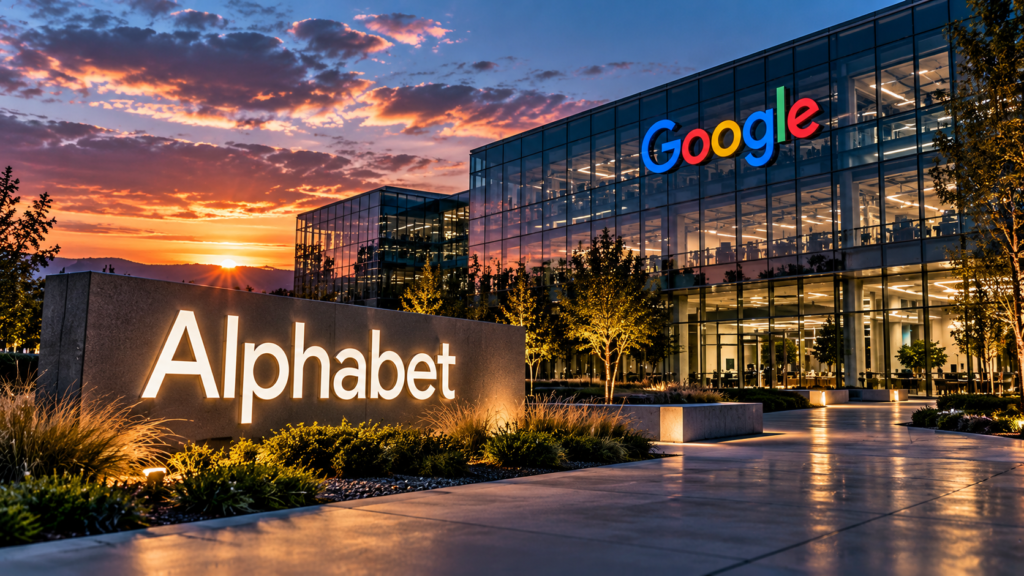
Short description: Alphabet shares plunged nearly 10% in after-hours trading on 28 October after its third-quarter results exposed the growing financial demands of artificial intelligence. Revenue continued to expand, but weaker-than-expected earnings and negative free cash flow intensified questions about the returns on its infrastructure spending. Microsoft moved in the opposite direction after delivering stronger cash generation. SEC
◉ AI spending pressures cash flow: Alphabet reported negative free cash flow of $9.1 billion as quarterly capital expenditure reached $51.4 billion.
◉ Revenue growth was not enough: Revenue increased 25% to $127.6 billion, but earnings per share fell short of expectations and net income declined.
◉ Investors are differentiating between AI leaders: Microsoft generated $18.6 billion in free cash flow, reinforcing market scrutiny of how effectively technology companies convert AI investment into cash. SEC
A Costly AI Expansion
Alphabet’s latest earnings report has sharpened a debate at the centre of the technology sector: how much capital can companies commit to artificial intelligence before investors demand clearer financial returns?
Shares of Google’s parent company dropped approximately 10% in after-hours trading following its 28 October results. The reaction came despite another quarter of substantial revenue growth, indicating that investors were more concerned about profitability, cash generation and the cost of expanding AI infrastructure than about headline sales alone. Reuters
Alphabet generated $127.6 billion in revenue in the third quarter, up 25% year over year. Operating income rose 30% to $40.6 billion, demonstrating that its core operations continued to expand. However, net income declined to $26.2 billion, while diluted earnings per share fell to $2.12. A substantial unrealised loss on an investment also weighed on reported results. SEC
The more immediate concern was cash flow. Capital expenditure reached $51.4 billion, largely reflecting investment in technical infrastructure, including servers, networking equipment and data centres. Operating cash flow was $42.3 billion, leaving free cash flow negative by approximately $9.1 billion.
The figure highlights the difference between accounting profitability and cash available after infrastructure investment. A company can report strong operating earnings while spending more on physical capacity than its operations generate in cash during a particular quarter.

Cloud Growth Offers a Counterweight
Alphabet’s investment programme is not without commercial results. Google Cloud revenue surged 103% to $30.7 billion, supported by demand for AI infrastructure, enterprise AI solutions and its own tensor processing units. Cloud operating income also increased substantially, showing that the business is expanding its contribution to group profitability. SEC
The challenge is timing. Building data centres and acquiring advanced computing equipment requires capital before all the resulting revenue and profits are realised. Demand can be strong today while the financial payback on new infrastructure remains spread over several years.
Alphabet has also indicated that its capital spending will remain elevated. That creates a difficult balancing act: investing aggressively enough to meet demand and compete in AI, while protecting cash generation and shareholder returns.
The scale of the opportunity is visible in cloud demand and enterprise commitments. Yet investors must weigh those potential future benefits against immediate cash requirements, depreciation and the risk that computing capacity expands faster than profitable demand.
Microsoft Sets a Different Benchmark
Microsoft’s earnings offered a contrasting picture. The company reported free cash flow of approximately $18.6 billion, while its shares rose around 3% in extended trading after its latest results. Its performance reinforced the market’s focus on whether AI-related spending is accompanied by strong operating cash generation. Schwab Wall Street
The comparison does not mean Microsoft faces no infrastructure risks. Its own data-centre expansion requires substantial investment, and future returns depend on customers continuing to pay for cloud services and AI products.
Instead, the divergence illustrates a change in how investors assess the AI boom. Revenue growth and technical leadership remain important, but markets increasingly distinguish between companies that can finance expansion through internally generated cash and those whose investment programmes temporarily absorb more cash than operations produce.
That distinction could become more influential as infrastructure spending increases across the largest technology companies.
What Markets Watch Next
The next earnings reports from major technology companies will help determine whether Alphabet’s sell-off reflects company-specific concerns or a broader reassessment of AI investment.
Investors will focus on capital expenditure forecasts, cloud revenue growth, operating margins and free cash flow. Amazon’s infrastructure spending and cloud performance are particularly relevant, while results across the semiconductor industry could provide further evidence of whether demand for AI computing continues to justify the scale of investment.
The wider question is whether the industry can sustain its infrastructure buildout without eroding financial flexibility. Strong demand is necessary, but it does not automatically guarantee attractive returns on capital.
Alphabet’s latest results illustrate the tension. The company is growing rapidly, and its cloud business is benefiting from demand for AI services. Yet its negative free cash flow shows how expensive that expansion can become.
For the technology sector, the next phase of the AI cycle may be judged less by the scale of announced investment and more by the cash flow, margins and durable earnings that investment ultimately produces.
Sources
- Alphabet — Official Third-Quarter 2026 Results
- Reuters — Alphabet Earnings and AI Infrastructure Spending
- Associated Press — Alphabet Earnings and Global Market Reaction
- Reuters — Investors Focus on Cash Flow Across AI Companies
- Microsoft — Latest Earnings Coverage and Cash Flow
- Denarni Fokus — Editorial Disclosure & Transparency