Short Description: The NBA is preparing a potential European expansion while EuroLeague’s shareholder clubs pursue their own multibillion-euro growth strategy. The contest could reshape basketball’s commercial landscape, affecting media rights, club valuations, sponsorship and the balance of power between international investors and established European teams.
Hot Points
◉ €3.4 billion for clubs: EuroLeague’s ten-year plan projects €3.4 billion in total distributions to participating teams, including commercial revenue and franchise fees.
◉ NBA Europe targets 2027: The NBA continues to pursue an October 2027 launch for a proposed competition combining permanent franchises with places earned through sporting qualification.
◉ Two competing business models: EuroLeague wants to expand its existing club-led structure, while the NBA is seeking to build a new platform with international commercial reach and substantial investment.
A Battle for Basketball’s Future
European basketball is approaching a defining commercial moment. The NBA, the world’s most powerful basketball league, wants to build a larger presence across the continent. EuroLeague, meanwhile, is seeking to strengthen its own competition, increase club valuations and secure a greater share of the sport’s growing commercial potential.
The disagreement became clearer in October, when EuroLeague’s 13 shareholder clubs rejected the NBA’s latest collaboration proposal. The decision did not close the door to future negotiations, but it signalled that Europe’s leading club owners were unwilling to accept the proposed arrangement on the terms offered.
The NBA has continued to advance its project, with its leadership saying negotiations with potential participants are progressing and the target launch remains October 2027. The two organisations are therefore pursuing overlapping ambitions: attracting elite clubs and players, growing audiences, and converting European basketball’s cultural appeal into a larger commercial business.
The prize extends beyond ticket sales. A successful competition could generate new broadcasting contracts, international sponsorship agreements, licensing income, premium hospitality revenue and opportunities for investors to acquire stakes in teams. It could also change how clubs are valued, how revenue is distributed and how much control team owners retain over their future.
The central uncertainty is whether Europe’s basketball market can support two major competitions without dividing audiences, sponsors and top-level talent between them.
EuroLeague’s €3.4 Billion Counterplan
EuroLeague is not waiting for the NBA’s European ambitions to take shape. Its shareholder clubs have approved a ten-year business plan built around expansion, a franchise-based ownership model and a more commercially integrated competition.
The plan projects €3.4 billion in total distributions to participating teams over the decade. Of that amount, €2.2 billion is expected to come from competition revenue, while another €1.2 billion is forecast to come from franchise fees associated with two expansion windows, planned for 2027 and 2031.
EuroLeague also targets €648 million in annual commercial revenue by the tenth year. Its long-term projections envisage the combined value of the league and its clubs exceeding €13 billion, provided the expansion and commercial strategy is delivered successfully.
These figures are ambitions rather than guaranteed outcomes. The projected value depends on attracting new investors, securing stronger commercial agreements, increasing the competition’s reach and distributing the resulting income in a way that supports participating clubs.
The franchise model is particularly important. Long-term licences can provide a degree of security, but a franchise structure is intended to give clubs a more permanent economic stake in the competition. That may make clubs more attractive to investors who want exposure not only to a team’s performance, but also to the value created by the league as a whole.
The approach also carries a strategic risk. Franchise fees can bring substantial capital into the system, but they are not the same as recurring operating revenue. Long-term financial health will depend on whether the league can convert investment and audience growth into sustainable commercial income.
The NBA’s European Play
The NBA is approaching the market from a different position. It already operates a globally recognised sports property, with established commercial relationships, international media distribution and a brand that reaches far beyond North America.
Its proposed European competition is being developed in partnership with FIBA, basketball’s international governing body. The working model envisages 16 teams: 12 permanent franchises and four places available through sporting qualification. The planned markets have included major centres such as London, Paris, Madrid, Barcelona, Milan, Berlin, Munich, Athens and Istanbul.
The NBA’s ambition is to build a platform that combines the commercial consistency of permanent franchises with a pathway for clubs to qualify on sporting merit. Its executives have also described investment in academies, grassroots basketball, marketing, league operations and arena infrastructure as part of the broader project.
For investors, the attraction is not simply the prospect of owning a basketball team. A franchise in a major European city could provide access to local sponsorship, hospitality, merchandising and a potentially wider international audience. The NBA’s global brand may help attract commercial partners who would not otherwise invest at the same scale in European club basketball.
But the launch timetable and the commercial projections remain subject to execution. Agreements with clubs, suitable arenas, regulatory and sporting arrangements, and the structure of the competition all need to be finalised. The economics of a new league will also depend on the cost of acquiring franchises, operating teams and building an audience capable of supporting premium media and sponsorship contracts.
Broadcasting Is the Commercial Prize
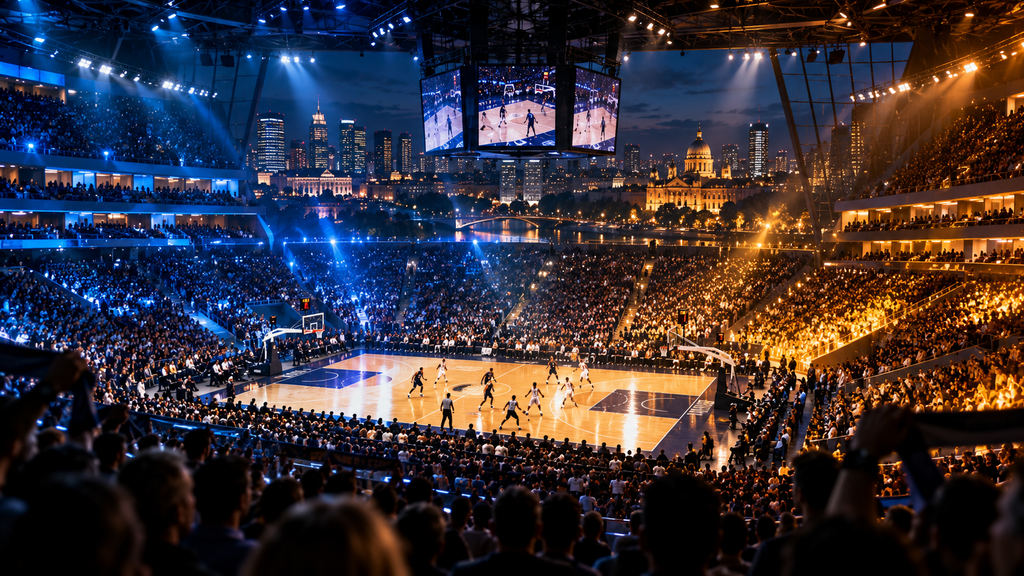
Media rights are central to the financial logic behind both strategies. A competition with reliable schedules, recognisable teams and a large audience can package its games for broadcasters and streaming platforms, generating recurring revenue and increasing the value of sponsorship inventory.
European basketball already has established fan bases and a history of high-level competition. The commercial challenge is to turn that interest into a larger, more consistent and internationally marketable product. More attractive broadcast windows, improved digital distribution and stronger storytelling around teams and players could expand the audience beyond the traditional basketball markets.
A second league could increase the number of premium games available to viewers, but it could also split attention. Broadcasters and streaming platforms may be asked to pay for overlapping competitions, while sponsors could face a more complicated choice about where to allocate their budgets.
If the NBA and EuroLeague compete directly for the same clubs, players and commercial partners, the outcome will depend partly on whether audience growth offsets the additional costs of competing for talent and rights. If they reach a commercial agreement instead, there could be opportunities to coordinate international promotion, digital products, events and infrastructure investment.
For now, the two organisations are signalling different priorities. EuroLeague is emphasising the economic value that its existing clubs can create together, while the NBA is positioning its proposed competition as a new international platform with a different ownership and qualification structure.
Club Valuations and Investor Returns
The competition also raises a question about how investors should value a basketball club. Under a traditional club model, valuation can be heavily influenced by sporting performance, local fan loyalty, arena economics, debt and the financial resources of the owner. A franchise system can add another element: the value of a long-term place within a commercially developed league.
EuroLeague’s plan projects the combined value of its licensed clubs increasing from an estimated €1.8 billion to €5.4 billion over the decade, while the league’s own value is projected to rise from approximately €1.4 billion to €7.98 billion. Those estimates depend on the successful execution of its strategic plan and should be treated as targets rather than independently assured future values.
For a potential investor, projected valuation growth is only one part of the calculation. The relevant questions include the capital required to acquire a stake, the recurring cash flow available to owners, future funding obligations, the distribution of media and commercial income, and the ability to sell the investment later.
The NBA’s established global brand could support a different valuation proposition, but a new competition would still need to prove its economics in Europe. High franchise prices can increase the capital at risk, and strong audience interest does not automatically translate into operating profits.
Both strategies therefore depend on a similar commercial equation: expand the audience, secure recurring revenue, control costs and distribute enough value to make participation attractive to clubs and investors.
Cooperation or Competition?
Despite the rejection of the NBA’s initial proposal, a future agreement remains possible. EuroLeague executives have indicated that dialogue can continue, while NBA leadership has maintained that its project can proceed without a merger.
A commercial partnership could allow both sides to benefit from the NBA’s global marketing expertise and EuroLeague’s established clubs and local audiences. Potential areas for cooperation include digital distribution, international events, youth development, arena investment and sponsorship.
A direct rivalry, however, would create difficult choices for clubs considering their long-term position. Teams would need to evaluate the financial terms, sporting opportunities, competition format and governance rights associated with each organisation. Investors would have to weigh the potential upside of a new platform against the uncertainty of a market divided between rival competitions.
For fans, competition could mean more high-profile games and new ways to follow the sport. But overlapping schedules and fragmented media rights could also make access more complicated, while clubs could face rising costs as the leagues compete for players and commercial partners.
The eventual outcome will depend on the value each model delivers—not just the size of its financial projections, but whether it can create durable revenue and a sustainable environment for clubs.
The Commercial Stakes
The NBA and EuroLeague are competing to shape the structure of European basketball before the next phase of investment and expansion takes hold. EuroLeague’s plan seeks to increase the value of its existing ecosystem, while the NBA is offering a new competition built around global brand recognition, permanent franchises and sporting qualification.
Both strategies assume that European basketball’s audience and commercial potential can grow substantially. Neither can guarantee that the projected revenues, distributions or valuations will materialise.
The key question is not simply which organisation has the bigger brand or the more ambitious financial plan. It is which model can turn audience interest into recurring income, give clubs a credible path to financial sustainability, and preserve the competitive appeal that makes basketball valuable in the first place.
For investors, broadcasters and club owners, the next year could help determine who captures the economic value of European basketball—and on what terms.
Sources
- EuroLeague — Ten-Year Business Plan — Official projections for club distributions, annual commercial revenue, expansion and long-term combined value.
- Reuters — EuroLeague Shareholders Reject NBA Europe Offer — Reporting on the rejected proposal and the continuing possibility of negotiations.
- Reuters — NBA Europe Remains on Track for 2027 — NBA update on prospective club agreements and the planned launch.
- Reuters — EuroLeague Warns Against Market Fragmentation — Analysis of the competing strategies and risks of dividing Europe’s basketball market.
- NBA — Progress Continues on Proposed NBA Europe League — Background on the proposed 16-team structure and target markets.
- The Straits Times — EuroLeague Expects Rise in Club and Competition Values — Reporting on the ten-year financial targets and franchise model.