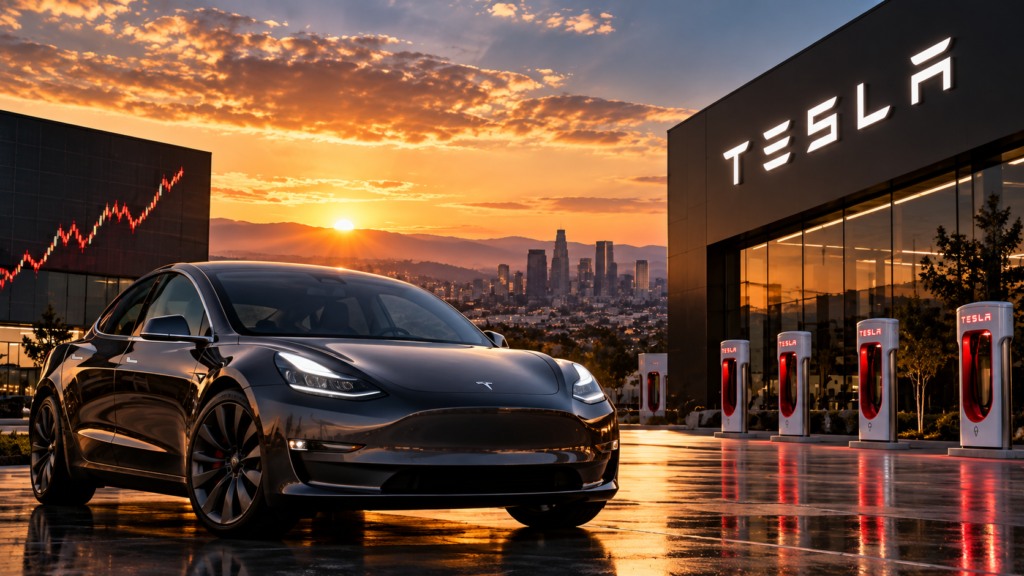
Tesla shares climbed approximately 5% on Monday after Barclays upgraded the electric-vehicle manufacturer, raising its price target and highlighting improving automotive performance, robotaxi development and the possibility of a combination with SpaceX. The rally reflects a broader shift in how investors assess Tesla’s potential beyond conventional vehicle manufacturing.
◉ Barclays raises its target — The bank upgraded Tesla to Overweight from Equal Weight and increased its price target from $370 to $450.
◉ SpaceX speculation attracts attention — Discussions about a possible combination have become part of the investment narrative, although no merger agreement has been announced.
◉ Valuation extends beyond vehicles — Investors are increasingly assessing Tesla’s autonomous-driving technology, energy business, robotics ambitions and potential strategic links with other technology ventures.
The Upgrade Behind the Rally
Tesla shares rose to approximately $391 on Monday, 26 October, following the Barclays upgrade. The bank’s revised $450 price target reflects a more optimistic assessment of the company’s operating outlook and potential corporate developments.
The upgrade comes after a period in which investors have weighed Tesla’s growth prospects against pressure on automotive profitability and competition in the electric-vehicle market.
Barclays highlighted improving trends in Tesla’s core business, including the prospect of renewed annual automotive growth following two years of declines. The bank also pointed to developments in robotaxi operations as a potential source of future value.
The revised target nevertheless represents an analyst forecast rather than a guaranteed future price. Tesla’s performance will continue to depend on its financial results, execution and the expectations already embedded in its valuation.
SpaceX Speculation Enters the Equation
The possibility of a Tesla–SpaceX combination has added another dimension to the investment debate. Both companies have established special committees to examine a potential transaction, while Elon Musk has publicly discussed the potential merits of bringing their businesses together.
A combination could create a broader technology group spanning electric vehicles, satellite communications, artificial intelligence and robotics. However, the companies operate in different industries, and a transaction would raise complex questions about valuation, governance, financing and shareholder approval.
The distinction between discussions and a completed agreement remains critical. No definitive merger terms have been announced, and the eventual structure, if a transaction proceeds, remains uncertain.

Tesla’s Broader Business Model
Tesla’s investment narrative increasingly extends beyond vehicle deliveries. Autonomous driving, robotaxis, energy storage and robotics represent potential sources of future growth, although their commercial contribution varies in scale and maturity.
Robotaxi operations are particularly important because investors are looking for evidence that autonomous mobility can develop into a scalable business. Progress will depend on operational expansion, regulatory requirements, safety performance and the economics of providing the service.
The energy business offers another potential growth channel, supported by demand for electricity storage and infrastructure associated with data centres. Yet expansion in these areas must ultimately translate into sustainable revenue and operating returns.
Valuation Remains the Central Question
Tesla’s share price reflects expectations about businesses that are still developing, alongside the performance of its established automotive operations.
That combination can amplify market reactions to analyst upgrades, product announcements and strategic speculation. Investors may assign substantial value to future opportunities before their financial contribution becomes fully measurable.
The Barclays upgrade highlights the potential influence of these expectations. But a higher price target does not remove the execution risks associated with autonomous driving, competition, capital expenditure or a possible corporate transaction.
The key question is how much future growth is already reflected in the share price, and how much additional value Tesla can demonstrate through measurable operating performance.