Kimi Antonelli’s pole position for the United States Grand Prix has placed Mercedes at the centre of a defining Formula 1 weekend. With a 102-point championship lead and the possibility of becoming the sport’s youngest-ever world champion, the 20-year-old Italian represents more than a sporting story: he is emerging as a potentially powerful commercial asset for Mercedes and its global brand partners.
Short description: Mercedes’ Kimi Antonelli starts the United States Grand Prix from pole with a historic Formula 1 championship within reach. The stakes extend beyond the circuit, highlighting the commercial power of sporting success, global media exposure and the luxury automotive market.
◉ A historic opportunity: Antonelli leads teammate George Russell by 102 points, with 125 points remaining after the Austin race. A victory combined with specific results from Russell and Ferrari’s Lewis Hamilton could secure the title.
◉ Mercedes in the spotlight: A championship-winning driver can strengthen a manufacturer’s brand narrative, attract international attention and create new opportunities for sponsors.
◉ Motorsport as a luxury business: Formula 1 connects engineering, performance, premium hospitality and global advertising, making championship success valuable well beyond race-day results.
Illustrative AI-generated motorsport image; not a verified photograph of Antonelli or his car.
A Pole Position With Historic Stakes
Antonelli set the fastest qualifying time at the Circuit of The Americas in Austin, recording 1:34.035 to beat Red Bull’s Max Verstappen by 0.179 seconds. Verstappen secured second on the grid, with teammate Isack Hadjar third. Ferrari’s Charles Leclerc qualified fourth, while Hamilton took fifth and Russell sixth.
The result gives Antonelli an important starting position for a race that could reshape the championship narrative. His 102-point advantage over Russell means the title is mathematically within reach, although pole position alone does not guarantee the outcome.
To clinch the championship in Austin, Antonelli needs to win the race, Russell must finish ninth or lower, and Hamilton must finish fifth or lower. If those conditions are not met, the championship battle continues into the remaining rounds.
The distinction matters commercially as well as competitively. A title decided on Sunday would create an immediate global sporting moment; a prolonged contest could extend attention around Mercedes, its drivers and its commercial partners over subsequent race weekends.
The Commercial Value of a Champion
A Formula 1 driver’s value to a manufacturer extends far beyond results. Drivers are central figures in advertising campaigns, sponsor activations, digital content, hospitality programmes and international brand events.
A world championship can strengthen that relationship by giving sponsors a compelling story to tell. Campaigns can connect a driver’s performance with themes such as precision, innovation, resilience and engineering excellence—qualities that premium automotive brands often seek to communicate.
For Mercedes, Antonelli’s age adds another dimension. At 20, he represents a younger generation of talent in a sport where established champions have historically dominated the public conversation. If he secures the title, the achievement would provide a clear narrative for future campaigns and potentially deepen his appeal among younger audiences.
However, championship success does not automatically translate into a measurable increase in vehicle sales. Commercial outcomes depend on a range of factors, including campaign execution, consumer demand, brand positioning and the extent to which Formula 1 audiences overlap with prospective customers.
The Mercedes Brand Effect
Formula 1 offers manufacturers a highly visible platform for presenting technical performance under extreme conditions. Every race places engineering decisions, reliability, strategy and execution under international scrutiny.
For Mercedes, a drivers’ championship would reinforce its motorsport credentials at a time when premium automotive companies compete across traditional performance vehicles, electrification and increasingly software-driven mobility.
The relationship between racing and road cars is not always a direct transfer of technology. Formula 1 machinery operates under specialised regulations and engineering requirements. Yet the championship can still support the broader brand story: performance is presented as the product of technical expertise, investment and sustained development.
Sponsors Compete for Attention
Formula 1’s commercial model relies on the combined reach of teams, drivers, race organisers and corporate partners. Sponsors gain visibility through car liveries, race suits, trackside advertising, digital channels and hospitality experiences.
A title fight can make that exposure more valuable by placing a team and its partners at the centre of sustained media coverage. When a driver is close to a historic achievement, coverage often expands beyond specialist motorsport audiences to include mainstream sports, business and lifestyle publications.
For sponsors, the attraction is not simply the number of people watching a race. It is also the context in which the brand appears. A company associated with a championship contender may benefit from repeated exposure to themes of excellence, competition and technical achievement.
The value remains difficult to quantify from a single result. Audience size, geographical reach, media prominence, activation quality and contractual rights all influence the commercial return. A pole position is a major sporting asset, but its financial effect depends on how effectively teams and partners use the attention it generates.
Ferrari, McLaren and Red Bull Remain Part of the Story
Mercedes is not competing in isolation. Ferrari, McLaren and Red Bull each bring distinctive sporting identities and commercial strengths to Formula 1.
Ferrari benefits from a long-standing association with Italian automotive heritage, racing history and high-performance road cars. McLaren combines its Formula 1 presence with a specialist supercar business. Red Bull has built a motorsport identity closely associated with competition, energy and youth-oriented branding.
Mercedes occupies a different but overlapping position, linking Formula 1 performance with a global premium-car portfolio and a long motorsport history. A title for Antonelli would provide a fresh chapter in that story, particularly if a young driver became the face of a championship campaign.
The competitive implications also extend to the constructors’ standings, team sponsorship and future driver-market narratives. A successful season can improve a team’s bargaining position and reinforce its appeal to commercial partners, although sponsorship contracts and automotive sales cycles generally operate on longer timelines than a single race.
A Global Stage for Luxury Automotive Brands
The United States Grand Prix is staged at a circuit that combines racing with a broader entertainment and hospitality experience. Austin’s event places Formula 1 in a major market for luxury vehicles, premium consumer brands and corporate partnerships.
The sport’s wider appeal has helped make race weekends platforms for hospitality, networking and brand engagement. Manufacturers and sponsors can use these environments to meet customers, host business partners and associate their products with a high-profile international event.
For luxury automotive companies, that setting offers a distinctive combination of engineering spectacle and lifestyle positioning. The cars demonstrate speed and technical sophistication, while the surrounding event creates opportunities to communicate exclusivity and brand identity.
Antonelli’s title opportunity gives Mercedes a timely focus within that environment. A championship would not independently determine the company’s commercial performance, but it could strengthen the visibility of its racing operation at a strategically useful moment.
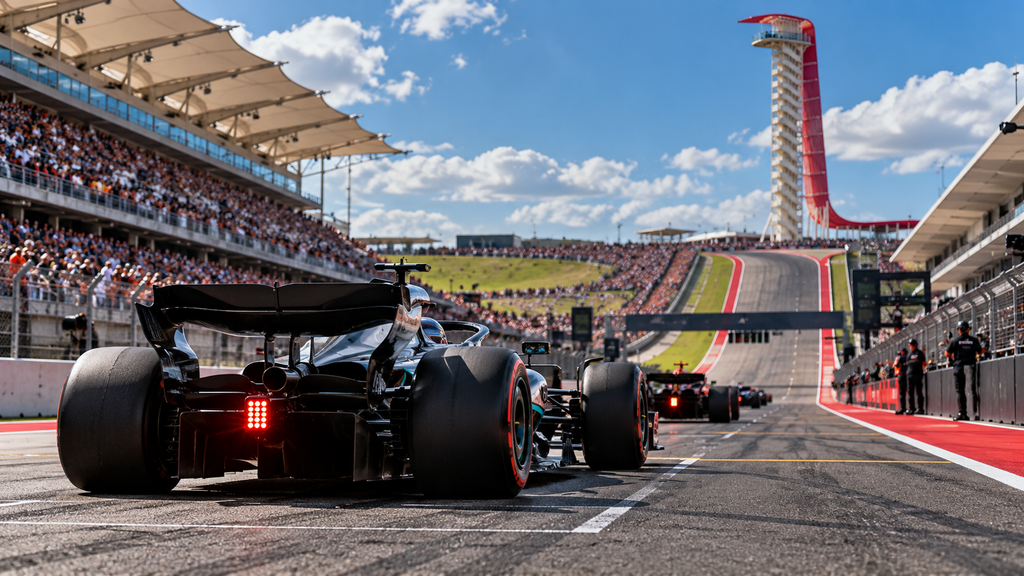
Illustrative AI-generated image of a Formula 1-style circuit; not a verified photograph of the United States Grand Prix.
The Race Still Has to Be Won
Antonelli’s pole position has created the conditions for a potentially historic result, but the championship remains dependent on what happens over 56 laps. Verstappen starts alongside him, while Russell and Hamilton remain important to the title calculation.
The commercial story will therefore evolve with the sporting outcome. A title secured in Austin would give Mercedes an immediate milestone to communicate around. If the championship remains undecided, attention could carry into the next round in Mexico, extending the period of uncertainty and public interest.
Either way, the weekend illustrates the relationship between sporting performance and commercial value in modern Formula 1. The result on track is the central event; its influence on brand visibility, sponsor exposure and the identity of a luxury manufacturer can continue long after the chequered flag.
Sources
- Reuters, Antonelli on pole for US Grand Prix with F1 title in sight: Reuters coverage via The Straits Times
- Formula 1, 2026 United States Grand Prix qualifying report and results: Official Formula 1 qualifying report
- Sky Sports, How Antonelli could clinch the 2026 F1 Drivers’ Championship: Sky Sports championship permutations
- Formula 1, United States Grand Prix 2026 event page: Official United States Grand Prix page