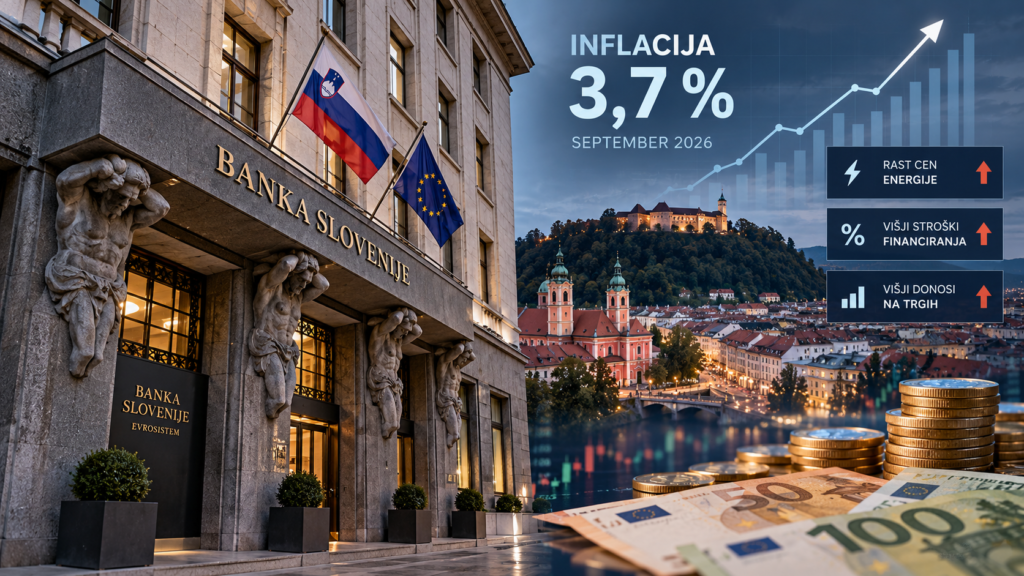
Energy Costs Push Prices Higher
Slovenia’s inflation rate accelerated in September as surging energy prices intensified pressure on households, businesses and public finances. The latest assessment points to a growing economic challenge: activity remains relatively resilient, but higher energy costs and rising government borrowing yields are making the outlook more complicated.
Harmonised consumer price inflation reached 3.7% year on year in September, up from 3.4% in August. Core inflation, which excludes energy and food, moved in the opposite direction, easing to 2.3%. The divergence suggests that energy remains the principal driver of the latest acceleration rather than a broad-based surge across all consumer prices. Banka Slovenije
Three Key Points
- Energy is driving inflation: Slovenian energy prices increased by 18.3% year on year in September, with petroleum products making the largest contribution to headline inflation.
- Government borrowing is becoming more expensive: The yield on Slovenian government bonds rose during the third quarter, increasing the potential cost of refinancing maturing debt.
- The economy remains resilient: Employment conditions are relatively stable and wage growth continues to support household purchasing power, although it also contributes to domestic price pressures. Banka Slovenije
The Energy Shock Returns
Energy has once again become a central factor in Slovenia’s inflation outlook. Higher oil prices and rising petroleum product costs have pushed up transport expenses and household fuel bills, while also increasing operating costs for companies that depend on energy-intensive production and logistics.
In September, energy prices were 18.3% higher than a year earlier. Petroleum products alone contributed approximately 1.7 percentage points to the 3.7% harmonised inflation rate, representing their largest contribution since September 2022. Banka Slovenije
The transmission of these increases through the economy is not instantaneous. Fuel costs can affect transport prices quickly, while increases in wholesale electricity and gas prices may take longer to reach consumers, depending on contracts, regulation and supplier pricing.
This creates a risk that the initial energy shock could gradually influence a wider range of prices if elevated costs persist.
The latest figures nevertheless show that the pass-through into core inflation remains limited for now. That distinction matters: a rise concentrated in energy can have different implications from one accompanied by accelerating prices across services, manufactured goods and other domestic sectors.
Slovenia in the European Inflation Picture
Slovenia’s inflation data also reflect a wider European problem. Energy prices have accelerated across the euro area, increasing pressure on monetary policy and household purchasing power.
Eurostat reported annual euro-area inflation of 3.8% in September, up from 3.2% in August. Energy inflation reached 18.9%, while services inflation stood at 3.2%. The figures indicate that Slovenia’s latest inflation increase is occurring alongside a broader regional energy shock. European Commission
Government Financing Faces Higher Costs
Inflation is only one part of the challenge. Rising yields in government bond markets are also increasing the cost of refinancing public debt, creating an additional pressure point for Slovenia’s fiscal outlook.
During the third quarter, the yield to maturity on Slovenian government bonds increased by 21 basis points to 3.63%, subsequently exceeding 4% toward the end of the period. The spread over German government bonds narrowed to 37 basis points, indicating that Slovenia’s borrowing costs rose alongside broader market yields rather than through a widening relative risk premium alone. Umar
The distinction is important. Government bond yields reflect multiple forces, including expected interest rates, inflation expectations, global investor demand and the perceived fiscal outlook. Higher yields across several European bond markets suggest that the current pressure is not exclusive to Slovenia.
Nevertheless, refinancing costs can accumulate over time. When existing bonds mature, the government may need to replace them with new borrowing at prevailing market rates. The budgetary impact depends on the amount refinanced, the maturity structure of outstanding debt and the difference between previous and current financing costs.
Slovenia’s debt-management profile therefore matters as much as the latest yield movement. The immediate impact on the budget is gradual, but persistently higher yields can increase interest expenditure over successive years.
Monetary Policy Faces a Difficult Balance
The energy shock also complicates the outlook for the European Central Bank.
Higher energy prices can lift headline inflation even when underlying price pressures remain comparatively stable. Monetary policy cannot directly reduce the cost of imported oil or resolve supply disruptions, but it can influence demand, financing conditions and inflation expectations.
In September, the ECB raised its three key interest rates by 25 basis points, citing inflationary pressures associated with the conflict in the Middle East. Its projections indicated that headline inflation would remain above the 2% target in 2026 and 2027. European Central Bank
For Slovenia, which uses the euro, the consequences extend across the domestic economy. Changes in euro-area interest rates influence borrowing conditions, while government bond yields also respond to international market developments.
The challenge is to prevent an energy-driven price increase from becoming entrenched without imposing unnecessary pressure on economic activity. If energy prices remain elevated, policymakers must assess whether the shock is temporary or whether it is beginning to influence wages, services prices and longer-term expectations.
Household Purchasing Power and Business Costs
The latest economic picture contains opposing signals.
Nominal wages in Slovenia grew by 7.6% year on year in July, while real wages increased by 4.4%. Wage growth has supported household purchasing power, but it has also contributed to domestic price pressures. Employment conditions remained relatively stable, with registered unemployment near historically low levels. Banka Slovenije
For households, the effect of inflation depends on how individual spending patterns compare with the average consumer basket. Motorists and households relying on liquid fuels may experience a more immediate impact than those whose energy expenses are less sensitive to short-term market changes.
For businesses, the pressure can emerge through transport, heating, production and supplier costs. Companies may absorb some increases through lower margins or pass them on through higher prices. The outcome depends on competitive conditions and the ability of customers to tolerate additional costs.
This creates an important economic tension: wage growth can support consumption, but persistent energy inflation can erode some of those gains.
The Fiscal Outlook Beyond Inflation
Slovenia’s public finances face several competing demands, including social transfers, public-sector wages, investment and defence commitments. Higher refinancing costs add to those pressures, particularly if market yields remain elevated for an extended period.
The fiscal effect should not be confused with an immediate financing crisis. Higher yields do not reprice every outstanding government bond overnight. Their impact depends on the timing of maturities, new borrowing requirements and the government’s existing debt structure.
The more important question is whether borrowing costs remain elevated long enough to affect medium-term budget planning. If they do, interest expenditure could gradually reduce the room available for other spending priorities.
A sustained increase in energy prices could also complicate fiscal planning if additional support measures become necessary. Policymakers would then face a balance between cushioning households and businesses and maintaining control over public expenditure.
What Markets Will Watch Next
Several developments will help determine whether the September inflation increase becomes a more persistent economic problem:
- Energy prices: Further increases in oil and refined petroleum products could prolong headline inflation pressures.
- Core inflation: A sustained rise in services and other underlying prices would indicate that the energy shock is spreading more widely.
- Government bond yields: Continued increases could gradually raise Slovenia’s refinancing costs.
- Wage and employment trends: Strong real wage growth may support demand, while continued nominal wage increases could add to domestic cost pressures.
- ECB policy: Future decisions will depend on incoming inflation data, energy-market developments and the balance between price stability and economic growth.
The interaction between these factors will matter more than any single monthly inflation reading.
Market Outlook
Slovenia enters the final months of 2026 with an economy that remains resilient but faces a more difficult inflation and financing environment. The September HICP reading of 3.7% highlights the renewed importance of energy prices, while rising government bond yields point to a gradual increase in the cost of servicing and refinancing public debt.
The divergence between headline and core inflation remains particularly important. If energy prices stabilise and underlying inflation stays contained, the current shock may prove relatively limited. If higher costs persist and spread into wages, services and business pricing, inflation could become more difficult to contain.
For public finances, the key variable is the duration of higher yields rather than a single market movement. Refinancing costs tend to build over time, making the trajectory of bond yields, debt maturities and future borrowing needs central to the outlook.
The broader message is that energy markets, inflation and government financing are increasingly interconnected. Developments in one area can influence household purchasing power, business profitability and fiscal flexibility across the Slovenian economy.
Sources
- Banka Slovenije — The Economy Remains Resilient to Heightened Geopolitical Tensions, While Inflation Is Gradually Picking Up
- Banka Slovenije — Review of Macroeconomic Developments, October 2026
- Statistical Office of the Republic of Slovenia — Consumer Price Indices, September 2026
- Eurostat — Annual Inflation Up to 3.8% in the Euro Area
- Eurostat — Evolution of Fuel Prices in September 2026
- European Central Bank — Monetary Policy Decisions, September 2026
- Institute of Macroeconomic Analysis and Development — Slovenian Government Bond Yields, Q3 2026
- Government of Slovenia — Borrowing and State Budget Debt Management