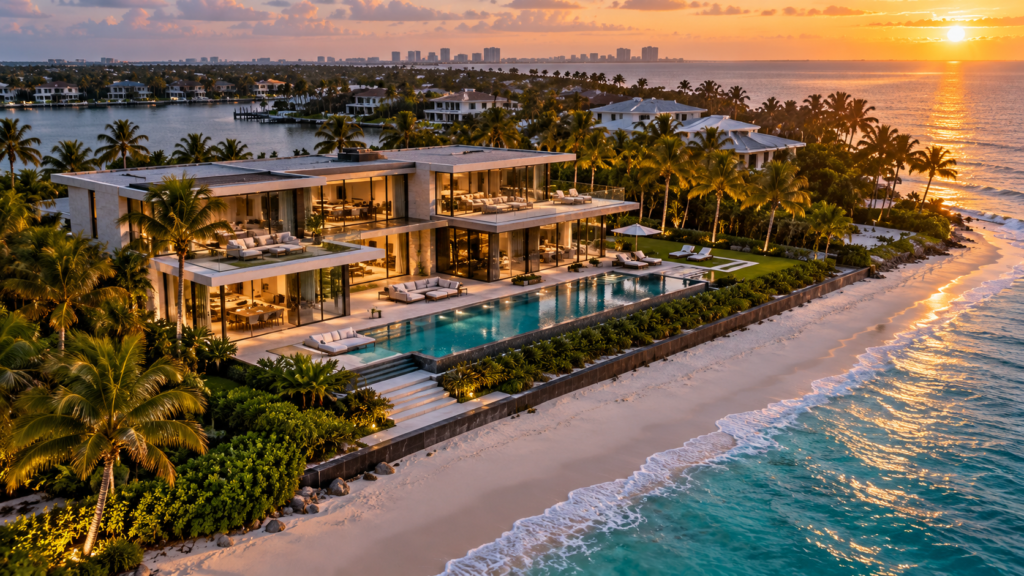
An unconfirmed report linking Jeff Bezos to a $69.5 million beachfront estate in Florida highlights a wider shift in ultra-prime real estate: the world’s wealthiest buyers increasingly seek portfolios of properties that combine privacy, lifestyle flexibility and access to scarce locations.
◉ A $69.5 million transaction: Public records identify Meridian Coast LLC as the buyer of an oceanfront estate in Golden Beach, Florida. Local property sources have linked the transaction to Jeff Bezos, but he has not publicly confirmed the purchase. Fortune
◉ Property as a portfolio: For ultra-high-net-worth households, multiple homes can serve different purposes—from primary residences and private retreats to properties offering direct beach access or proximity to business and travel hubs.
◉ Scarcity drives the market: In exclusive coastal communities, limited waterfront land and a shortage of comparable homes can make individual properties difficult to replace, supporting demand even at exceptionally high price levels. Realtor
Why One Home May Not Be Enough
At the highest end of the residential market, ownership is increasingly about access to distinct experiences rather than simply the size of a house.
One residence may function as a primary home, another as a seasonal retreat, and a third as a private waterfront property designed around leisure. Even within the same region, different locations offer different combinations of beach access, boating facilities, security, architecture and proximity to urban amenities.
The reported Golden Beach transaction illustrates this distinction. The estate at 255 Ocean Boulevard reportedly covers approximately 17,500 square feet and includes seven bedrooms, 12 bathrooms, a guesthouse, a pool and spa, and 100 feet of waterfront.
If the reported connection to Bezos is accurate, the property would sit within a broader South Florida portfolio that already includes his Indian Creek residences. Yet the ownership connection remains unconfirmed, and the transaction should not be treated as evidence of his personal intentions.
The broader point is that a property can hold value for its owner beyond its conventional financial return. Privacy, location, convenience and the ability to control a scarce waterfront site may all contribute to its appeal.
The Role of Privacy Structures
High-value property purchases often attract intense public attention, particularly when a buyer is internationally recognisable. Limited liability companies and trusts can introduce a layer between a property’s public record and the individual or individuals behind the ownership structure.
Such arrangements can serve legitimate purposes, including asset administration, estate planning and privacy. They do not, by themselves, establish who ultimately benefits from a transaction or why the property was acquired.
In the Golden Beach case, public records identify Meridian Coast LLC as the purchaser. That is a verifiable detail; the reported association with Bezos is a separate claim attributed to property-market sources.
This distinction matters because anonymous or corporate ownership can encourage speculation. A famous name attached to an undisclosed buyer may generate headlines, but the identity of the actual purchaser cannot be established solely from the property’s price, location or apparent suitability for a particular individual.
For the ultra-prime market, discretion is part of the wider transaction environment. Yet privacy structures should not be confused with proof of ownership, investment intent or tax strategy.
Scarcity and the Ultra-Prime Market
Waterfront real estate has a structural characteristic that differentiates it from many other assets: the supply of desirable locations is inherently limited.
A property with direct ocean access, substantial frontage, privacy and a large site cannot always be replicated nearby. New development may be restricted by zoning, land availability, environmental rules or the cost of construction. Existing owners may also have little incentive to sell if they cannot find a comparable replacement.
That scarcity can support high prices, but it does not make every expensive property a guaranteed investment. Ultra-prime homes are illiquid assets with substantial ownership costs, including maintenance, insurance, security, taxes and staff. Their value can also be affected by financing conditions, climate exposure, local regulations and shifts in international wealth flows.
South Florida has attracted buyers from technology, finance, business and international family offices. Its combination of coastal living, established luxury infrastructure and favourable state tax treatment has become part of the region’s appeal.
Market activity at the very top of the price range can also influence seller expectations. A record transaction may encourage nearby owners to raise asking prices, even though the eventual value of another property depends on its specific characteristics and what buyers are willing to pay.
The difference between a headline price and a repeatable market valuation is especially important in a segment where each transaction can involve a unique asset.
Wealth, Location and Asset Allocation
For billionaire households, real estate can occupy several roles within a broader wealth structure. It can provide a place to live, a base for business and family life, a store of capital or exposure to a particular property market.
These roles are not interchangeable. A personal residence is generally selected around lifestyle requirements, while an investment property is more likely to be assessed against expected income, costs, liquidity and potential resale value. Some properties combine both purposes, making their financial performance more difficult to isolate from the owner’s personal preferences.
A portfolio of homes can also provide geographical flexibility. Business commitments, family relationships, travel schedules and seasonal preferences may create demand for residences in different locations.
However, owning multiple properties does not automatically mean a buyer is pursuing a deliberate investment strategy. A collection of residences can reflect lifestyle choices as much as financial planning, and publicly reported transactions rarely reveal the full reasoning behind a private purchase.
The same caution applies to tax considerations. Florida’s absence of a state personal income tax is one factor frequently discussed in connection with wealthy individuals relocating there, but a property’s acquisition alone does not establish a buyer’s residency status or the tax implications of a broader portfolio.

What the Transaction Says About Luxury Demand
The reported $69.5 million sale also illustrates how the ultra-prime market can operate differently from the wider housing sector.
In more liquid markets, prices are supported by large numbers of comparable transactions. At the very top of the residential market, the number of suitable properties and qualified buyers can be small. One sale can therefore become an important reference point without necessarily establishing a new valuation for every nearby estate.
The Golden Beach property was reportedly listed at $88.5 million before its asking price was reduced to $79.5 million. Its reported sale at $69.5 million was below both asking prices, despite being described as a record for a single-family home in the town.
That difference offers a useful reminder: a record transaction can coexist with a negotiated discount from the seller’s original expectations. The result reflects the price agreed by the parties, not necessarily the value that every owner or future buyer would assign to a similar home.
The market’s longer-term direction will depend on factors including the supply of exceptional properties, the concentration of global wealth, the movement of high-net-worth households and the cost of maintaining waterfront assets. Individual sales provide evidence of demand, but a sustained market trend requires a broader set of transactions over time.
A Portfolio Is More Than Its Price Tag
The reported Golden Beach acquisition has attracted attention because of its price, location and possible connection to one of the world’s wealthiest entrepreneurs. But the most useful insight extends beyond the identity of the buyer.
At the top of the property market, wealth can translate into control over scarce locations and the ability to maintain multiple residential options. Those assets may combine personal utility with long-term value, while their ownership structures can make the underlying portfolio difficult to assess from public information alone.
If Bezos is ultimately confirmed as the purchaser, the estate would add another chapter to his widely reported South Florida property holdings. Until then, the responsible conclusion is narrower: Meridian Coast LLC purchased the property, while the reported Bezos connection remains unconfirmed.
For the ultra-prime real estate market, the larger story is the continued importance of location, scarcity and privacy—and the difficulty of separating lifestyle demand from investment logic when the assets involved are among the world’s most exclusive homes.
Sources
- Fortune, Jeff Bezos reportedly added a $69.5 million beach house to his $237 million Miami compound
- The Real Deal, Coverage of the reported Golden Beach transaction
- Realtor.com, How Golden Beach became a discreet haven for ultra-wealthy buyers
- MIAMI Realtors, South Florida luxury sales market reports
- The Wall Street Journal, Coverage of luxury real estate transactions on Indian Creek