Defense Demand Lifts Earnings Forecasts
The global aerospace and defense industry is entering another period of strong financial growth as governments increase military spending and airlines continue investing in aircraft maintenance, engines and spare parts. Three major US companies — Northrop Grumman, RTX and GE Aerospace — have raised their 2026 earnings forecasts, highlighting the strength of demand across both military and commercial aviation.
The latest outlooks point to a sector benefiting from long-term contracts, expanding order books and sustained demand for advanced aircraft, missile systems and propulsion technologies. For investors, the key question is whether companies can convert their growing backlogs into higher revenue, stronger cash flow and sustainable earnings growth.
Record Backlogs Strengthen Visibility
Northrop Grumman increased its adjusted earnings forecast for 2026 to $29.35–$29.75 per share, compared with its previous range of $28.60–$29.10. The company reported third-quarter sales of approximately $11.1 billion, up 7% year over year, while its order backlog reached a record $109.6 billion.
Demand for its B-21 Raider strategic bomber, F-35 fighter aircraft components and missile defense programs contributed to the improvement. Northrop also secured approximately $16.4 billion in new contracts during the quarter, with orders exceeding the value of work delivered.
RTX, the parent company of Raytheon, Pratt & Whitney and Collins Aerospace, also raised its full-year outlook. The company now expects adjusted earnings of $7.65–$7.75 per share, up from $7.10–$7.25 previously. Its projected annual sales range increased to $97 billion–$97.5 billion.
RTX’s backlog climbed to a record $340 billion, reflecting demand for both defense systems and commercial aerospace products. The figure includes substantial commitments for aircraft engines, maintenance services, air defense systems and precision weapons.
These backlogs provide revenue visibility over several years, although they are not equivalent to guaranteed future profits. Production schedules, supplier capacity, contract terms and execution costs will determine how much of that demand ultimately reaches the bottom line.

GE Aerospace Adds Another Upgrade
GE Aerospace raised its adjusted earnings forecast for the second time this year, now expecting $8.00–$8.10 per share in 2026, compared with its previous projection of $7.65–$7.85.
The company is benefiting from robust demand for aircraft engine maintenance, spare parts and commercial aviation services. Revenue from its commercial engines and services business increased 21% to $10.34 billion in the third quarter, demonstrating the financial importance of servicing aircraft already in operation.

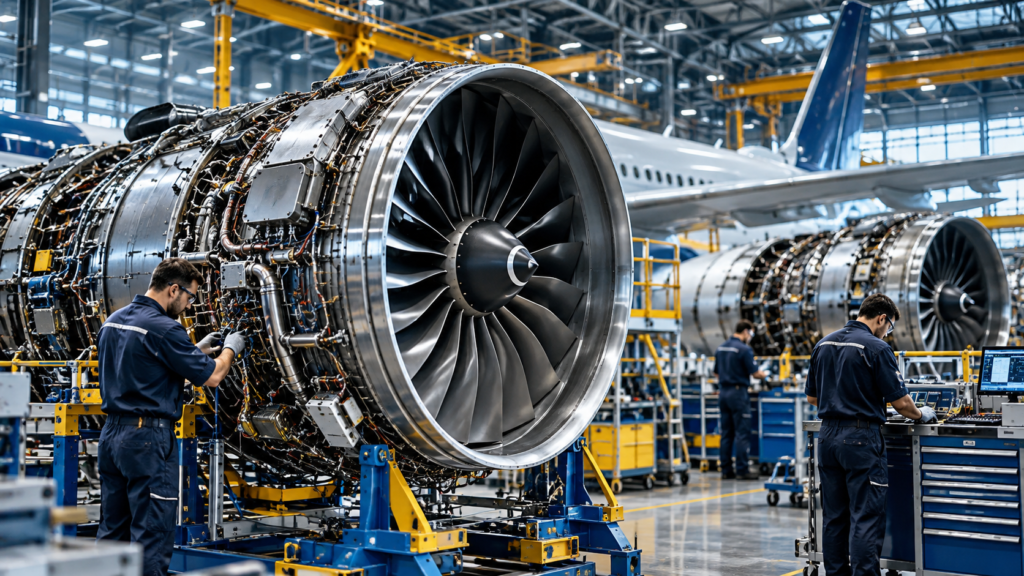
Image 1 — Aircraft engine maintenance and military aviation. AI-generated editorial illustration.
The broader trend extends beyond new aircraft deliveries. Airlines are keeping aircraft in service and spending on maintenance, creating a recurring revenue stream for engine manufacturers and service providers. This can offer greater revenue visibility than relying exclusively on new aircraft orders.
However, higher fuel prices remain a potential risk. If airlines reduce flight schedules, demand for engine repairs, replacement parts and other maintenance services could eventually weaken. GE’s upgraded annual forecast also implied fourth-quarter earnings below market expectations, illustrating why positive full-year guidance does not automatically translate into a rising share price.
Defense Spending Supports Long-Term Growth
The companies’ results reflect a wider increase in demand for defense equipment as the United States and its allies seek to strengthen military capabilities.
Northrop Grumman’s exposure to strategic aircraft, missile defense and space systems positions it to benefit from government procurement programs with multiyear delivery schedules. RTX has a broader mix of defense and commercial aerospace activities, including air defense systems, missiles, aircraft engines and aviation technology.
These businesses operate in markets where production capacity and supply-chain reliability can be as important as demand itself. Manufacturers must secure specialized components, expand production lines and manage complex certification requirements before additional orders translate into completed deliveries.
The ability to increase manufacturing output without allowing costs to rise too quickly will therefore be central to future profitability.
What Investors Should Watch
The latest earnings revisions offer several important signals for investors evaluating aerospace and defense stocks.
- Order backlog: Record commitments provide a substantial pipeline of future work, but investors should monitor how quickly those orders become recognized revenue.
- Profit margins: Higher sales are most valuable when manufacturers can control labor, materials, production and warranty costs.
- Cash flow: Large contracts can require significant upfront investment, making cash conversion an important measure of financial quality.
- Commercial aviation: Engine maintenance and spare-parts demand can support recurring earnings, although elevated fuel costs may eventually pressure airline activity.
- Valuation: Strong earnings growth can already be reflected in share prices. Investors should compare expected growth with the price they are paying rather than treating an upgraded forecast as an automatic buy signal.
The Investment Outlook
The combination of record defense backlogs and resilient commercial aviation demand suggests that the aerospace sector has meaningful earnings visibility heading into 2027. Northrop Grumman and RTX are benefiting from military procurement, while GE Aerospace demonstrates how maintenance and aftermarket services can support growth even when airlines face cost pressures.
Nevertheless, investors should distinguish between strong demand and the ability to deliver profitable growth. Production bottlenecks, contract execution, rising costs and valuation risks remain important considerations.
For the broader stock market, the results highlight two investment themes: sustained defense spending and the recurring economics of aircraft maintenance. Both could remain relevant over the coming years, but company-specific execution will determine which businesses convert these favorable conditions into the strongest returns.