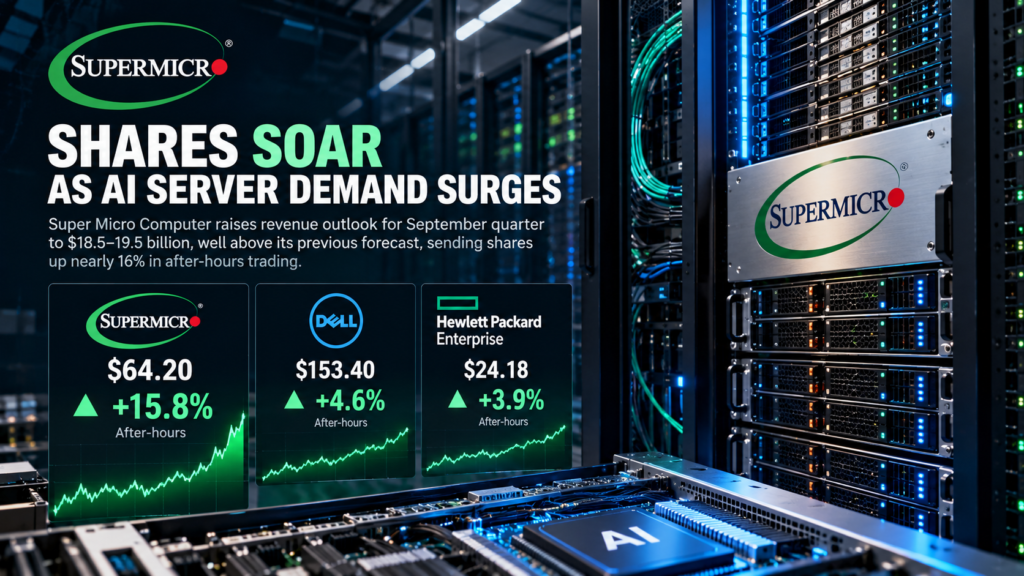
Shares of Super Micro Computer surged in extended trading after the company delivered a dramatic upgrade to its revenue outlook, providing fresh evidence that demand for artificial-intelligence computing infrastructure remains strong.
The server maker now expects revenue of $18.5 billion to $19.5 billion for its fiscal first quarter ended September 30, compared with its previous forecast of $14.5 billion to $15.5 billion. The new range also sits well above Wall Street expectations of approximately $15.2 billion. Shares rose nearly 16% after hours, while rival server manufacturers Dell Technologies and Hewlett Packard Enterprise also advanced.
The update offers a tangible measure of the AI boom: not just rising enthusiasm for new software, but billions of dollars flowing into the physical systems needed to train and run AI models.
Revenue Forecast Jumps
Super Micro’s revised outlook represents a substantial increase from its previous guidance. At the midpoint of the new range, expected quarterly revenue is $19 billion — roughly 27% above the midpoint of its earlier forecast.
Compared with the same quarter a year earlier, the midpoint implies revenue growth of close to 280%, although the figures remain preliminary and unaudited. The company attributed the stronger outlook primarily to increased demand for AI platforms.
The scale of the revision matters because AI servers are complex, high-value systems that combine accelerators, processors, memory, networking and specialised cooling. As technology companies expand their data-centre capacity, suppliers that can assemble and deliver these systems at scale are positioned to benefit.
Super Micro’s update suggests that customers are continuing to place substantial orders for AI infrastructure, despite recent concerns about the cost of building data centres and how quickly those investments will generate returns.
However, the revenue forecast does not yet reveal the full picture. Investors still need to understand the timing of shipments, the concentration of customers and whether the current pace of demand can be sustained over coming quarters.

Margins Improve Alongside Sales
The company also raised its expected gross margin to 12%–12.5%, compared with its previous guidance of 10.4%–10.8%. Super Micro said the improvement was primarily due to customer and product mix.
That detail is important. Rapid sales growth can be less valuable to investors if a hardware supplier must sacrifice profitability to win large contracts or pass through expensive components at low margins.
Gross margin measures the share of revenue left after direct product costs, before operating expenses and other costs are deducted. The improved outlook suggests that the expected mix of orders is more favourable than previously anticipated, though the margin range remains relatively narrow.
Investors will be watching whether the company can sustain both strong sales and improving margins as competition intensifies. Larger technology suppliers have scale, purchasing power and established customer relationships, while AI hardware configurations and customer requirements can change quickly.
Dell and HPE Join the Rally
The reaction extended beyond Super Micro. Shares of Dell Technologies and Hewlett Packard Enterprise also rose in after-hours trading, as investors interpreted the forecast as a positive signal for the wider AI-server market.
The read-through is straightforward: if one major supplier is seeing demand materially above expectations, customers may still be investing aggressively in computing infrastructure. That can support sentiment toward other companies supplying servers, storage, networking and related data-centre equipment.
But the gains do not prove that every supplier will experience the same growth. Super Micro’s results can reflect its specific customer mix, delivery schedules and share of individual contracts. Competitors have different product portfolios and profitability profiles, so their earnings will need to confirm whether demand is broad-based.
The wider question is how much of the current spending wave comes from the largest cloud providers and how much comes from newer AI-focused computing companies. The answer matters because customers with different financing structures and business models may have very different abilities to maintain spending.
The AI Boom Meets a Profitability Test
The investment cycle behind AI infrastructure is enormous. Major technology companies are committing hundreds of billions of dollars to computing capacity, data centres and related equipment. Hardware suppliers can benefit immediately from this spending, while customers must wait for their AI services to generate sufficient revenue and cash flow.
This creates an important distinction between the companies selling the infrastructure and those financing it. Strong orders are positive for server makers, but the sustainability of those orders ultimately depends on customers’ ability to earn acceptable returns on their investments.
Recent market volatility has reflected concerns that data-centre operators could take longer than expected to monetise their infrastructure, particularly if borrowing costs rise or demand for computing capacity disappoints. Super Micro’s update offers reassurance about current hardware demand, but it does not resolve those broader questions.
For investors, the key issue is whether the AI buildout is translating into durable business growth or creating a spending cycle that could eventually slow. The distinction will become clearer as more companies report earnings and provide details on capital expenditure, customer demand and operating returns.
What Investors Should Watch
Super Micro is scheduled to report its full fiscal first-quarter results on November 3. Until then, investors will be assessing whether the preliminary revenue and margin figures are confirmed and whether management provides evidence that demand will remain strong into the next quarter.
Three issues stand out:
- Revenue execution: whether the company converts strong demand into completed deliveries and reported sales.
- Profitability: whether gross margins remain near the improved forecast as competition and hardware costs evolve.
- Customer spending: whether major cloud providers and AI infrastructure companies continue expanding capacity at the current pace.
The rally shows how quickly a company can benefit when actual business forecasts exceed expectations. It also highlights the next challenge for the AI industry: proving that the enormous investment in computing infrastructure can support sustainable returns throughout the supply chain.
For now, Super Micro’s update provides a strong signal that demand for AI servers remains substantial. The longer-term test is whether that demand translates into consistent revenue, healthy margins and dependable cash generation.
Sources
- MarketWatch — Super Micro’s Stock Soars After Surprise Update, With Dell and HPE Shares Joining the Rally
- Reuters — Super Micro Sees Quarterly Revenue Soaring on AI Server Boom
- Supermicro — Official Preliminary Fiscal Q1 2027 Business Update
- Reuters via MarketScreener — Super Micro Climbs After Upbeat Forecast Shows Robust AI Demand
- Barron’s — Super Micro Stock Surges on Strong AI Demand. Why Chip Investors Remain Cautious